Adoption credit refunds arriving with no application: what Treasury's 2025-only fix does
The IRS is paying adoption-credit carryforwards out automatically to more than 50,000 taxpayers. The interpretation is narrow, one year long, and running.
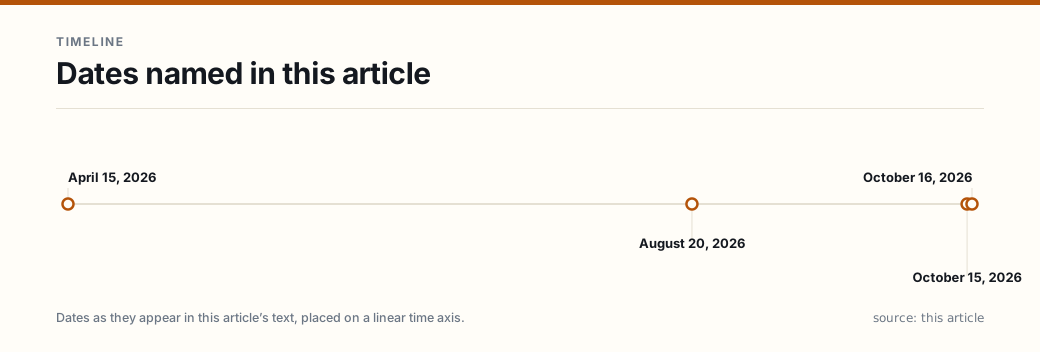
On October 16, 2026, the Internal Revenue Service said it had already begun paying refunds to more than 50,000 taxpayers who carried an unused adoption tax credit forward from an earlier year — and that the payments were going out without anyone applying for them. Adjustments started in late September. The agency expects the process for most eligible taxpayers to be finished by the end of 2026.
Nothing was enacted on October 16. What changed is how the Treasury Department reads a provision Congress wrote in 2025, and the reading is deliberately narrow: tax year 2025 only. If you adopted a child years ago and have been carrying credit forward ever since, that sentence is the difference between money arriving and money sitting.
What Congress did, and what it left open
The 2025 tax law — Public Law 119-21, which the IRS now catalogs as the Working Families Tax Cuts — made part of the adoption credit refundable, beginning with tax year 2025. Section 70402(a) added § 23(a)(4) to the Internal Revenue Code: so much of the credit as does not exceed $5,000 is “treated as a credit allowed under subpart C,” which is the part of the code that holds refundable credits such as the earned income credit. In practice that means the money can be paid even when the household owes no tax.
The statute did not say what happens to a credit that arose in an earlier year and was carried forward under § 23(c). That subsection lets the nonrefundable part of the credit be carried to a later year, but only up to the fifth taxable year after the year it arose, used first-in first-out, and — before 2025 — it could never turn into a refund. So a family that adopted in 2021 and could not use the whole credit in that year has been moving a number forward on Form 8839 ever since. Whether that carried number could count toward the new $5,000 refundable slice was genuinely unresolved.
Treasury’s answer, as the release describes it: for tax year 2025 only, carryforwards from 2020 through 2024 can increase the amount of the adoption credit that is refundable in 2025, subject to the $5,000 per qualifying child limitation.
The years named are not arbitrary. Under § 23(c)(2) a credit that arose in 2020 could not be carried past 2025. The interpretation therefore reaches the carryforwards still alive in that year — and stops there, because an earlier credit would already have expired.
One caution about the document itself. The release calls this a clarification of Treasury’s interpretation. It cites no regulation, no revenue procedure and no notice, and a search of the Federal Register through October 16 turned up no document on the subject. The operative text today is the release. That is a reason to read it as a one-year administrative position rather than as a rule that will necessarily govern 2026 the same way.
The numbers for 2025
| Item | 2025 amount |
|---|---|
| Qualified adoption expenses, per qualifying child | $17,280 |
| Refundable share of the credit | up to $5,000 per qualifying child |
| Income for the full credit (modified AGI) | $259,190 or less |
| Reduced between | $259,191 and $299,189 |
| No credit at | $299,190 or more |
| Employer-provided adoption benefits excluded from income | up to $17,280 |
| Carryforward of the nonrefundable part | 5 years, and never refundable |
Those dollar figures are the indexed versions of round numbers in the statute — § 23(b) still reads $10,000, $150,000 and $40,000 — which is why anything quoted from the code text alone will look wrong against a 2025 return. The $5,000 refundable figure is itself indexed from 2025 under § 23(h)(3), on a 2024 base year, so a later year’s cap will be a slightly different number set in the annual inflation procedure rather than the round figure. The IRS describes the cap as per qualifying child; § 23(a)(4) states the limit as $5,000 of the credit allowed, and the per-child reading is the agency’s.
Who gets money without asking, and who waits
The release divides taxpayers into two groups, and the dividing line is when the 2025 return was filed.
Automatic, generally: taxpayers who filed their 2025 return before April 15, 2026. The IRS adjusts the account and issues any resulting refund.
Later, after something else is resolved: taxpayers who filed under an extension, and taxpayers whose accounts carry identity theft indicators, freezes, dependency conflicts or other issues. Those accounts are to be reviewed later in 2026, once the return is processed or the account problem is cleared. The extended filing deadline for 2025 returns fell on October 15, 2026, one day before the announcement, so returns filed under an extension are only now being processed.
Notice, not a call. The IRS says taxpayers will receive a notice, generally within 30 days of the adjustment, stating the amount and whether it produced a refund or was applied against another tax or a non-tax debt. That second possibility is the one that catches people: an offset can consume the adjustment, and the notice is where that shows up.
No amended return. The agency’s position is that taxpayers should not need to file one. If you already filed an amended 2025 return claiming this treatment, the useful step is to compare the notice against what you claimed before sending anything else.
What the adjustment does not do
It does not make the whole credit refundable. The $5,000 slice is a slice. Anything above it stays nonrefundable, keeps carrying forward under the five-year clock, and is forfeited when the clock runs out.
It does not change your 2026 return. The release frames the carryforward treatment as applying to tax year 2025 only. The refundability rule itself continues, but this particular permission to count old carryforwards against the refundable slice is not written as permanent.
It does not settle the separate proposal about who may receive refunded credits at all. On August 20, 2026, Treasury and the IRS proposed regulations that would treat the refunded portion of four credits — earned income, child, American opportunity and adoption — as a “Federal public benefit” under the 1996 welfare law, which would bar people who are not “qualified aliens” from receiving the refunded part. That is a proposal, not a rule, and it would apply to tax years ending on or after the date a final rule is published. We covered it separately in the refund a proposal would tie to immigration status. Nothing in the October 16 release addresses it.
The scam this announcement invites
An unexpected refund with no application is the ideal pretext for impersonation, so the shape of the real thing is worth stating plainly. The IRS makes contact about an account adjustment by mail. It does not open a conversation by text, email or social media, does not ask for a payment or a gift card to release a refund, and does not need your IRS account password — and there is no application, no processing fee and no intermediary, because the adjustment is already happening on the agency’s side.
Anyone who offers to “claim,” “unlock” or “expedite” the money for a fee is selling access to something that requires none. A message that arrives with a link and a deadline is the thing to forward rather than click: the IRS keeps a mailbox for exactly that at its report phishing page, and consumer fraud reports go to the FTC at reportfraud.ftc.gov. If you want to know whether an adjustment has hit your account, the IRS online account shows notices and balances directly, without a third party and without a charge.
What to do now
- Check whether you are in the population at all. Did you claim the adoption credit for a 2020–2024 adoption, and did part of it go unused? That is the group the release is about. If your returns showed no carryforward, there is nothing waiting.
- Compare the notice with your 2025 return and Form 8839, not with a memory of what you were owed. The carryforward worksheet is where the number came from.
- Wait out the offsets. If a refund does not appear, read the notice before assuming an error — an offset is reported there.
- If you filed on extension or have a freeze on your account, expect the review to come later in 2026, and make sure the account issue is actually resolved rather than merely old.
- Do not pay anyone to move this along. There is no step to buy.
The wider pattern is one worth remembering beyond this credit: a change described as a clarification can move real money, but it is usually bounded by a year, a population, and a document that may not exist in the Federal Register. The pages behind federal programs that do publish their terms are collected in the network’s government resources directory.
This article is general information about federal tax rules, not tax advice for your situation. Income limits, adoption timing and filing status interact, and the amended-return question in particular is one to take to a qualified preparer.
Frequently asked questions
- Do I need to file an amended return to get this?
- No. The IRS says affected taxpayers should not need to file an amended return, and that it is adjusting accounts itself and issuing any resulting refund. Taxpayers who filed their 2025 return before April 15, 2026 will generally receive the adjustment automatically. If you already filed an amended return for 2025 on this point, compare the IRS notice with what you claimed before filing anything further.
- How much can the refundable part be?
- Up to $5,000 per qualifying child for tax year 2025, as the IRS describes the cap. The statute sets the refundable share at $5,000 of the credit allowed and indexes that amount from 2025 under section 23(h)(3), so later years use a figure set in the annual inflation procedure rather than the round number. The rest of the credit stays nonrefundable and can still be carried forward.
- Does this apply to my 2026 return?
- No. The release describes the treatment as applying to tax year 2025 only. What carries into 2026 is the underlying rule that up to $5,000 per qualifying child of the credit is refundable — not this carryforward interpretation, and not a promise that the same administrative fix will be repeated.
- I got a text about my refund. Is it the IRS?
- No. The IRS contacts taxpayers about an account adjustment by mail, and the notice arrives after the adjustment, generally within 30 days of it. There is nothing to apply for, nothing to unlock and no fee. Anyone who texts, emails or messages you offering to release this money, or asking for your IRS account credentials, is not the IRS.
Sources
Each source is a primary or official reference, checked before publication. Links open the original.
- Internal Revenue Service — IR-2026-123, 'IRS has begun issuing automatic refunds to individuals who claimed Adoption Tax Credit carryforward from prior years', October 16, 2026 (more than 50,000 taxpayers; tax year 2025 only; carryforwards from 2020–2024; the $5,000 per qualifying child limitation; refunds and adjustments began in late September; notices generally within 30 days; the extension-filer and account-issue exceptions; the statement by IRS Chief Executive Officer Frank J. Bisignano) — https://www.irs.gov/newsroom/irs-has-begun-issuing-automatic-refunds-to-individuals-who-claimed-adoption-tax-credit-carryforward-from-prior-years
- Internal Revenue Service — 'Adoption Credit' (qualified expenses limited to $17,280 per qualifying child for 2025; a portion refundable up to $5,000 per qualifying child beginning in tax year 2025; the nonrefundable portion carried forward a maximum of five years and never refundable; MAGI of $259,190 or less for the full credit, reduced between $259,191 and $299,189, unavailable at $299,190; married taxpayers must file jointly; the $17,280 employer exclusion) — https://www.irs.gov/credits-deductions/individuals/adoption-credit
- 26 U.S.C. § 23 — 'Adoption expenses' (subsection (a)(4), added by Public Law 119-21 § 70402(a), treats so much of the credit as does not exceed $5,000 as a credit under subpart C; subsection (b) sets the statutory base amounts of $10,000, $150,000 and $40,000; subsection (c)(2) limits a carryforward to the fifth taxable year after the year the credit arose and applies first-in first-out; subsection (h)(3) indexes the (a)(4) amount from 2025 on a 2024 base year) — https://www.law.cornell.edu/uscode/text/26/23
- Internal Revenue Service — 'Working Families Tax Cuts' (the agency's index of the 2025 law's provisions, listing 'Adoption Credit enhancement (Section 70402)' under families and dependents and 'Indian tribal governments and the Adoption Credit (Section 70403)') — https://www.irs.gov/newsroom/working-families-tax-cuts
- Public Law 119-21, as printed by the Government Publishing Office — the 2025 tax law whose section 70402 amended 26 U.S.C. § 23 — https://www.govinfo.gov/content/pkg/PLAW-119publ21/pdf/PLAW-119publ21.pdf
- Internal Revenue Service — Instructions for Form 8839, Qualified Adoption Expenses (the carryforward worksheet and the line-by-line computation a taxpayer would compare against an IRS notice) — https://www.irs.gov/instructions/i8839
- Internal Revenue Service — Online account for individuals (view tax records, notices, account balances and refund status without calling) — https://www.irs.gov/payments/online-account-for-individuals
- Internal Revenue Service — Refunds (Where's My Refund, and what the tool can and cannot show) — https://www.irs.gov/refunds
- Internal Revenue Service — 'Tax Scams and Consumer Alerts' (how the IRS makes contact, and the impersonation patterns it warns about) — https://www.irs.gov/newsroom/tax-scams-consumer-alerts
- Internal Revenue Service — Report phishing (the mailbox for forwarding a suspicious IRS-related message) — https://www.irs.gov/privacy-disclosure/report-phishing
- Federal Trade Commission — reportfraud.ftc.gov, the consumer fraud reporting portal — https://reportfraud.ftc.gov/
- Federal Register — documents search for 'adoption tax credit' with a publication date from August 1, 2026, run October 17, 2026 (no document about the refundability of adoption-credit carryforwards appeared; the October 16, 2026 release cites no regulation, notice or revenue procedure) — https://www.federalregister.gov/documents/search?conditions%5Bterm%5D=adoption+tax+credit&conditions%5Bpublication_date%5D%5Bgte%5D=08%2F01%2F2026