The 2027 Social Security COLA Is Set: 3.6% — and Now the Part B Premium Is Too
Social Security confirmed a 3.6% COLA for 2027 on October 14. CMS has now set the 2027 Part B premium at $209.40 — here is the full net-check picture.
The number is official. On October 14, 2026, the Social Security Administration announced a 3.6% cost-of-living adjustment for 2027 — the yearly raise applied to retirement, survivor, disability and SSI benefits, and the largest since the 8.7% increase for 2023 (announced in October 2022). The headline is settled, and the second number that decides what actually hits your bank account — the 2027 Medicare Part B premium — was set on November 17, 2026: $209.40 a month. Here is what both announcements changed, and what to do between now and December.
How the 3.6% was produced
The COLA is not a policy choice and not a forecast. It is a formula run once a year:
- Take the Consumer Price Index for Urban Wage Earners and Clerical Workers (CPI-W) — a specific inflation index, not the headline CPI.
- Average it over the third quarter: July, August and September.
- Compare that average to the same three months of 2025, the last year a COLA took effect.
- The percentage increase, rounded to the nearest 0.1%, becomes the COLA.
SSA publishes its work. The third-quarter 2025 average was 317.265; the third-quarter 2026 average was 328.746; and (328.746 − 317.265) ÷ 317.265 × 100 = 3.6%. The September CPI released that morning by the Bureau of Labor Statistics was the final input the formula needed, which is why the announcement could not have come earlier. The 3.6% lands at the top of the 3.4–3.6% range analysts had projected.
What the announcement actually said
- 3.6%, effective with December 2026 benefits — paid starting January 2027.
- Nearly 72 million Social Security beneficiaries will see the increase in January; higher payments for about 7.3 million SSI recipients begin December 31, 2026, because January 1 is a holiday and SSI is paid on the first of the month.
- On average, retirement benefits rise by $75 a month, per SSA. Your own dollar figure will differ — the percentage is applied to your benefit, not the average.
- COLA notices are a new simplified, one-page format. If you have a my Social Security account, you can view yours online in late November — up to three weeks before the paper notice mails. To get it online, you must be enrolled in paperless notices by November 18; everyone else gets the notice by mail in December.
Two cautions that did not change with the announcement:
- The COLA is not a raise in real terms. It restores purchasing power that inflation already took. The CPI-W rose 3.9% over the 12 months through September, so on average the 3.6% adjustment roughly keeps pace with the year’s price increases — it does not get you ahead.
- The $75 average is not your number. Multiply your own current monthly benefit by 0.036 for the gross increase, before any deductions.
The formal notice: the other 2027 numbers the announcement carried
The press release was the headline; the legally binding version of the same determination is SSA’s formal notice, published in the Federal Register on October 26, 2026 (91 Fed. Reg. 67380). It confirms the 3.6% figure and sets several 2027 amounts that change decisions for two groups the headline COLA coverage rarely mentions:
- Higher earners. The maximum earnings subject to the Social Security payroll tax — the taxable maximum — rises to $192,300 for 2027, up from $184,500. An employee earning above the old ceiling pays the 6.2% employee Social Security tax rate (set by 26 U.S.C. § 3101(a)) on about $7,800 more wages — roughly $484 more over the year (about double for the self-employed, whose combined rate is 12.4% under 26 U.S.C. § 1401(b)). Everyone below the ceiling pays the same as before.
- Beneficiaries who still work. The retirement earnings test exempt amounts rise to $25,560 a year for beneficiaries below full retirement age all year, and $67,920 for the months before full retirement age in the year it is reached. SSA withholds $1 in benefits for every $2 of earnings over the first limit and $1 for every $3 over the second — both formulas are stated in the notice itself. The notice expresses these as monthly amounts ($2,130 and $5,660) and says annual amounts are exactly twelve times the monthly ones.
- People still earning credits. The earnings needed to credit one quarter of coverage rise to $1,970 for 2027. Covered wages up to the new taxable maximum also count toward your future benefit, so workers earning above the old ceiling are paying in more — and crediting more — next year.
The notice also carries the SSI amounts ($1,029 a month for an eligible individual, $1,544 for an eligible individual with an eligible spouse in 2027) and the new benefit-formula bend points — bookkeeping that matters mostly to people whose 2027 benefit is being calculated from scratch.
The number that was not announced on October 14 — announced November 17
Here is the part most headlines still skip. For most beneficiaries on Medicare, the Part B premium is deducted directly from the Social Security check — and Part B premiums for 2027 are set by a separate process that concludes after the COLA announcement. That number is now official. CMS’s notice CMS-8094-N, placed on public inspection on November 17, 2026 and scheduled for Federal Register publication on November 19, sets the 2027 standard premium at $209.40 a month — up $6.50 (3.2%) from $202.90 in 2026 — with the Part B annual deductible rising to $292. The Medicare Trustees’ June 2026 report projected a standard premium near $209.50; the binding figure landed ten cents below it, and the increase is well below 2026’s $17.90 jump. The full rate sheet — including the income-related surcharge (IRMAA) tiers that run from $293.10 to $711.80 a month — is in our companion guide, The 2027 Medicare Part B premium is official.
For a typical enrollee, the arithmetic is now complete: a 3.6% COLA worth about $75 a month on the average retirement benefit, minus a $6.50 standard premium increase, leaves roughly $68–$69 net — before any stand-alone Part D drug plan premium, which comes from your plan, not from CMS. Some long-standing beneficiaries are protected by the “hold harmless” provision, which caps the premium increase so their net check does not decrease; it does not cover IRMAA payers, and people who claim Social Security for the first time after the premium increase takes effect have no prior-year check for it to protect, so the full increase applies to them.
Why the wait mattered to your budget rather than to policy trivia: until November 17, every “2027 increase” figure you saw — including the $75 average monthly rise SSA quoted in October — was stated before the premium was deducted, not as the net amount that reaches your account. That gap is now closed.
The practical consequence: the 3.6% is not your number. Your number arrives in December, when SSA issues the personalized COLA notice showing your exact 2027 benefit and the exact Part B premium withheld from it — $209.40 for standard-premium enrollees, more for those paying an income-related surcharge. That December notice — not the October headline — is the figure to plan your 2027 budget around.
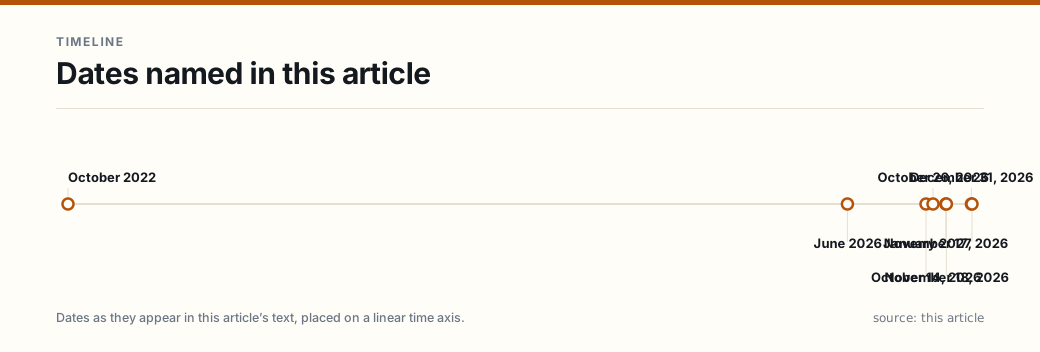
The dates that actually matter now
- October 14, 2026 ✅ — done: the 2027 COLA is 3.6%.
- November 18, 2026: deadline to enroll in paperless notices in my Social Security if you want your COLA notice online in late November.
- November 17, 2026 ✅ — done: CMS set the official 2027 Part B premium at $209.40 and the deductible at $292 (notices placed on public inspection November 17; Federal Register publication scheduled November 19). The figure that decides your net check is no longer an open date.
- Late November 2026: COLA notices appear online in my Social Security accounts.
- December 2026: paper COLA notices arrive by mail, showing your exact benefit and Part B withholding.
- December 31, 2026: SSI recipients receive their January 2027 payment (which includes the COLA) a day early.
- January 2027: the first regular checks at the new amount arrive.
What to do with all this
- Budget from the December notice, not from October arithmetic. The gap between the two is exactly the Part B premium. For the full list of every adjustment since 1975 — and the table convention that makes “last year’s COLA” so hard to pin down — see our Social Security COLA history table.
- Ignore anyone who sells urgency around the COLA. You do not need to “claim” your COLA, verify anything by phone, or pay a fee to receive it — the adjustment is automatic. The scam pattern that follows every SSA headline is covered in Is That Really America.gov? A Scam-Spotting Checklist.
- If you are still deciding when to claim benefits, the COLA applies to your benefit once you claim it regardless of timing — the COLA itself is never a reason to claim early or late. The claiming decision runs on its own math, and ssa.gov’s calculators are the place to start.
Bottom line
The 2027 COLA is 3.6% — confirmed October 14, top of the projected range, and the largest adjustment in three years. The last unknown fell on November 17: the Part B premium is $209.40, so the average beneficiary keeps roughly $68–$69 of the $75 gross increase. Budget on your December notice — that is the number that reaches your account.
This article explains a government benefit formula in general terms; it is not personal advice about your claiming decision or taxes. Rules and figures here are federal — Social Security is a national program, though state Supplemental Security Income supplements vary by state.
Frequently asked questions
- How much is the 2027 Social Security COLA?
- 3.6%, announced by the Social Security Administration on October 14, 2026. It applies to December 2026 benefits, which are paid in January 2027; higher SSI payments begin December 31, 2026. The average retirement benefit rises by $75 a month, per SSA.
- How was the 3.6% calculated?
- It compares the average CPI-W for the third quarter of 2026 (328.746) with the same quarter of 2025 (317.265) and rounds to one decimal place: a 3.6% increase. SSA publishes the computation on its Latest Cost-of-Living Adjustment page.
- How much can I earn in 2027 before my Social Security benefit is reduced?
- If you are below full retirement age all year, the limit is $25,560 — SSA withholds $1 in benefits for every $2 of earnings above it. In the year you reach full retirement age, the limit is $67,920 for the months before that month, with $1 withheld per $3. Both figures come from SSA's formal notice for 2027.
- Will the COLA be reduced by Medicare premiums?
- The COLA itself is not reduced, but Medicare Part B premiums are usually deducted from Social Security checks, so the increase you keep can be smaller than the headline percentage. CMS set the 2027 standard Part B premium at $209.40 a month — $6.50 more than 2026 — so the average beneficiary keeps roughly $68–$69 of the $75 average gross increase. Your December notice shows your exact net figure.
Sources
Each source is a primary or official reference, checked before publication. Links open the original.
- Social Security Administration — press release, 'Social Security Announces 3.6 Percent Benefit Increase for 2027' (October 14, 2026): ssa.gov/news/en/press/releases/2026-10-14.html
- Social Security Administration — 'Cost-of-Living Increase and Other Determinations for 2027', Federal Register Doc. 2026-21796, 91 Fed. Reg. 67380 (October 26, 2026): the formal notice carrying the 3.6% determination, the $192,300 taxable maximum, the retirement earnings test exempt amounts, and the $1,970 quarter-of-coverage amount — federalregister.gov/documents/2026/10/26/2026-21796/cost-of-living-increase-and-other-determinations-for-2027
- Internal Revenue Code — 26 U.S.C. § 3101(a), the 6.2% employee Old-Age, Survivors, and Disability Insurance tax rate, and 26 U.S.C. § 1401(b), the combined 12.4% self-employment rate used in the taxable-maximum arithmetic — law.cornell.edu/uscode/text/26/3101 and law.cornell.edu/uscode/text/26/1401
- Social Security Administration — Latest Cost-of-Living Adjustment, with the official CPI-W computation for the December 2026 determination (ssa.gov/oact/cola/latestCOLA.html)
- Bureau of Labor Statistics — Consumer Price Index, September 2026, released October 14, 2026: the CPI-W rose 3.9% over the 12 months to an index level of 330.654
- Independent 2027 COLA projections of roughly 3.4–3.6% from analysts including The Senior Citizens League and AARP, as reported in October 2026 coverage — cited as the pre-announcement range the final figure can be compared against
- Social Security Administration — cost-of-living adjustment (COLA) information and historical COLA series: ssa.gov/cola
- Centers for Medicare & Medicaid Services — Notice CMS-8094-N, 'Medicare Program; Medicare Part B Monthly Actuarial Rates, Premium Rates, and Annual Deductible Beginning January 1, 2027' (RIN 0938-AV86), published in the Federal Register on November 19, 2026 — the source for the $209.40 standard premium and $292 deductible — www.federalregister.gov/documents/2026/11/19/2026-23601/medicare-program-medicare-part-b-monthly-actuarial-rates-premium-rates-and-annual-deductible
- Centers for Medicare & Medicaid Services — the annual announcement of Medicare Part A and Part B premiums, deductibles, and coinsurance amounts, published each fall (typically November); the 2026 standard Part B premium of $202.90 a month was set in the November 2025 announcement
- 2026 Medicare Trustees Report (June 9, 2026) — projection of a 2027 standard Part B premium of approximately $209.50 a month; the final figure announced November 17, 2026 landed at $209.40, ten cents below the projection