Series I savings bonds: what a 5.51% rate locks in, and what resets in six months
I bonds issued from November 2026 through April 2027 pay 5.51%, including a 1.40% fixed rate. What that locks in, what resets, and the rules that decide fit.
Treasury reset the Series I savings bond rate on November 1: 5.51% for bonds issued from November 1, 2026 through April 30, 2027, of which 1.40% is fixed for the life of the bond — the highest fixed rate Treasury has set since 2006. The previous six months paid 4.26%.
That headline invites a specific mistake, and it is the reason this page exists. A 5.51% rate on a government bond sounds like a rate you lock in. Most of it is not locked in. Understanding which part is — and which part resets on a schedule you do not control — is the whole decision.
The rate is two numbers added together
An I bond’s rate has two components, and they behave differently:
- A fixed rate, set at purchase, which never changes for that bond, for 30 years.
- A semiannual inflation rate, reset every May 1 and November 1, which applies to every I bond ever issued — including yours, on its own schedule.
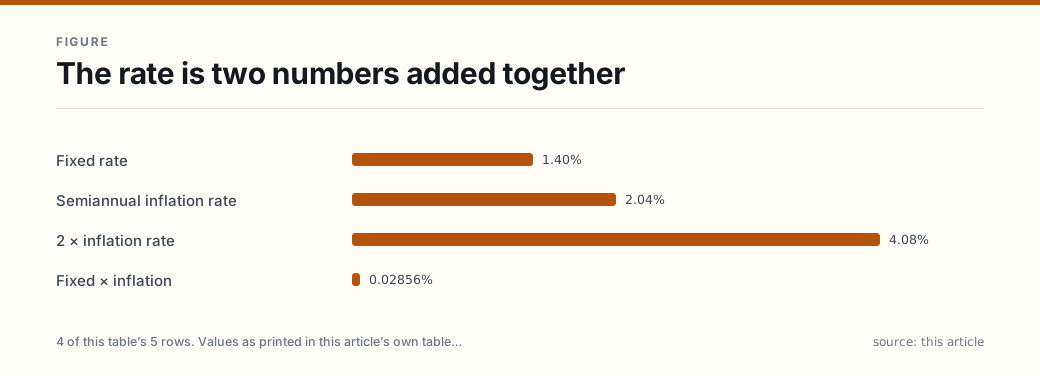
Treasury combines them with a published formula: fixed rate + (2 × semiannual inflation rate) + (fixed rate × semiannual inflation rate). For the current cycle that is:
| Component | Value |
|---|---|
| Fixed rate | 1.40% |
| Semiannual inflation rate | 2.04% |
| 2 × inflation rate | 4.08% |
| Fixed × inflation | 0.02856% |
| Composite rate | 5.50856%, rounded to 5.51% |
The same formula reproduces the rate that just ended: 0.90% + (2 × 1.67%) + (0.90% × 1.67%) = 4.255%, which is the 4.26% that applied from May through October 2026. That is worth checking yourself, because it shows the mechanics are arithmetic rather than discretion.
The 2.04% is not a forecast. It is the six-month change in the Consumer Price Index for All Urban Consumers, not seasonally adjusted — 330.213 in March 2026 against 336.940 in September 2026, a 2.04% increase. That is also why the composite rate jumped more than the fixed rate did: the fixed part rose half a point (0.90% to 1.40%) and the inflation part rose 0.37 points, which the doubling in the formula turns into 0.74 points of the composite.
The fixed rate is the part worth arguing about
Inflation comes and goes; the fixed rate is yours permanently, and it is paid on top of whatever inflation does. Treasury’s own table of every fixed rate it has set since 1998 puts 1.40% in context: the last time the fixed rate reached 1.40% was 2006, when both the May and November resets set it there. Everything after that stayed at or below 1.30% — including the 1.30% of 2023 and 2024, the 1.10% of May 2025, and the 0.90% that applied from November 2025 through October 2026.
For a long-term holder, that is the meaningful change. A bond bought in this window earns 1.40% above inflation for three decades. A bond bought six months earlier earns 0.90% above inflation for three decades. The half point is permanent, and no future reset takes it away.
For a holder who intends to redeem in two or three years, the opposite is true: what matters is the composite rate during the months they actually hold, and that is decided by inflation reports nobody has seen yet.
What resets, and when — not on May 1 and November 1
The announcement dates are not your bond’s reset dates. Your bond’s rate changes every six months from its own issue month. Treasury publishes the mapping, and the logic is a fixed six-month offset:
| If your bond was issued in | Its rate changes every |
|---|---|
| January | July 1 and January 1 |
| April | October 1 and April 1 |
| May | November 1 and May 1 |
| October | April 1 and October 1 |
So a bond bought in November 2026 resets on May 1, 2027; a bond bought in December 2026 does not reset until June 1, 2027. Two consequences follow. Interest accrues from the first day of the month you buy, not the day of purchase, so the timing question is which month — not which day. And when a reset is imminent, the purchase date decides which fixed rate you get for 30 years: buy in late April and you take the old fixed rate permanently, buy three days later and you take the new one. That cuts both ways, and it is the most time-sensitive decision in this product.
Four rules that decide whether it fits
- You cannot touch the money for 12 months. Treasury does not permit redemption during the first year. This is the rule that disqualifies I bonds for the first tier of an emergency fund — the money you might need this quarter belongs somewhere you can reach it this week.
- Cashing out before five years costs three months of interest. Redeem at 18 months and you receive 15 months of interest. Early redemption is allowed after the first year; it is just taxed by forfeiture rather than by penalty.
- The purchase limit is $10,000 per Social Security number per calendar year, for electronic I bonds. Minimum purchase is $25, in any amount above that to the penny. Bonds bought as gifts, or bought for a child, count against the recipient’s limit, not the buyer’s; while a gift sits undelivered in a TreasuryDirect gift box it counts against nobody’s. EE bonds carry their own separate $10,000 limit.
- Everything ends at 30 years. Interest accrues until you cash the bond or it matures, whichever comes first, and Treasury pays a matured electronic bond automatically into the Certificate of Indebtedness in your TreasuryDirect account.
One thing that has changed and still trips people up: since January 1, 2025, I bonds are issued electronically only. Treasury sells them in a TreasuryDirect account, in amounts from $25 to $10,000 to the penny, and there is no paper certificate to hold. The older routes — paper bonds at a bank, and the payroll savings plan, which Treasury retired on January 31, 2025 — are not options for a new purchase. Any guide that walks you through either one is describing a process that ended.
Tax: deferral is the feature, and the education exclusion has a trap
Interest on savings bonds is subject to federal income tax and exempt from state and local income tax. That exemption is worth real money in a high-tax state, and it applies automatically.
You choose when to report the interest: either defer it until you cash the bond or it matures, or report it as it accrues each year. Almost everyone defers. Treasury issues a Form 1099-INT in the year the interest is paid, and the switch between methods is asymmetric in a way worth knowing — you can move from deferral to annual reporting without IRS permission, but you must then report all prior years’ interest for every bond under that Social Security number at once. Moving back the other way requires Form 3115 or the procedure in IRS Publication 550.
The higher-education exclusion is the part most often misunderstood. Interest can be excluded when the proceeds pay qualified higher education expenses, but the conditions are cumulative, and one of them decides most cases before the income test is even reached: the bond owner must have been 24 or older when the bond was issued. A bond registered in a child’s name does not qualify, ever, even when that child is 18 and enrolled — Treasury says so in plain language on its own buying page, in capitals: do not put the bond in the child’s name if the money is meant for college. Two further conditions sit in front of the income test: only bonds issued after 1989 qualify, and the bond must be registered in your name, or in your and your spouse’s names. Beyond those, the remaining tests are the income and timing ones — a modified adjusted gross income below the cutoff the IRS sets for the year, redemption and tuition in the same tax year, expenses for you, your spouse or a dependent, and any filing status except married filing separately — and they are laid out on Form 8815.
The comparison most buyers are actually making
Treasury sells two savings bonds, and for the same six months the EE bond pays 2.90%, fixed for at least the first 20 years. On the rate alone the I bond is not close. The reason people still buy EE bonds is a separate guarantee: an EE bond bought today is guaranteed to be worth double its purchase price at 20 years. Doubling in 20 years is about 3.53% a year compounded (2^(1/20) − 1), so the guarantee is best understood as a floor that the 2.90% rate alone would not reach — an EE bond left alone for two decades delivers roughly 3.5% annually regardless of what the posted rate does.
Against that, the I bond offers protection that no fixed rate can: if inflation runs higher than the market expected, the composite rate rises with it. Both bonds carry the same 12-month lockout, the same three-month forfeiture before five years, the same $10,000 annual limit and the same tax treatment.
The honest framing is that these are different instruments for different jobs. If you want a known nominal amount at a known date, the EE guarantee is the cleaner answer. If you want your purchasing power preserved and you can leave the money alone for years, the I bond’s inflation linkage plus a 1.40% permanent real component is the stronger one — but only for the part of your savings that can be locked up.
When an I bond is the right place for money
It fits when all three of these are true: the money is not needed for at least a year, ideally five; you have already funded the accessible part of your emergency savings; and you are buying inflation protection rather than chasing a rate. It does not fit when the money is a down payment you need in eight months, when it is your only cushion, or when the sum you want to place exceeds $10,000 per person per year — in which case the excess needs a different home, and a household can legitimately use both spouses’ limits. The sizing and location questions for that first, accessible layer are worked through in How Big Should an Emergency Fund Be; an I bond is a candidate for the second layer, never the first.
The comparison worth running before you buy is not “5.51% versus my savings account.” It is “5.51% for six months, then an unknown rate for 29 and a half years, minus three months of interest if I cash out early, with the money unreachable for a year.” If that trade is acceptable, the arithmetic is straightforward.
Buying, and the one thing not to do
I bonds are bought directly from Treasury, and the buying page is unusually direct about where: TreasuryDirect is “the official United States government application in which you can buy and keep savings bonds.” There is no broker, no commission and no intermediary in that route, which makes the security rule simple: no step in an official purchase requires handing your money, your TreasuryDirect password or a one-time code to another person. Treasury’s own index of known schemes describes frauds built around “what are claimed to be securities issued or backed by the Treasury Department” and aimed at individuals as well as institutions — which is the shape of any offer urging you to buy government savings bonds through someone else, at a “guaranteed” higher rate, or on a deadline. Open the account yourself and fund it from your own bank account.
Bottom line
The 5.51% is real, and it is temporary. The 1.40% is real, and it is permanent — for that bond. Decide which of those two facts your situation actually turns on before the window closes on April 30, 2027, and remember that the fixed rate you get is decided by the month of issue, not the day of your deposit.
This article is general information about U.S. savings bonds, not investment or tax advice. Rates, limits and tax rules change; confirm the current figures at TreasuryDirect and, for the education exclusion, in the instructions to IRS Form 8815.
Frequently asked questions
- Is the 5.51% rate guaranteed for as long as I hold the bond?
- No. Only the fixed part is. Bonds issued from November 1, 2026 through April 30, 2027 carry a 1.40% fixed rate that applies for the bond's entire 30-year life, plus an inflation rate that Treasury resets every May 1 and November 1. The 5.51% figure is those two parts combined for the first six months, and it changes at each reset — up or down, though never below zero overall.
- Can I cash an I bond out whenever I want?
- Not in the first year. Treasury does not allow redemption until 12 months after issue. After that you can cash it, but if you redeem before five years you forfeit the last three months of interest — redeem at 18 months and you receive 15 months of interest. Interest stops at 30 years, when the bond matures.
- How much can one person buy in a year?
- For one Social Security number, $10,000 in electronic I bonds per calendar year, in amounts from $25 up, specified to the penny. Gift bonds and bonds bought for a child count against the recipient's limit, not yours. Separate limits apply to separate series, so the EE cap is its own $10,000.
- Do I owe state tax on the interest?
- No. Savings bond interest is subject to federal income tax but exempt from state and local income tax. Federal tax can be deferred until you cash the bond or it matures, and in limited cases it can be excluded entirely when the proceeds pay qualified higher education expenses — but only if the owner was 24 or older when the bond was issued.
Sources
Each source is a primary or official reference, checked before publication. Links open the original.
- TreasuryDirect, 'I bonds interest rates' — the 5.51% composite rate for bonds issued November 1, 2026 through April 30, 2027, the 1.40% fixed rate, the 2.04% semiannual inflation rate, the composite-rate formula and the reset-month table (treasurydirect.gov/savings-bonds/i-bonds/i-bonds-interest-rates/)
- TreasuryDirect, 'I bonds' — electronic-only issuance since January 1, 2025, the $25 minimum, the $10,000 annual limit, the 12-month holding period, the three-month interest forfeit before five years, and the 30-year term (treasurydirect.gov/savings-bonds/i-bonds/)
- TreasuryDirect, 'Comparing EE and I bonds' — the 2.90% EE rate for the same six months, the 20-year doubling guarantee, and the shared redemption and tax rules (treasurydirect.gov/savings-bonds/comparing-ee-and-i-bonds/)
- TreasuryDirect, 'Buying savings bonds' — TreasuryDirect as the official government application for buying and keeping savings bonds, the BuyDirect purchase steps, the January 1, 2025 electronic-only change for I bonds, the payroll savings plan ending January 31, 2025, and the warning not to register bonds intended for college in a child's name (treasurydirect.gov/savings-bonds/buy-a-bond/)
- TreasuryDirect, 'How much can I spend/own?' — how the annual limits are counted by Social Security number, and the treatment of gifts, children's accounts and co-owned bonds (treasurydirect.gov/savings-bonds/how-much-can-i-spend-own/)
- TreasuryDirect, 'Tax information for EE and I bonds' — federal but not state taxation, the deferral election, Form 1099-INT reporting and the rules for switching methods (treasurydirect.gov/savings-bonds/tax-information-ee-i-bonds/)
- TreasuryDirect, 'Using bonds for higher education' — the age-24 condition, the modified adjusted gross income cutoff and the Form 8815 requirements (treasurydirect.gov/savings-bonds/tax-information-ee-i-bonds/using-bonds-for-higher-education/)
- Bureau of Labor Statistics, CPI-U, U.S. city average, all items, not seasonally adjusted (series CUUR0000SA0) — March 2026 index 330.213 and September 2026 index 336.940, the change that corresponds to Treasury's 2.04% semiannual inflation rate (bls.gov)
- TreasuryDirect, 'Frauds, Phonies, & Scams' — the Bureau of the Fiscal Service's index of schemes built around what are claimed to be Treasury-issued or Treasury-backed securities (treasurydirect.gov/laws-and-regulations/fraud/)