Five checks before you hold a stablecoin as cash
A dollar coin sits somewhere between a bank deposit and a voucher. Five questions, in order, decide how much of your money it can safely replace.
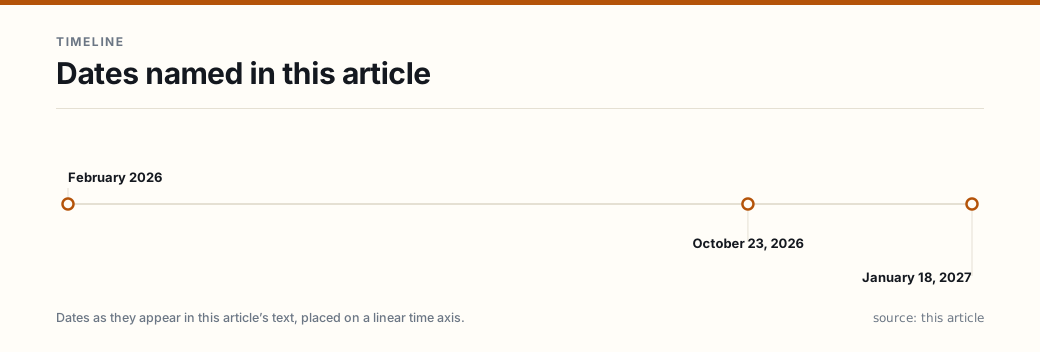
The GENIUS Act’s effective date is January 18, 2027, and the OCC’s implementing rule — 91 Fed. Reg. 67000, published October 23, 2026 — arrives at the same moment. That has produced a wave of explainers about a “regulated dollar coin,” most of them written from the issuer’s side of the rule. This piece does the opposite: it assumes you might hold one, and asks what you would need to know first.
The answer is not “avoid it” or “it’s safe now.” A dollar stablecoin is a specific instrument with a specific failure mode, and the five checks below are ordered by how much they change the answer.
For what the rule itself says in detail — the redemption text, the reserve list, the capital floor — the companion piece is what the OCC’s stablecoin rule promises you.
1. Who issues it, by legal name
Not the app, not the exchange, not the brand on the wallet. Every redemption right in the rule attaches to a permitted payment stablecoin issuer, and the rule requires the issuer to disclose its own name as “the entity that is obligated to convert, redeem, or repurchase the payment stablecoin for a fixed amount of monetary value.”
That sentence is the whole point of the check. A coin you bought inside a platform is often issued by a separate company, and the obligation runs to the issuer — not to the venue where you clicked buy. If no issuer is named on a disclosure page, the duties described in the next four checks are not the duties you are relying on.
The related scope point is worth stating because it limits what has actually changed: the OCC’s rule covers the entities it supervises — national banks and their subsidiaries, federal savings associations and their subsidiaries, federal branches and their subsidiaries, foreign issuers, nonbank Federal qualified issuers, and state-qualified issuers over which the OCC has authority. A state-qualified issuer with total consolidated outstanding issuance above $10 billion must announce itself within five calendar days and either transition to the federal framework within 360 days or stop issuing new coins on a net basis. Below that line, a state issuer stays with its state regulator.
2. How fast you can get out, and from when
The promise is two business days, and the wording is narrower than the phrase “instant.”
An issuer’s published policy must state that timely redemption “may not exceed two business days following the date of the requested redemption.” The clock starts only when the issuer has your order and you have been successfully onboarded. It stops when the issuer has “fully processed and initiated” the outgoing payment — initiated, not received. The OCC says explicitly that time spent in transit, or waiting to be credited at your bank, sits outside the window.
Two things follow that a cash-flow plan cannot ignore. First, the two days are business days, counted from a completed request, and the rule separately requires the issuer’s onboarding to be designed not to unduly delay customers “including in times of stress.” Second, the window can move: after a day in which requests exceed 10 percent of the outstanding issuance value of a brand, an issuer must tell the OCC within 24 hours and may ask to extend the deadline, and the OCC decides.
If a bill is due on the 15th, a stablecoin balance is not the account to pay it from. That is not a defect in the rule; it is the difference between a settlement instrument and a checking account.
3. What actually backs it, and where the backing sits
From the rule, reserves must be identifiable, segregated from the issuer’s own assets, and worth at least the outstanding issuance at all times. The permitted composition is a closed list: currency and Reserve Bank balances, demand deposits or insured shares at insured institutions, Treasury obligations with 93 days or less remaining maturity, qualifying overnight repo and reverse repo, registered government money market funds holding only those assets, tokenised versions of them, and anything else the OCC approves as similarly liquid.
The monthly composition report is the document to read, and the issuer has to link to it in its disclosures. What the report tells you is the shape of the backing — how much sits in bank deposits, how much in Treasury bills, how concentrated at one counterparty (the rule caps that at 40 percent of reserves, with exceptions).
The OCC’s rule also declines to answer one question holders tend to assume was settled. Commenters asked it to state that reserve assets are held for the benefit of holders, or that they are not part of the issuer’s estate in an insolvency. The OCC’s response was to accommodate some structures, including special-purpose-vehicle issuers designed to protect holder rights, and to leave the insolvency treatment elsewhere. So the segregation requirement is a real constraint on the issuer, and it is not a court ruling about who owns what if the issuer fails.
4. It does not pay you — and that is not a defect
The GENIUS Act prohibits a regulated issuer from paying “any form of interest or yield (whether in cash, tokens, or other consideration) solely in connection with the holding, use, or retention” of a payment stablecoin. The OCC’s final rule implements that prohibition. In February 2026 the OCC had proposed a rebuttable presumption aimed at arrangements routed through affiliates and partners; the final rule withdrew the presumption, while keeping its anti-evasion authority.
For a household, the practical consequence is simple and worth internalizing: a compliant dollar coin is a zero-yield instrument. Anything paying you a percentage on a stablecoin balance is, by definition, doing something the issuing framework does not provide for. It might be a partner’s legitimate rewards program; it might be a structure the OCC would call evasion; either way the percentage is coming from somewhere other than interest on a reserve pool you own a claim to.
The comparison to make is therefore not “stablecoin versus high-yield savings.” It is “stablecoin versus a checking account or a payment app,” because that is the job it is structurally able to do. The arithmetic of what a low-risk dollar earns over time — and why the gap compounds — is in What Investment Returns Actually Look Like.
5. Convenience is not the same as insurance
This is where most of the confusion lives, and the rule is unusually direct about it. An issuer must disclose, publicly and conspicuously, that the coin is not legal tender, is not issued by the United States, is not guaranteed or approved by the United States, is not a deposit, is not backed by the full faith and credit of the United States, and is not insured by the FDIC or the NCUA.
Read that list against what a bank balance is. A deposit carries federal insurance up to the statutory limit and sits inside an institution supervised for safety and soundness. A stablecoin carries a reserve requirement, a redemption duty and a monthly report. Those are meaningful protections and they are different ones. “Fully reserved” answers “is there something there?” — it does not answer “who makes me whole if something goes wrong?”
The final backstop question — the issuer’s capital — follows the same logic. A new issuer must hold at least $5 million in capital (or more if its licensing conditions say so) for 36 months, and ongoing capital must be commensurate with its risks, alongside an operational backstop requirement. That is a floor on the institution. It is not a fund held for holders.
The tax point nobody puts in the marketing
The OCC’s rule says in terms that the tax treatment of payment stablecoins is outside its scope and outside its authority. The IRS’s position is separate and older: for U.S. tax purposes digital assets are property, not currency, and that page names stablecoins among them. Which means selling, exchanging or spending one is generally a disposal with a gain or loss to compute, and the return has to say whether you did any of it. Buying with dollars is generally not the taxable moment — but it is the leg that sets your basis, so it is the one worth documenting.
Two habits fix most of this. Record the dollar value at each leg — what you put in, what you took out, the date and the platform — and do not assume that a coin whose price does not move has no tax consequences. Our piece on the mechanics is Capital Gains Basics.
What a reasonable use looks like
None of the above makes stablecoins unusable. It makes them specific.
- As a settlement rail for a transaction you are already making, the two-day redemption right is a real protection that did not exist in rule form before January 18, 2027.
- As the account your rent comes out of, it is the wrong instrument, for the business-day reason above.
- As an emergency fund, no: the amount you may need within 48 hours needs a settlement time of zero. Our framework for that money is The Emergency Fund, and it starts with cash in an insured account.
- As a bet on an issuer’s fortunes, do not dress it as that. The rule forbids the issuer from paying you for holding it, so the only return you can earn from a compliant coin is the difference in convenience — not yield.
Three pitches to refuse
- “FDIC-insured stablecoin.” The issuer is required to disclose the opposite. A seller who says it is either selling something else or misdescribing this.
- “Regulated, so it’s guaranteed.” Regulation here means reserve rules, a redemption deadline and disclosure. It does not mean a government guarantee, and the required disclosure says so.
- “Fixed APY on a dollar coin — that’s the new regulated yield.” The statute’s yield prohibition targets exactly this framing. Ask who is paying, under what arrangement, and read the issuer’s own fee and disclosure page before believing a number.
Nobody from a federal agency will call, text or email you about a stablecoin account, and no regulator asks for gift cards, wire transfers or a private key to resolve a regulatory matter. Report fraud to the FTC at reportfraud.ftc.gov, check registration at Investor.gov, and if a page is imitating a government service, compare it against Is That Really America.gov?.
Jurisdiction, in one paragraph
The GENIUS Act and the OCC’s rule are federal, and they do not vary by state for the entities the OCC supervises. State-qualified issuers are licensed under state law, and the statute preserves state consumer protection law rather than preempting it — so which regulator answers a complaint about a smaller issuer varies by state. Whether a particular token is a security, and how it is taxed, are separate questions this rule does not settle.
A wider list of the official pages worth bookmarking for federal programs lives at omc.center/resources.
This article is general information about how federal stablecoin rules interact with a household budget, not investment, legal or tax advice, and it is not a recommendation about any asset, issuer or platform. Stablecoin supervision is federal; state licensing of state-qualified issuers varies by state. Nothing here predicts how any regulator will treat any particular firm, and the tax treatment of digital assets is outside the scope of the OCC’s rule. It is AI-written and independently AI-reviewed before publication; the review standard and this article’s findings are recorded in the network’s editorial review log.
Frequently asked questions
- Is a stablecoin a safe place for money I need next week?
- Treat it as the last step, not the first. From January 18, 2027, a stablecoin issued by a permitted issuer under the OCC's jurisdiction carries a redemption right that may not exceed two business days, counted from the issuer's receipt of the request and the customer's successful onboarding, subject to the issuer's own published policy and to an extension the regulator can allow. That is closer to a settlement promise than to the immediate availability of a checking account, and nothing in the rule insures it.
- Will I earn interest on a regulated stablecoin?
- Not from the issuer. The GENIUS Act prohibits a regulated issuer from paying any form of interest or yield solely in connection with holding, using or retaining the coin, and the OCC's October 2026 final rule implements that prohibition rather than creating it. Interest on a bank deposit, including a tokenised one, sits outside the prohibition because a deposit is excluded from the statutory definition of a payment stablecoin.
- What happens if the issuer fails?
- Reserve assets must be identifiable, segregated, and equal to or above outstanding issuance at all times, and the rule requires a monthly reserve composition report — but the disclosure the issuer must publish says plainly that the coin is not backed by the full faith and credit of the United States and is not FDIC- or NCUA-insured. Reserve segregation is a promise about where the assets sit, not insurance against loss, and the OCC's rule itself does not resolve every question about how reserves are treated in an insolvency.
- Do I owe tax when I move dollars into a stablecoin?
- Buying one with dollars is generally not a taxable event by itself. Selling, exchanging or spending one is a disposal, which is generally when a gain or loss is computed, so keep a record of the dollar value at each leg. This article is general information, not tax advice; the OCC states that tax treatment is outside the scope of its rule and outside its authority.
- Where can I check an issuer or report a problem?
- Registration status for investment firms and professionals can be checked at Investor.gov, fraud goes to the FTC at reportfraud.ftc.gov, and the issuer's own required disclosures — its name, its reserve report link and its fee schedule — are the first thing to read. If a page promises an insured stablecoin, that page is describing something the rule forbids an issuer to claim.
Sources
Each source is a primary or official reference, checked before publication. Links open the original.
- Federal Register — 'Implementing the Guiding and Establishing National Innovation for U.S. Stablecoins Act for the Issuance of Stablecoins by Entities Subject to the Jurisdiction of the Office of the Comptroller of the Currency', final rule, published October 23, 2026, 91 Fed. Reg. 67000 (FR Doc. 2026-21706; Docket ID OCC-2025-0372; effective January 18, 2027) — the rule text behind every threshold in this article: 12 CFR 15.11 (reserve composition and the monthly report), 15.12 (redemption timeline, the 10 percent notice threshold, and the required disclosures), 15.15 (the $10 billion transition threshold), and 15.41 (the $5 million de novo capital floor) — federalregister.gov/documents/2026/10/23/2026-21706/implementing-the-guiding-and-establishing-national-innovation-for-us-stablecoins-act-for-the
- Guiding and Establishing National Innovation for U.S. Stablecoins Act, 12 U.S.C. 5901 et seq. — the definition of a payment stablecoin and its exclusion of deposits in section 2(22), 12 U.S.C. 5901(22), and the yield prohibition in section 4(a)(11), 12 U.S.C. 5903(a)(11) — law.cornell.edu/uscode/text/12/5903
- Internal Revenue Service — 'Digital assets', the IRS page stating that for U.S. tax purposes digital assets are treated as property rather than currency, listing stablecoins among digital assets, explaining which transactions require a digital-asset answer on a return, and setting out the records to keep — irs.gov/filing/digital-assets
- Federal Deposit Insurance Corporation — 'Understanding Deposit Insurance', the FDIC's own explanation of what deposit insurance covers and, by extension, what a non-deposit instrument does not — fdic.gov/resources/deposit-insurance
- Federal Trade Commission — reportfraud.ftc.gov, the FTC's consumer fraud reporting portal, cited in the checks below — reportfraud.ftc.gov
- U.S. Securities and Exchange Commission, Investor.gov — how to check whether an investment professional or firm is registered, and how to report investment fraud — investor.gov