What the OCC's stablecoin rule promises you, and what it does not
From January 18, 2027, a regulated dollar stablecoin carries a two-day redemption right and no interest. The fine print is where the safety ends.
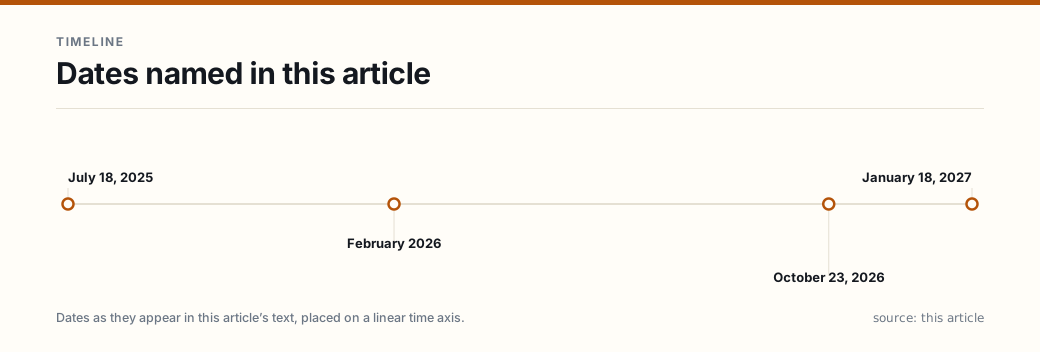
On October 23, 2026, the Office of the Comptroller of the Currency published the final rule that turns the GENIUS Act — the federal stablecoin law enacted on July 18, 2025 — into a supervision manual. It runs from page 67000 to page 67194 of volume 91 of the Federal Register, and it takes effect on January 18, 2027, the same day the statute does.
Most of it is addressed to bank lawyers: reserve diversification, operational backstop debt, capital deductions, licensing. But three sections land squarely on a household balance sheet, and they are worth reading before any app tells you that a dollar coin is now “regulated.”
The short version: a stablecoin issued by a permitted issuer under the OCC’s jurisdiction will carry an enforceable two-day redemption right, a fixed list of things its reserves may contain, and a disclosure page that has to say what it is not. It will not pay interest, and it is not a deposit.
Which coins does this rule actually cover?
This is narrower than the announcement cycle suggests. Part 15 applies to six listed categories: national banks and their subsidiaries, federal savings associations and their subsidiaries, federal branches and their subsidiaries, foreign payment stablecoin issuers, nonbank entities that seek to be or are approved as Federal qualified payment stablecoin issuers, and state-qualified payment stablecoin issuers over which the OCC has regulatory or enforcement authority. The OCC’s own summary is blunt: “To the extent that an entity falls under one of these categories, it is subject to part 15. Otherwise, the entity is not captured by the rule.”
Two things follow, and both matter to a reader:
- The statute, not the rule, decides which regulator writes the rest. The OCC’s own summary says that “in many instances” the requirements for these entities — its examples are capital, liquidity and operational risk management — “will be established by regulations issued by the relevant primary Federal payment stablecoin regulator.” Part 15 is the OCC’s version of that for the entities it supervises. A state-qualified issuer below the size threshold is supervised elsewhere, and this rule is not its rulebook.
- Large state-qualified issuers are pulled in by size. Section 15.15 gives a nonbank state-qualified issuer with total consolidated outstanding issuance value above $10 billion two choices: transition to the federal framework within 360 days of crossing the threshold, or stop issuing new coins on a net basis from the day it crosses. Either way it must notify the OCC in writing within five calendar days, and within 270 days it must submit an analysis of its capital position for the OCC to set a minimum. Below that line, a state-qualified issuer stays with its state supervisor, behind the OCC’s enforcement authority for what the statute calls “unusual and exigent circumstances.”
So the protections below attach to a permitted issuer, and the identity of the issuer is the first thing to establish. The rule makes that easy on purpose: the disclosures have to name it.
What does the redemption right say, in its actual words?
Section 15.12 is the section a holder would cite. In the rule’s words, an issuer’s redemption policy must provide procedures for timely redemption that state:
“That timely redemption may not exceed two business days following the date of the requested redemption.”
Three details decide what that sentence is worth.
When the clock starts. The obligation begins when the issuer receives the redemption order and the customer has been successfully onboarded, along with any other legal conditions. The rule also requires the issuer’s onboarding procedures to be “reasonably designed to not unduly delay the onboarding of retail or other customers, including in times of stress.” That sentence is doing real work: a two-day promise is defeated by an onboarding queue, and the rule knows it.
When redemption counts as done. The clock stops in one of two places. The rule says redemption is deemed to occur when the issuer has “fully processed and initiated the outgoing transfer of monetary value” to you or to your financial institution as you directed — or, if you asked for it, when the issuer has credited the value to your account with the issuer. Initiated, not arrived. The OCC says this expressly in response to a comment asking whether cross-border redemptions could take longer: the time for funds to be received or credited is outside the redemption window. That is a fair reading of “initiated”, and it is also the reason a wire that sits at an intermediary bank is not an issuer’s problem under this rule.
Who can stop the clock. Any discretionary limit on timely redemption “can only be imposed by the OCC or, in the case of a State qualified payment stablecoin issuer, by the OCC, the Federal Reserve, or the State payment stablecoin regulator.” The issuer cannot impose one unilaterally.
There is a stress clause underneath that. If redemption requests in a single 24-hour period exceed 10 percent of the outstanding issuance value of any brand of its stablecoin, an issuer must notify the OCC within 24 hours and may then request an extension. The OCC decides whether to grant it. Commenters argued that a freeze provision could accelerate a run; what the final rule did in response was keep the extension available on request while removing the issuer’s own discretion to invoke it.
One more line in section 15.12 is easy to miss and matters for small balances: the policy must state “the minimum number of payment stablecoins, if any, that the permitted payment stablecoin issuer will redeem, provided that the issuer must redeem any number greater than or equal to one payment stablecoin.” One coin, subject to normal customer screening.
Why is there no yield, and what presumption was dropped?
Section 4(a)(11) of the statute prohibits a regulated issuer from paying “any form of interest or yield” — in cash, tokens or other consideration — solely in connection with the holding, use, or retention of a stablecoin. The rule implements that prohibition; it did not create it.
What changed between the February 2026 proposal and the final rule is the enforcement machinery. The proposal had a rebuttable presumption: if an issuer had an arrangement with an affiliate or related third party to pay yield, and that party had an arrangement to pay yield to holders, the issuer was presumed to be violating the prohibition, and could rebut it in writing. The OCC has now eliminated the presumption.
That is a real change, and it is worth stating plainly. What it does not do is legalise indirect payments:
- The OCC says an agent paying on the issuer’s behalf is inside the prohibition, because “the issuer pays interest or yield to a payment stablecoin holder” through the agent.
- It refuses a safe harbour for rewards programs that predate the statute: “rewards programs that predate the enactment of the GENIUS Act will be evaluated the same as rewards programs that are established after the enactment or effective date.”
- It keeps the anti-evasion power in section 4(h)(1) and says it “retains its authority to address evasion,” while declining to publish a list of permitted or prohibited arrangements.
- It declines to carve out a de minimis exemption for small payments.
- It confirms the prohibition applies to institutional and retail holders alike, because the statute does not distinguish them.
For a reader, the practical translation is simple: a regulated dollar stablecoin will not be an interest-bearing account. If a platform is offering you a percentage on a stablecoin balance, the first question is who is paying it and on what legal basis — the OCC has just made that question easier to ask and harder to answer from the rule text alone.
The rule also settles one adjacent point: interest paid on deposits, including tokenised deposits, is outside the prohibition, because the statute’s definition of a payment stablecoin excludes deposits.
What must appear on the disclosure page?
Section 15.12(e) is the part a holder can actually use. An issuer must publicly and conspicuously disclose, in plain language and segregated from other information:
- The issuer’s name — the entity obligated to convert, redeem or repurchase the coin for a fixed amount of monetary value.
- A link to the monthly reserve composition report required by section 15.11(e), so you can see what backs it.
- All fees for buying or redeeming. Any change needs at least seven calendar days’ prior notice, delivered to customers with a current relationship.
- That the coin is not legal tender, not issued by the United States, and not guaranteed or approved by the United States.
- That it is not a deposit, is not backed by the full faith and credit of the United States, and is not insured by the FDIC or the NCUA.
That last bullet is the sentence to hold on to. A regulated stablecoin is a claim on a segregated reserve pool with a redemption promise, not an insured deposit. The rule requires the issuer to say so; a marketing page that implies otherwise is contradicting the issuer’s own required disclosure.
On the reserve pool itself, section 15.11(b) is a closed list: coins and currency, balances at a Federal Reserve Bank, demand deposits or insured shares at an insured depository institution, Treasury bills, notes or bonds with 93 days or less remaining maturity, overnight repo backed by those bills, qualifying overnight reverse repo, registered government money market funds whose assets are confined to the categories above, tokenized versions of those, and any other similarly liquid federal asset the OCC approves. Reserves must be identifiable, must not be commingled, and must equal or exceed outstanding issuance “at all times.”
The diversification numbers came out softer than the proposal: at least 5 percent in demand deposits, on-demand share accounts or Reserve Bank balances (the alternative option had said 10 percent), and exposure to any one counterparty capped at 40 percent of reserve assets, subject to exceptions.
What capital floor protects the redemption promise?
A redemption right is only as good as the issuer’s ability to honour it in a bad week, which is what subpart E is for. A de novo issuer — one that received OCC approval within the prior three years — must hold minimum capital equal to the greater of its licensing condition or $5 million, for 36 months. Ongoing capital must be “commensurate with the level and nature of all risks,” with a process for assessing adequacy. Alongside that sits an operational backstop requirement, and backstop debt is capped at 50 percent of it.
None of this is a guarantee. It is a floor on the institution, sized by the OCC’s risk assessment — not a fund earmarked for holders. Which is why the disclosure sentence about deposit insurance is the accurate one, and why “fully reserved” and “insured” should never be used as synonyms.
What should you do before January 18?
- Find out who issues the coin you hold. Not the app, not the exchange — the issuer named on the disclosure page. If there is no named permitted issuer, the redemption and disclosure duties described here are not the duties you are relying on.
- Read the redemption policy for the two words that matter: the stated timeframe, and the stated minimum redemption amount. Section 15.12(b) requires both to be published.
- Do not count a stablecoin as cash or as an emergency fund. It is a redeemable claim with a two-day settlement window and a regulator who can, in defined circumstances, allow that window to move. Our framework for the money you may need this week is The Emergency Fund, and the arithmetic of what a “safe” asset actually earns over time is in What Investment Returns Actually Look Like.
- Read the earlier piece on the CFTC’s separate crypto rulemaking if you trade with leverage — leverage and delivery covers the spot-trading side of federal crypto regulation, which this rule does not touch at all.
Two things this rule openly declines to do. It does not decide whether a particular stablecoin arrangement is a security — the OCC notes that an arrangement paying yield solely in connection with holding could be one, and adopts no safe harbour. And it does not address tax, which the OCC says is outside both the rule and its authority.
What if someone offers to help you “get in before the deadline”?
A final rule with a date in it is a reliable marketing prop. Expect all of the following.
- No individual has anything to register, claim or pay. The January 18, 2027 date governs issuers, and there is no consumer application, no waitlist and no fee.
- “FDIC-insured stablecoin” is a contradiction the issuer has to disclaim in writing. The rule requires the opposite disclosure. Treat the phrase as a red flag about the seller, not a feature of the coin.
- Guaranteed yield on a dollar coin is the thing the statute prohibits. An offer of a fixed percentage on a stablecoin balance, framed as “regulated yield,” is either misdescribing the arrangement or describing one the OCC would treat as evasion.
- The OCC does not call, text or email asking for money, account details or a private key, and no federal regulator asks for gift cards or crypto to resolve a regulatory matter. Report fraud to the FTC at reportfraud.ftc.gov, and check the registration status of any firm at Investor.gov. Our network’s scam checklist is at Is That Really America.gov?.
What about jurisdiction?
The GENIUS Act and this rule are federal law, and they do not vary by state for the entities the OCC supervises. Two limits. State-qualified issuers are, by definition, licensed under state law, and the statute preserves state consumer protection law: section 7(f)(4) provides that nothing in the Act preempts it. And whether a particular token is a security, a commodity, or neither is a separate question this rule does not answer.
A wider list of the official pages worth bookmarking for federal programs lives at omc.center/resources.
This article is general information about a final federal rule, not investment, legal or tax advice, and it is not a recommendation about any asset, issuer or platform. Stablecoin regulation is federal; state licensing of state-qualified issuers varies by state. Nothing here is a prediction about how the OCC will supervise any particular firm, and the tax treatment of digital assets is outside this rule and outside our scope. It is AI-written and independently AI-reviewed before publication; the review standard and this article’s findings are recorded in the network’s editorial review log.
Frequently asked questions
- Is a regulated stablecoin now as safe as a bank deposit?
- No, and the rule requires the issuer to say so on its own website. The disclosures the OCC sets out must state that a payment stablecoin is not legal tender, is not issued or guaranteed by the United States, is not a deposit and is not insured by the FDIC or the NCUA. Reserves must equal outstanding issuance at all times, but that is a promise about assets, not an insurance policy.
- Will my stablecoin start paying interest after January 2027?
- No. The GENIUS Act prohibits a regulated issuer from paying any form of interest or yield solely because you hold or use the coin, and the OCC's rule implements that prohibition rather than creating it. The OCC did drop the rebuttable presumption that sat alongside it, so arrangements with partners are judged case by case — but it kept its power to treat an arrangement as evasion.
- Can an issuer simply suspend redemptions in a crisis?
- Only the regulator can impose a discretionary limit on timely redemption — the OCC, and for a state-supervised issuer the OCC, the Federal Reserve or the state regulator. The rule does let an issuer ask the OCC to extend the two-day window after a day in which redemption requests exceed 10 percent of outstanding issuance, and requires notice to the OCC within 24 hours.
- I hold a stablecoin bought in 2025. Am I grandfathered?
- Nothing in this rule protects a coin you already hold, and nothing in it requires a foreign issuer to be approved on the day it takes effect. The protections described here attach to a payment stablecoin issued by a permitted issuer under the OCC's jurisdiction, which is why the identity of the issuer on the disclosure page is the first thing to check.
- Does this settle whether I owe tax on gains?
- No. The OCC says outright that the tax treatment of payment stablecoins is outside the scope of the rule and outside its authority. Nothing here is tax advice.
Sources
Each source is a primary or official reference, checked before publication. Links open the original.
- Federal Register — 'Implementing the Guiding and Establishing National Innovation for U.S. Stablecoins Act for the Issuance of Stablecoins by Entities Subject to the Jurisdiction of the Office of the Comptroller of the Currency', final rule, Office of the Comptroller of the Currency, published October 23, 2026, 91 Fed. Reg. 67000 (FR Doc. 2026-21706; Docket ID OCC-2025-0372; RIN 1557-AF41; 12 CFR parts 3, 6, 8, 15 and 19; effective January 18, 2027) — the document this article is built on, including the rule text for 12 CFR 15.11 (reserves), 15.12 (redemption and disclosures) and 15.40-15.41 (capital and operational backstop) — federalregister.gov/documents/2026/10/23/2026-21706/implementing-the-guiding-and-establishing-national-innovation-for-us-stablecoins-act-for-the
- Federal Register — the same final rule in full text, as printed by the Government Publishing Office (the source of the regulation text quoted here and of the February 2026 proposal, 91 Fed. Reg. 10202) — federalregister.gov/documents/full_text/text/2026/10/23/2026-21706.txt
- Guiding and Establishing National Innovation for U.S. Stablecoins Act, 12 U.S.C. 5901 et seq. (enacted July 18, 2025) — the statute the rule implements: the definition of a payment stablecoin in section 2(22), 12 U.S.C. 5901(22); the reserve requirement in section 4(a)(1); the yield prohibition in section 4(a)(11), 12 U.S.C. 5903(a)(11); the anti-evasion authority in section 4(h)(1), 12 U.S.C. 5903(h)(1); and the preservation of state consumer protection law in section 7(f)(4) — law.cornell.edu/uscode/text/12/5903
- Federal Trade Commission — reportfraud.ftc.gov, the FTC's consumer fraud reporting portal, cited in the scam note below — reportfraud.ftc.gov
- U.S. Securities and Exchange Commission, Investor.gov — how to check whether an investment professional or firm is registered, and how to report investment fraud — investor.gov