The repayment menu was rebuilt on July 1, 2026: which plan you can pick, and what your AGI does to the bill
Since July 1, 2026, the plans you can pick depend on when your loans were disbursed. How RAP, IBR and the Tiered Standard plan differ, and what AGI does.
You have a federal balance, a servicer portal, and a list of repayment plans that no longer matches the one you read about two years ago. Since July 1, 2026 the question is no longer “which plan can I afford.” It is “which plans am I even allowed to choose” — and that answer now turns on facts about the loans themselves, not about you.
Three facts settle it: when your loans were disbursed, whether any of them are parent PLUS loans, and whether you are in default. Get those right and the menu is short. Get them wrong and the rest of the arithmetic does not matter, because you will be comparing plans you cannot enroll in.
The three questions that decide your menu
When were your loans disbursed? This is the dividing line in the current law, and it is the disbursement date that counts, not the date you applied. If every loan you hold was disbursed or consolidated before July 1, 2026, you keep access to Income-Based Repayment — and if you are already repaying under PAYE or ICR, you can stay on that plan until it closes. If you receive a first disbursement on a new loan on or after July 1, 2026 — including a new consolidation loan — the Department’s guidance says you lose IBR, ICR and PAYE, and your choice narrows to two plans: the Repayment Assistance Plan (RAP) or the Tiered Standard plan.
That last point catches people who consolidate to simplify. Consolidating today produces a loan disbursed today, and it takes your older loans with it: the Department says all of them then have to be repaid under RAP or the Tiered Standard plan, even if they were enrolled in IBR before. Consolidation is still the right move in some situations — it is how defaulted borrowers get back into an income-driven plan — but it is not a neutral administrative step any more.
Any parent PLUS loans? Parent PLUS loans are never eligible for RAP, even after consolidation. The Department’s FAQ goes further: a borrower holding only parent PLUS loans is not eligible for any income-driven plan, and the consolidation route it describes applies to parent PLUS debt consolidated before July 1, 2026. One narrow window survives for older consolidation loans that repaid parent PLUS debt — ICR stays available for them through June 30, 2028, and a consolidation loan disbursed on or after July 1, 2025 in that position is restricted to ICR rather than another income-driven plan.
Are you in default? Defaulted loans cannot be repaid under any income-driven plan. You can rehabilitate, or you can consolidate the defaulted loans into a Direct Consolidation Loan and repay that under RAP — which is the route the Department now points people toward.
The menu as it stands
| Plan | Monthly payment | Forgiveness clock | Who can enroll |
|---|---|---|---|
| RAP | 1–10% of AGI, divided by 12, minus $50 per dependent; never below $10 | 360 payments over at least 30 years | Most Direct Loans, disbursed before or after July 1, 2026; not parent PLUS |
| IBR | 15% of income above 150% of the poverty guideline, or 10% for a new borrower; capped at the 10-year Standard payment | 300 payments over 25 years, or 240 over 20 for a new borrower | Loans disbursed before July 1, 2026 |
| PAYE | 10% of income above 150% of the poverty guideline; same cap | 240 payments over 20 years | Only borrowers already repaying under PAYE; closes by July 1, 2028 |
| ICR | The lesser of 20% of discretionary income or a 12-year fixed payment adjusted for income | 300 payments over 25 years | Existing ICR borrowers, plus certain parent PLUS consolidation loans; closes by July 1, 2028 |
| Tiered Standard | Fixed payment over 10 to 25 years, set by balance | None — the loan is paid off | Loans disbursed on or after July 1, 2026; the default placement |
Two things in that table are worth pausing on. First, SAVE is not on it. A federal court order — the Department cites a final order in Missouri v. Department of Education vacating most aspects of the SAVE rule — ended the plan, and borrowers who were enrolled have to choose again. Second, PAYE and ICR are closing, not closed. Borrowers already on them can stay until July 1, 2028, and then must move to RAP, IBR, or a fixed plan.
“New borrower” in the IBR row is a term of art, not a description of when you graduated: the regulations define it as a borrower who had no outstanding balance before July 1, 2014, or none on the date of a later loan taken out before July 1, 2026, and who takes out no new loan on or after that date.
There is also one bar to know about before counting on IBR. A borrower who has made 60 or more qualifying payments under REPAYE — the plan SAVE replaced — on or after July 1, 2024 may not enroll in IBR at all, regardless of what else qualifies.
What RAP actually charges
RAP is not a percentage of income above a poverty allowance, the way IBR is. It is a percentage of your whole adjusted gross income, stepped by $10,000 bands:
| AGI | Base payment | Monthly, before dependents |
|---|---|---|
| $10,000 or less | $120 flat | $10.00 |
| $10,000 – $20,000 | 1% | $8.33 – $16.67 |
| $20,000 – $30,000 | 2% | $33.33 – $50.00 |
| $30,000 – $40,000 | 3% | $75.00 – $100.00 |
| $40,000 – $50,000 | 4% | $133.33 – $166.67 |
| $50,000 – $60,000 | 5% | $208.33 – $250.00 |
| $60,000 – $70,000 | 6% | $300.00 – $350.00 |
| $70,000 – $80,000 | 7% | $408.33 – $466.67 |
| $80,000 – $90,000 | 8% | $533.33 – $600.00 |
| $90,000 – $100,000 | 9% | $675.00 – $750.00 |
| Above $100,000 | 10% | $833.33 and up |
Then subtract $50 a month for each dependent claimed on your federal return, down to a floor of $10. At exactly $10,000 the table’s flat $120 works out to $10 a month; at $10,001 the 1 percent band produces $8.33, which the floor lifts back to $10 — so the seam at the bottom of the table has no practical effect.
The seams higher up do. Because the percentage applies to the entire AGI rather than to the margin, crossing a band boundary reprices every dollar below it:
- At $30,000 the payment is $50.00. At $30,001 it is $75.00.
- At $50,000 it is $166.67. At $50,001 it is $208.34.
The step at each boundary works out to 1 percent of the boundary amount, spread over twelve months — $25 at $30,000, $41.67 at $50,000, $83.33 at $100,000. The higher percentage applies to the whole AGI, not to the part above the line.
Three more features of RAP matter more than they look:
- The floor is $10, not $0. IBR and PAYE let a low-income borrower reach a $0 payment. RAP does not. For a borrower with an AGI of $15,000, RAP costs $12.50 a month where IBR would cost nothing.
- There is no cap tied to a fixed plan. IBR and PAYE payments are capped at what you would have paid on the 10-year Standard plan. RAP’s formula has a floor and no ceiling, so a high earner with a modest balance can owe more under RAP than under the Tiered Standard plan for the same debt. Being “income-driven” is not the same as being cheaper.
- The principal still falls. If an on-time RAP payment does not cover the month’s interest, the unpaid interest is not charged to you, and if the payment reduces principal by less than $50, the Department adds a matching principal payment — capped at the size of the payment itself. That is a real difference from ICR, where the regulations say all accrued interest is charged to the borrower.
What RAP does not have is the old shortcut for small balances. The rule that forgave the remainder after 120 payments when the original principal was $12,000 or less belongs to the SAVE/REPAYE provision, and RAP has no equivalent — its clock is 360 payments over at least 30 years, though Tiered Standard payments and payments under other plans that were at least the 10-year standard amount can count toward it.
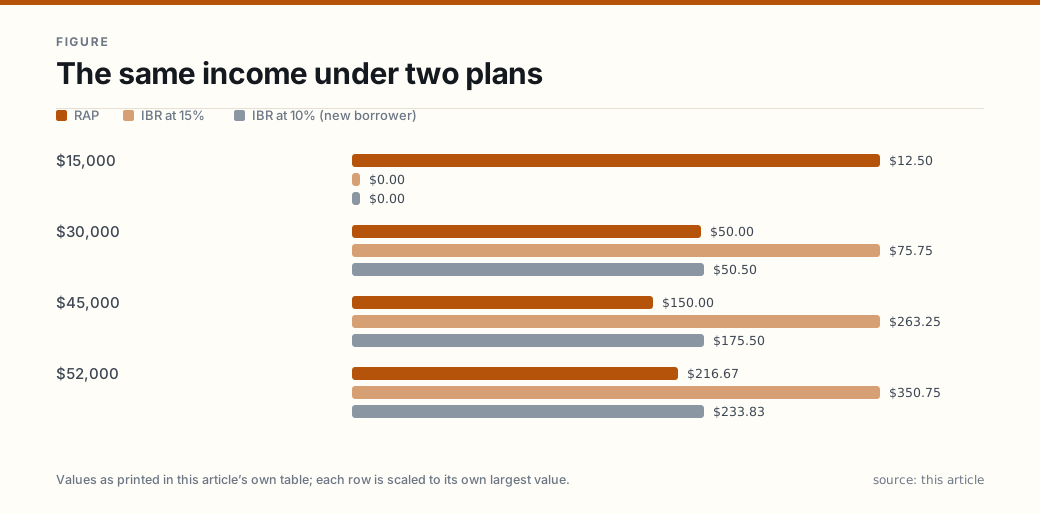
The same income under two plans
Here is the comparison the two formulas make easy to miss. Single filer, no dependents, 2026 poverty guidelines for the 48 contiguous states ($15,960 for a household of one, so 150 percent is $23,940):
| AGI | RAP | IBR at 15% | IBR at 10% (new borrower) |
|---|---|---|---|
| $15,000 | $12.50 | $0.00 | $0.00 |
| $30,000 | $50.00 | $75.75 | $50.50 |
| $45,000 | $150.00 | $263.25 | $175.50 |
| $52,000 | $216.67 | $350.75 | $233.83 |
Now change the household and the ranking flips. A family of four with two dependents claimed and an AGI of $60,000 pays $150.00 under RAP — 5 percent of $60,000 is $3,000, divided by twelve, minus $100. Under IBR at 15 percent it is $131.25, because IBR subtracts 150 percent of the poverty guideline for a household of four ($49,500) before applying its percentage, while RAP subtracts a flat $50 per dependent and no household allowance.
That is the whole structural difference in one example: IBR gives you a household-size allowance; RAP gives you a per-dependent credit. Which one is cheaper is not a matter of taste. It depends on your income, how many people the household contains, and how many of them you claim.
The lever nobody labels: your AGI
Every plan in that table reads the same input. “Income,” for RAP, IBR, PAYE and ICR, means your adjusted gross income as reported to the IRS, or the amount shown by alternative documentation of taxable income. Your monthly payment is therefore a function of a number you influence before it is ever printed on a return.
One lever is easy to miss because it never appears on the repayment application: a deductible traditional IRA contribution. Section 62(a)(7) of the tax code takes the section 219 retirement savings deduction in arriving at adjusted gross income — it is an above-the-line adjustment, not an itemized deduction — so a deductible contribution reduces the exact figure the repayment formula reads. For 2026 the limit is $7,500, plus $1,100 if you are 50 or older. The same lever exists in payroll form: pre-tax 401(k) deferrals and payroll HSA contributions come out before the wage figure your return starts from.
Three preconditions decide whether it works for you:
- The contribution has to be deductible. If you are covered by a workplace retirement plan, the deduction phases out in 2026 between $81,000 and $91,000 of income for a single filer, and between $129,000 and $149,000 for a married couple filing jointly where the contributing spouse is covered. Above those ranges the contribution still saves for retirement; it just stops moving your AGI.
- The effect is retrospective. The plan reads a return that has already been filed. A contribution made for 2026 changes the payment when that return becomes the basis at your next recertification — not this month. If your income has actually fallen, the tool for that is a recalculation based on alternative documentation, which is a different request.
- The size of the effect depends on which plan you are on, and this is where the two formulas diverge sharply. Under IBR the relationship is linear: every $1,000 of lower AGI cuts the payment by 15 percent of $1,000 a year, or $12.50 a month, wherever you sit. Under RAP it is a step function. A borrower at $50,400 of AGI pays 5 percent; the same borrower at $42,900 after a $7,500 contribution pays 4 percent, which is $143.00 a month instead of $210.00 — a saving of $67.00 a month, or 10.7 percent of the contribution. Put the contribution in a year when it drops you just under a boundary and it does far more work than the percentage suggests; put it in the middle of a band and it does less than you would expect.
And one warning about optimizing too hard. A lower payment is not automatically free money. If you are pursuing Public Service Loan Forgiveness, a lower payment is close to a pure gain, because the forgiven balance is not federal income. If you are on a 30-year RAP track, every dollar you avoid paying now is a dollar added to the balance that gets forgiven later — and forgiven balances are the subject of the next section.
The tax bill at the end of the tunnel
Forgiveness has a tax consequence, and the rule changed at the end of 2025.
Under the general rule, canceled debt is income. The IRS lists an exception for “certain student loan discharges after December 31, 2020, and before January 1, 2026” — the temporary exclusion that covered the pandemic-era discharges. A balance forgiven in 2026 or later does not fall inside that window, so it falls back under the general rule unless a different exception applies. Two that do: cancellation because of the borrower’s death or total and permanent disability, and the insolvency exclusion, which is claimed on Form 982 and requires reducing certain tax attributes by the excluded amount.
Public Service Loan Forgiveness is separate, and better: the Department states that amounts forgiven under PSLF are not considered income for federal tax purposes. It adds the caveat that a state may tax the same amount — which is the one place in this article where state law, not federal, decides the answer, and it varies by state.
So the plans are not equivalent even when the monthly payments are. Two borrowers paying the same amount for the same number of years can end up with very different after-tax outcomes depending on which forgiveness route they are on.
What to do this week
- Log in to StudentAid.gov and write down three things: the disbursement date of every loan, whether any loan is a parent PLUS loan, and whether anything is in default. Those three facts, not your income, determine the menu.
- If you were in SAVE, treat the servicer notice as the deadline it is. The Department’s FAQ tells borrowers to watch for an email setting that date, and SAVE is no longer a plan you can enroll in.
- If you are on PAYE or ICR, diarize July 1, 2028. The plans close then; the choice is better made with time to compare than in the last month.
- Run both plans on your own numbers with the Department’s repayment calculator — it lists the plans you are eligible for as well as the estimates — before assuming the income-driven plan is cheaper. With a high income and a modest balance, the missing cap on RAP can cost more than the cap on IBR saves.
- Decide what the forgiveness is for. If you are aiming at PSLF, minimize the payment and keep the 120 qualifying payments clean — auto pay protects that record, and the current 1 percent auto-pay discount runs through June 30, 2028 (see the auto-pay deadline explainer). If you are aiming at 30-year forgiveness, remember the balance you are forgiven is likely taxable income.
- If you are choosing between a traditional and a Roth contribution this year, note that only the traditional side moves your AGI. That trade-off is the same one in Roth vs. traditional: the decision, not the slogan, with one extra consequence for borrowers.
And if a servicer gives you an answer that contradicts the rules above — a plan it says you cannot have, a payment that does not match the formula — the Consumer Financial Protection Bureau accepts complaints about student loans through its online portal, and says most companies respond within 15 days: consumerfinance.gov/complaint.
The plans described here are federal programs, so the rules are national — state law does not change the menu, though a state may tax a forgiven balance differently from the federal government. Nothing here is personal advice about your loans or your taxes; your servicer, StudentAid.gov and a tax professional control the specifics of your case.
Frequently asked questions
- I am still in the SAVE plan. What happens to me now?
- SAVE is gone. The Department of Education says a federal court order ended it and that it is no longer available, and borrowers who were enrolled or had an application pending must choose a different plan. The Department's own FAQ tells borrowers to watch for an email from their servicer setting the deadline to choose, so the notice you receive is the date that matters. A separate default rule covers borrowers leaving PAYE and ICR: those plans close by July 1, 2028, and a borrower who has not elected another plan by then is placed in the Repayment Assistance Plan, or in Income-Based Repayment if the loans are ineligible for RAP.
- Does a traditional IRA contribution actually lower my student loan payment?
- It can, because every income-driven plan in the current menu uses your adjusted gross income from your federal return, and the deduction under section 219 of the tax code is taken in arriving at that figure. Two preconditions: the contribution has to be deductible for you (if you are covered by a workplace plan, the deduction phases out above $81,000 of income for a single filer in 2026), and the effect arrives at your next recertification, not in the current month, because the plan looks at a return that has already been filed.
- Is the Repayment Assistance Plan always cheaper than Income-Based Repayment?
- No. RAP is a flat percentage of your whole AGI, so it has a $10 floor that IBR does not have — at low income IBR can reach $0 while RAP cannot go below $10 a month. And RAP has no ceiling tied to a fixed repayment plan, while IBR and PAYE payments are capped at what you would have paid on the 10-year standard plan. Which one is cheaper depends on your income, your family size and how many dependents you claim.
- Will the balance forgiven at the end be taxed?
- Under the current rules, forgiveness through Public Service Loan Forgiveness is not federal income, and the Department says so. Other forgiveness is a different story: the IRS lists an exception for student loan discharges made after December 31, 2020 and before January 1, 2026, so a discharge in 2026 or later falls under the general rule that canceled debt is income, unless another exception applies — death or total and permanent disability, for instance, or an insolvency exclusion reported on Form 982. Your state's treatment can differ from the federal one.
- Do I have to recertify my income every year?
- Yes. Recertification is annual under the regulations, and you can authorize the Department to pull your tax information from the IRS each year instead of submitting it yourself. If a payment no longer reflects your current income — because you lost a job rather than because you filed a return — you can ask for a recalculation using alternative documentation of income.
Sources
Each source is a primary or official reference, checked before publication. Links open the original.
- 34 CFR 685.209 — Income-driven repayment plans, as revised by the final rule effective July 1, 2026. The operative text for this article: the five plans (a)(1)–(5); the IBR applicable amount of 15 percent, or 10 percent for a new borrower, of AGI above 150 percent of the poverty guideline (b)(1)(i)–(ii); the RAP base payment table by AGI band (b)(2); the definition of a dependent as an IRC section 152 dependent claimed on the borrower's federal return (b)(3); income defined as AGI reported to the IRS or income shown by alternative documentation (b)(10); the RAP monthly payment as base payment divided by 12 minus $50 per dependent (f)(5); the $10 minimum (g)(3)(ii); the rule that unpaid interest is not charged under RAP when the on-time payment does not cover it (h)(4)(i); the matching principal payment of up to $50 (o)(2)(i); forgiveness after 360 qualifying payments over at least 30 years (k)(7) and what counts toward those 360 payments (k)(8)(iii); and the ban on IBR enrollment for a borrower with 60 or more qualifying REPAYE payments on or after July 1, 2024 (c)(3)(ii). ecfr.gov/current/title-34/subtitle-B/chapter-VI/part-685/subpart-B/section-685.209
- Department of Education — 'Reimagining and Improving Student Education--Federal Student Loan Program Final Regulations', final rule published May 1, 2026, 91 Fed. Reg. 23768, effective July 1, 2026. Establishes the republished Part 685 text this article relies on, records that P.L. 119-21 (the Working Families Tax Cuts Act) was signed July 4, 2025, and in its preamble notes the order in Missouri v. Department of Education, Case No. 4:24-cv-00520-JAR (E.D. Mo. March 10, 2026), which vacated most aspects of the SAVE rule. federalregister.gov/documents/2026/05/01/2026-08556/reimagining-and-improving-student-education-federal-student-loan-program-final-regulations
- Federal Student Aid (StudentAid.gov) — 'Top FAQs About Income-Driven Repayment Plans'. The borrower-facing version of the same rules: the RAP payment formula and the $10 minimum, IBR at 15 percent with a 10 percent new-borrower rate and a cap at the 10-year Standard payment, ICR ending no later than July 1, 2028, the notice that a federal court order ended SAVE and that affected borrowers must choose another plan, the rule that parent PLUS loans are never eligible for RAP, and the rule that defaulted loans are not eligible for any IDR plan. studentaid.gov/articles/faqs-idr-plan
- Federal Student Aid (StudentAid.gov) — 'Federal Student Loan Repayment Plans'. The plan menu as published: the Tiered Standard plan for loans disbursed on or after July 1, 2026 and its 10-to-25-year terms, the statement that a borrower who receives a first disbursement on a new loan on or after July 1, 2026 loses eligibility for IBR, ICR and PAYE, and that a borrower who does not choose is placed on the Tiered Standard plan. studentaid.gov/manage-loans/repayment/plans
- Federal Student Aid (StudentAid.gov) — 'One Big Beautiful Bill Act updates'. The Department's implementation notes, including that the Act removed the partial financial hardship requirement for IBR and that the Department's systems were updated to implement that change on December 22, 2025, and how a new loan after July 1, 2026 affects existing loans in repayment. studentaid.gov/announcements-events/big-updates
- Federal Student Aid (StudentAid.gov) — 'Are loans forgiven under Public Service Loan Forgiveness (PSLF) considered taxable by the IRS?' States that forgiven amounts are not considered income for federal tax purposes, with the warning that a state may tax the same amount. studentaid.gov/help-center/answers/article/loan-amounts-forgiven-under-pslf-taxable
- Internal Revenue Service — 'Topic no. 431, Canceled debt – Is it taxable or not?' The general rule that canceled debt is income, the list of exceptions, including 'certain student loan discharges after December 31, 2020, and before January 1, 2026' and cancellation due to death or total and permanent disability, and the insolvency exclusion reported on Form 982. irs.gov/taxtopics/tc431
- Internal Revenue Service — '401(k) limit increases to $24,500 for 2026, IRA limit increases to $7,500', IR-2025-111, November 13, 2025 (Notice 2025-67). The 2026 IRA contribution limit of $7,500 and the $1,100 catch-up amount, the $24,500 elective deferral limit, and the 2026 phase-out ranges for deducting a traditional IRA contribution when the taxpayer is covered by a workplace plan: $81,000 to $91,000 for single filers, $129,000 to $149,000 for married couples filing jointly where the contributing spouse is covered. irs.gov/newsroom/401k-limit-increases-to-24500-for-2026-ira-limit-increases-to-7500
- 26 U.S.C. 62(a)(7) — the deduction allowed by section 219 (retirement savings) is taken in arriving at adjusted gross income, which is why a deductible traditional IRA contribution changes the AGI an income-driven plan reads. govinfo.gov/content/pkg/USCODE-2023-title26/html/USCODE-2023-title26-subtitleA-chap1-subchapB-partI-sec62.htm
- Department of Health and Human Services — 'Annual Update of the HHS Poverty Guidelines', published January 15, 2026, 91 Fed. Reg. 1797. The 2026 guideline figures used in the worked examples: $15,960 for a household of one, $21,640 for two, $27,320 for three and $33,000 for four in the 48 contiguous states and the District of Columbia, which is what the 150 percent thresholds in the IBR formula are computed from. federalregister.gov/documents/2026/01/15/2026-00755/annual-update-of-the-hhs-poverty-guidelines
- Consumer Financial Protection Bureau — 'Submit a complaint about a financial product or service'. Student loans are among the products the Bureau accepts complaints about, and the page states that most companies respond within 15 days. consumerfinance.gov/complaint