The IRS's new IRA correction program: four mistakes it fixes, and what it costs
The IRS created the IRA Compliance Resolution System on October 22, 2026. It fixes four failures, three tied to provider error, for $3,500 from May 1, 2027.
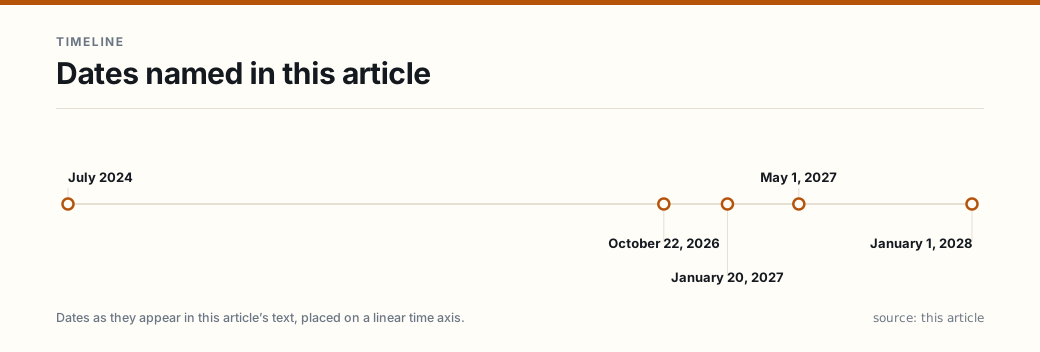
On October 22, 2026, the Treasury Department and the IRS published two revenue procedures that, between them, rewrite how retirement-account mistakes get fixed. One of them — Revenue Procedure 2026-34 — updates the long-running program for employer plans. The other, Revenue Procedure 2026-33, creates something that did not exist before: a formal correction program for IRAs, called the IRA Compliance Resolution System, or ICRS.
It is narrower than the headlines suggest, and more expensive. ICRS covers four specific failures, most of them only when a service provider caused the problem, charges $3,500 for a regular submission, and does not open until May 1, 2027. Here is what is actually in it, what it leaves out, and which of the free routes already on the books is the better answer for most people.
What the two procedures do, in one table
| Revenue Procedure 2026-33 | Revenue Procedure 2026-34 | |
|---|---|---|
| Program | IRA Compliance Resolution System (ICRS) | Employee Plans Compliance Resolution System (EPCRS) |
| Covers | Traditional, Roth, SEP and SIMPLE IRAs | 401(a) plans, 403(b) plans, SEP arrangements, SIMPLE IRA plans |
| Who applies | The IRA custodian or the IRA owner | The plan sponsor |
| Effective | May 1, 2027 | October 22, 2026 (generally) |
| Replaces | Nothing — it is new | Rev. Proc. 2021-30 |
The statutory hook is section 305(c) of the SECURE 2.0 Act of 2022, which told the Treasury Secretary to expand EPCRS so that IRA custodians could address “eligible inadvertent failures” in IRAs. The IRS did that by building a separate program rather than folding IRAs into EPCRS, which is why there are two procedures and two sets of rules.
The four mistakes ICRS will fix
ICRS is closed by design. Section 4.01 says the program is available only for the failures listed in Appendix A, and “at this time” not for anything else. There are four:
- An RMD failure — the year’s required minimum distribution came out short because a service provider failed to distribute it.
- An IRA establishment failure — you asked for a traditional IRA and, because of a provider error, got a Roth IRA, or a non-IRA account.
- A nonspouse beneficiary distribution or rollover failure — a provider told an inherited-IRA beneficiary, incorrectly, that a distribution could be rolled over, so the money came out and became taxable.
- A 60-day rollover failure — an eligible rollover distribution missed the 60-day window, and failing to waive the deadline would be against equity or good conscience.
For the first three, the definition carries a condition that decides most real cases: the failure must have been caused by a service provider — and, for the RMD and establishment failures, the provider must also have had “established practices and procedures” reasonably designed to keep the account compliant, routinely followed, with the failure occurring through an oversight in applying them. The fourth is different: section 2 of Appendix A says a 60-day rollover failure “does not need to have occurred due to an error by a Service Provider.”
That distinction is the whole ballgame. A missed RMD because you forgot is not an ICRS failure. A missed RMD because your custodian’s distribution calendar was wrong may be. And a contribution you made in the wrong amount is not on the list at all.
Which makes the first question a timing question: an RMD only exists once you reach your applicable age, and for a traditional IRA that age now depends on your birth year — 73 for most people born from 1951 through 1958, 75 from 1960 on, and for the 1959 birth year a July 2024 proposed rule would fill the blank at 73, which the regulation has not yet been amended to say. Our Roth-versus-traditional comparison walks through the birth-year table, because a failure cannot exist in a year before distributions were required.
What a correction buys you
If the IRS accepts the submission, it issues a compliance statement, which is binding on the IRS and on the applicant, and the agency will not treat the IRA as having failed the IRA requirements because of that error. The correction itself has to restore the account to the position it would have been in — missed RMDs distributed with earnings, for example, calculated year by year off the adjusted account balance.
The submission can also carry requests for relief from three separate taxes:
- Section 4973 — the 6% excise tax on excess contributions that stayed in the account.
- Section 4974 — the excise tax on a shortfall in required distributions. That one is 25% of the shortfall under current law, reduced to 10% if the shortfall is distributed and reported inside the statutory correction window.
- Section 72(t) — the 10% additional tax on an early distribution, where the distribution is being returned to the IRA.
Each of those is discretionary. You have to ask for it in the submission and explain why, and the IRS decides whether to pursue the tax. If it decides not to, the relief is written into the compliance statement.
The price, stated plainly
For submissions filed before January 1, 2028:
- $3,500 for a regular submission.
- $10,000 for a custodian’s group submission covering the first ten affected IRA owners, plus $250 for each additional owner, with a $50,000 cap.
- Submitted on Pay.gov using Form 15443. The initial fee is due when you file; on a group submission the per-owner additions are due when the custodian signs and returns the compliance statement.
From 2028 the fees move to the annual employee-plans revenue procedure, which is the IRS’s way of saying they will be revisited.
Before you pay $3,500, check the free routes
Here is the part the announcement does not stress. Section 3.03 of Revenue Procedure 2026-33 says IVCP — the only program inside ICRS today — is generally not available to correct failures that can be corrected under the Code and regulations already. But it then carves out two exceptions, and they cover two of the four failures above: an RMD shortfall that could be waived at no fee under Treas. Reg. § 54.4974-1(g) on Form 5329, and a 60-day rollover that could be self-certified or automatically waived. For both, the IRS says a submission is still allowed. So the $3,500 route overlaps with the free ones rather than sitting behind them — which means the question is not whether you may file, but whether you need the written statement.
Four routes already cost nothing:
- A timely corrective distribution. Under section 408(d)(4), a contribution taken back out on or before the due date of your return (including extensions), with its net earnings and with no deduction claimed for it, is treated by section 4973(b) as an amount not contributed — so the 6% excise tax never attaches. This is the fix for a plain over-contribution.
- Self-certification of a late rollover. Revenue Procedures 2016-47 and 2020-46 let you certify your own reason for missing the 60 days, on a written self-certification, at no cost.
- Automatic waivers. Revenue Procedure 2003-16 still waives the 60-day rule in defined situations without any filing.
- The RMD waiver on Form 5329. Section 4974(d) lets the IRS waive the excise tax where the shortfall was due to reasonable error and reasonable steps are being taken to fix it. Separately, the tax itself falls from 25% to 10% if you distribute the shortfall and file a return reflecting it inside the statutory correction window. The waiver request runs through Form 5329, with no user fee.
Paying for a compliance statement makes sense when the amount at stake is large, when a custodian or beneficiary needs the IRS’s written position to unwind a transaction, or when the free routes are already gone.
The sleeper: 60-day rollover requests move out of the letter-ruling queue
The change with the widest reach is procedural. Requests to waive the 60-day rollover deadline currently go in as private letter ruling requests under Rev. Proc. 2026-4. ICRS takes them over:
- 2027: you can file under either ICRS or the 2027 letter-ruling procedure (Rev. Proc. 2027-4, expected in the 2027-1 Internal Revenue Bulletin).
- 2028 onward: the IRS anticipates that ICRS will be the only route.
For a 60-day rollover failure, the applicant must be the IRA owner — a custodian cannot file on your behalf — and the IRS weighs the facts it has always weighed: errors by a financial institution, death, disability, hospitalization, incarceration, restrictions imposed by a foreign country, postal error, whether a check was actually cashed, and how much time has passed. Two limits do not move: the rollover cannot exceed the amount distributed, and the one-rollover-per-year rule still applies to IRA-to-IRA rollovers (trustee-to-trustee transfers and Roth conversions are outside it).
The gates that can shut you out
- Under examination. If your Form 1040 series return or Form 1041 for any year is under examination, IVCP is generally unavailable. The exception carved out is narrower than it looks: a 60-day rollover waiver may still be granted under section 4 of Rev. Proc. 2020-46 if the IRS determines that you qualify.
- Current filing. You must currently be in compliance with your filing obligations to be included in a submission.
- Open years only. Refunds are available only for open taxable years. If the refund statute expires while your submission is pending, you lose the refund for that year unless a protective claim was filed — and filing under IVCP does not extend the statute.
- A hard deadline for establishment failures. A submission to fix an IRA that was set up as the wrong type will not be accepted after December 31 of the year following the year the incorrect account was opened.
- Clock after approval. The compliance statement sets a deadline that binds every applicant, not just custodians: the corrections must be implemented within 90 days of its date (150 days for a group submission), and an extension has to be requested in writing before the window closes and be approved by the IRS. For a custodian, two extra clocks run: the signed statement has to go back within 21 calendar days, and the 90- or 150-day correction period is then measured from the signed statement — only the IRAs actually corrected inside that window end up covered.
If the mistake was in a 401(k), the boundary runs through the rollover
Plan administration failures — a missed deferral, a botched vesting schedule, an overpayment — stay inside EPCRS, and there the applicant is the plan sponsor, not the participant. Rev. Proc. 2026-34 modifies and supersedes Rev. Proc. 2021-30 and is generally effective October 22, 2026. It folds in changes required by SECURE 2.0 sections 301, 305 and 350, including the overpayment-recovery rules and the safe harbor for correcting elective deferral failures. If your plan made the error, the useful move is to ask the plan administrator, in writing, how it is correcting the failure.
The 60-day rollover waiver is the exception that crosses over. ICRS takes waiver requests for eligible rollover distributions from IRAs and from section 401(a) plans, 403(a) annuity plans, 403(b) tax-sheltered annuities and governmental 457(b) plans — and for that failure the applicant has to be the individual, not an IRA custodian. So a late rollover of a 401(k) distribution is your filing; a plan that calculated your balance wrong is not.
What to do, in order
- Identify the failure precisely and put a date on it. “My IRA is wrong” cannot be matched to a program; “the 2024 RMD was $4,000 short” can.
- Check who caused it. If it was your own arithmetic, the ICRS list probably does not reach it — go to the free routes instead.
- Use the free route if one exists — corrective distribution before the due date, self-certification for a late rollover, Form 5329 for an RMD shortfall.
- Write to the custodian before filing anything. The procedure itself recommends that an IRA owner confirm with the custodian that it can actually implement the correction; a compliance statement you cannot execute is $3,500 spent for nothing.
- If you do file, file after May 1, 2027, on Form 15443 through Pay.gov, and ask for the specific tax relief in the submission rather than assuming it.
Both revenue procedures are long and written for practitioners, not taxpayers. If you want the primary documents rather than a summary, they are linked in the source list below and in our resources library.
Bottom line
The new IRA program is real, but it is a narrow instrument: four failures, mostly requiring a provider’s error, $3,500 a submission, and no self-correction inside it at this time. For most IRA mistakes the cheapest fix is still the one that already existed — take the money out on time, certify your own late rollover, or file Form 5329. What changed on October 22 is that the IRS has finally put a price and a procedure on the cases those routes cannot reach. Comments on both procedures are due January 20, 2027, and the IRS says future versions may add failures, so the list is worth re-reading before you file.
This article explains federal tax procedure in general terms; it is not tax advice or a substitute for a preparer’s review of your own return. Penalty amounts and program rules here are federal — state income tax treatment of the same distribution can differ, and a few states impose their own excise or reporting rules.
Frequently asked questions
- Does the new program let me fix my own IRA mistake?
- Only if the mistake is one of four listed failures, and for three of them a service provider — usually the custodian or an adviser — has to have caused it. A contribution you simply made in the wrong amount is not on the list, and the revenue procedure says self-correction is not available under the new system yet.
- How much does a correction cost?
- $3,500 for a regular submission filed before January 1, 2028, paid through Pay.gov with Form 15443. A custodian filing on behalf of a group of IRA owners pays $10,000 for the first ten owners, $250 for each additional owner, and no more than $50,000.
- When does the program open?
- May 1, 2027. For 2027, a request to waive the 60-day rollover deadline can go through either the new system or the private letter ruling process; from 2028 the IRS anticipates the new system will be the only route.
- Is there a free way to fix a missed required minimum distribution?
- Often yes. If the shortfall was due to reasonable error and you are taking steps to fix it, you can ask the IRS to waive the excise tax under section 4974(d) on Form 5329 without paying the $3,500 fee. Separately, the tax falls from 25% to 10% if you distribute the shortfall and file a return reflecting the reduced tax inside the statutory correction window. The new program is for cases where the custodian caused the miss and you want the IRS to say so in writing.
Sources
Each source is a primary or official reference, checked before publication. Links open the original.
- Internal Revenue Service — news release IR-2026-126, 'Treasury, IRS update retirement plan correction program and establish correction program for individual retirement accounts' (October 22, 2026): irs.gov/newsroom/treasury-irs-update-retirement-plan-correction-program-and-establish-correction-program-for-individual-retirement-accounts
- Revenue Procedure 2026-33, 'IRA Compliance Resolution System' (October 22, 2026), 59 pages — the operative text: eligible failures in section 2 and Appendix A, the $3,500 and group fee schedule in section 7, the May 1, 2027 effective date in section 10 — irs.gov/pub/irs-drop/rp-26-33.pdf
- Revenue Procedure 2026-34 (October 22, 2026), 133 pages — the rewritten Employee Plans Compliance Resolution System; section 14 supersedes Rev. Proc. 2021-30 and section 15 sets the general effective date of October 22, 2026 — irs.gov/pub/irs-drop/rp-26-34.pdf
- 26 U.S.C. § 4974 — 25% excise tax on a missed required minimum distribution, reduced to 10% when the shortfall is distributed and reported inside the statutory correction window; subsection (d) allows a waiver for reasonable error (law.cornell.edu/uscode/text/26/4974)
- 26 U.S.C. § 4973 — 6% excise tax on excess contributions to an IRA, capped at 6% of the account's value, with the rule that a contribution distributed under section 408(d)(4) is treated as an amount not contributed (law.cornell.edu/uscode/text/26/4973)
- 26 U.S.C. § 408(d)(3)(I) — the Secretary's authority to waive the 60-day rollover requirement where failing to do so would be against equity or good conscience; § 408(d)(4) — distribution of a contribution before the return's due date (law.cornell.edu/uscode/text/26/408)
- Public Law 117-328, Division T (SECURE 2.0 Act of 2022), including section 305(c), which directs the Treasury Secretary to expand the Employee Plans Compliance Resolution System so IRA custodians can address eligible inadvertent failures: govinfo.gov/content/pkg/PLAW-117publ328/html/PLAW-117publ328.htm
- Internal Revenue Service — 'Correcting Plan Errors', the landing page for the employee-plan correction programs (irs.gov/retirement-plans/correcting-plan-errors)
- Internal Revenue Service — 'Retirement Plans FAQs Relating to Waivers of the 60-Day Rollover Requirement', covering the automatic waivers and the self-certification procedure that remain free (irs.gov/retirement-plans/retirement-plans-faqs-relating-to-waivers-of-the-60-day-rollover-requirement)
- Internal Revenue Service — 'Required Minimum Distributions' proposed rule, FR Doc. 2024-14543 (July 19, 2024), which would fill the reserved paragraph 26 C.F.R. § 1.401(a)(9)-2(b)(2)(v) with age 73 for an employee born in 1959: federalregister.gov/documents/2024/07/19/2024-14543/required-minimum-distributions
- Internal Revenue Service — Publication 590-B, Distributions from Individual Retirement Arrangements (IRAs), for the required-minimum-distribution rules and the Form 5329 waiver procedure it points to (irs.gov/pub/irs-pdf/p590b.pdf)