The IRS published its 2027 numbers: what moved, what stayed frozen, and the December choices that turn on it
The IRS set 2027 brackets, standard deduction and gift limits on November 5. What moved, what stayed frozen, and the December choices that turn on it.
The Internal Revenue Service (IRS) published the tax year 2027 inflation adjustments on November 5, 2026 in Revenue Procedure 2026-35, announced by news release IR-2026-133 — almost 70 provisions, from the standard deduction to the Section 179 expensing cap. The figures generally apply to tax years beginning in 2027, which means the returns most people file in 2028, not the 2026 return they will file in early 2027. That single distinction is where most of the confusion around this announcement starts, and it decides which of the numbers below you can use in December.
What did the IRS actually publish?
Two documents, and they do different jobs. IR-2026-133 is the readable summary — the standard deduction, the rate thresholds, the Child Tax Credit, the estate and gift amounts. Revenue Procedure 2026-35 is the operative determination: 32 pages of tables, including the base tax amount for each bracket so a filer can compute liability without re-adding the slices, and the smaller items most coverage omits (§ 199A thresholds, the § 448(c) gross receipts test, the education loan interest phase-out).
Three mechanics matter more than any single figure:
- The adjustment is indexation, not legislation. The seven rates — 10%, 12%, 22%, 24%, 32%, 35%, 37% — are unchanged, and 37% is still the top rate. What moved is the income level where each rate begins.
- Most items follow the tax year; a few follow the calendar year. Section 4 of the revenue procedure says the general rule is taxable years beginning in 2027, with a calendar-year rule for specific sections. Gift and estate amounts are calendar-year items, which is why the 2027 gift limit is already published while December 2026 gifts still use the 2026 limit.
- Nothing here is retroactive. The 2026 return filed in spring 2027 is a 2026 return and uses 2026 figures throughout.
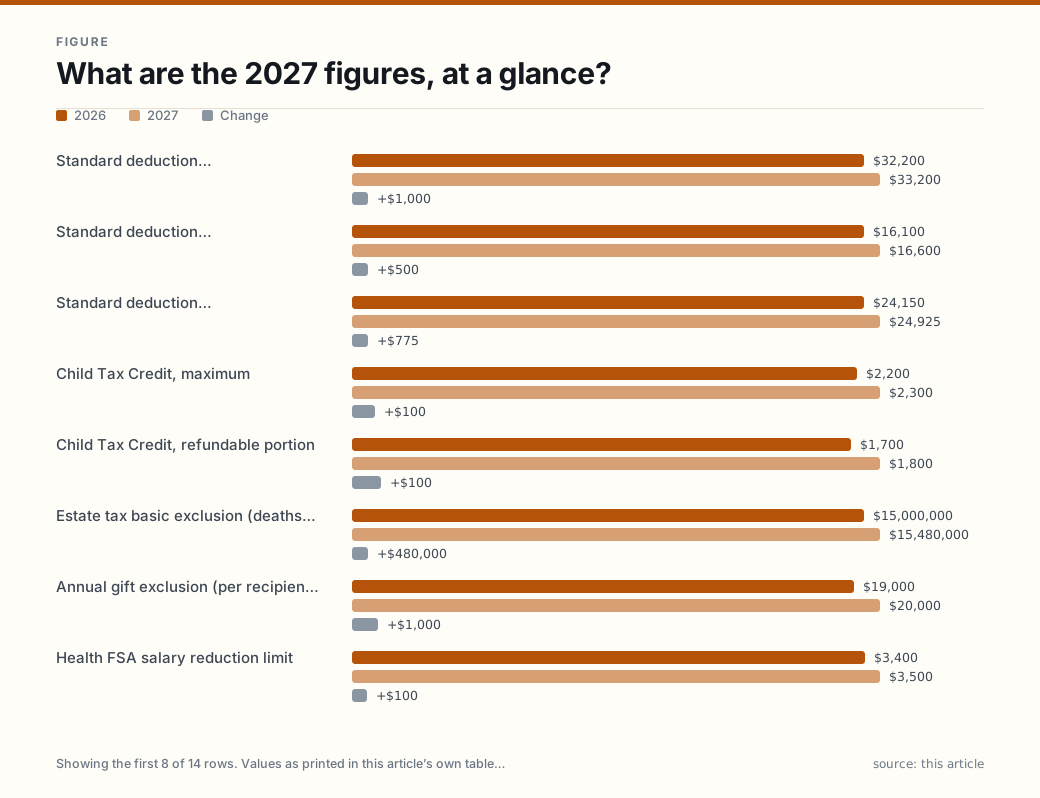
What are the 2027 figures, at a glance?
| Item | 2026 | 2027 | Change |
|---|---|---|---|
| Standard deduction, married filing jointly | $32,200 | $33,200 | +$1,000 |
| Standard deduction, single and married filing separately | $16,100 | $16,600 | +$500 |
| Standard deduction, head of household | $24,150 | $24,925 | +$775 |
| Top rate (37%) starts at, joint / single | $768,700 / $640,600 | $793,650 / $661,375 | +3.2% / +3.2% |
| Child Tax Credit, maximum | $2,200 | $2,300 | +$100 |
| Child Tax Credit, refundable portion | $1,700 | $1,800 | +$100 |
| AMT exemption, single / joint | $90,100 / $140,200 | $93,000 / $144,700 | +3.2% / +3.2% |
| Estate tax basic exclusion (deaths in that year) | $15,000,000 | $15,480,000 | +$480,000 |
| Annual gift exclusion (per recipient) | $19,000 | $20,000 | +$1,000 |
| Health FSA salary reduction limit | $3,400 | $3,500 | +$100 |
| Health FSA carryover maximum | $680 | $700 | +$20 |
| Qualified parking / transit fringe, monthly | $340 | $350 | +$10 |
| Section 179 expensing limit | $2,560,000 | $2,640,000 | +$80,000 |
| Earned Income Tax Credit, maximum (three or more children) | $8,231 | $8,496 | +$265 |
| Adoption credit, maximum | $17,670 | $18,250 | +$580 |
| Foreign earned income exclusion | $132,900 | $137,300 | +$4,400 |
The 2026 column is the comparison the IRS itself uses in the release (“up $1,000 from 2026”, and so on). Where the release states only the change rather than both years — the Child Tax Credit and the FSA figures — the 2026 amount is that change subtracted from the 2027 amount. The 2026 standard deduction and rate thresholds come from the agency’s own summary page for the Working Families Tax Cuts.
Where does each rate start in 2027?
| Rate | Single | Married filing jointly | Head of household |
|---|---|---|---|
| 10% | up to $12,800 | up to $25,600 | up to $18,250 |
| 12% | over $12,800 | over $25,600 | over $18,250 |
| 22% | over $52,025 | over $104,050 | over $69,650 |
| 24% | over $109,125 | over $218,250 | over $109,100 |
| 32% | over $208,325 | over $416,650 | over $208,300 |
| 35% | over $264,550 | over $529,100 | over $264,550 |
| 37% | over $661,375 | over $793,650 | over $661,350 |
The revenue procedure also carries the base tax for each step — for a joint return, $2,560 plus 12% of the excess over $25,600, rising to $213,290.50 plus 37% of the excess over $793,650 — so the liability can be read off the table instead of rebuilt from scratch. Those base amounts are internal to the table: recomputing the slices by hand has to produce the same answer, which is a useful self-check if you are working from a spreadsheet.
Two capital-gains breakpoints are worth filing away, one per rate band: for 2027 the 0% rate on long-term gains runs to $102,100 of taxable income for a joint return and $51,050 for a single filer, and the 15% rate runs to $633,600 and $563,200 respectively before the 20% rate applies. The arithmetic of which gains fall in which band is covered in capital gains basics.
What is a 3% shift in the brackets actually worth?
Take a single filer with $120,000 of wages, the standard deduction, and no other items. The bracket arithmetic, done explicitly:
- 2026: taxable income $120,000 − $16,100 = $103,900. Tax = $12,400 × 10% ($1,240) + $38,000 × 12% ($4,560) + $53,500 × 22% ($11,770) = $17,570.
- 2027: taxable income $120,000 − $16,600 = $103,400. Tax = $12,800 × 10% ($1,280) + $39,225 × 12% ($4,707) + $51,375 × 22% ($11,302.50) = $17,289.50.
Difference: $280.50 a year, about 0.23% of the salary. That is the honest size of the adjustment for a household in the middle of the 22% band. It restores the purchasing power inflation took out of the bracket edges; it does not leave anyone ahead. Coverage that frames these figures as a tax cut is describing indexation as though it were a policy choice.
The same arithmetic explains why the adjustment only matters at the margins. Inside a band, a dollar is taxed at the same rate in 2026 and 2027 — the rate did not change. What changed is where the band ends. A filer whose 2026 taxable income sits just above the 24% threshold of $105,700 gains $3,425 of room in 2027, because that threshold moves to $109,125. Income moved from 2026 into 2027 within that $3,425 window is taxed at 22% instead of 24%, which is worth up to $68.50. Real, calculable, and small — the reason a deferral decision should be made on the size of a specific slice, not on the headline that “brackets went up.”
What didn’t move — and who does it catch?
Three items sit outside the annual adjustment. The middle one gets the least coverage, and in our reading it is the one that most often surprises tuition-paying households.
- The personal exemption stays at $0. The Tax Cuts and Jobs Act of 2017 zeroed it; IR-2026-133 states that the Working Families Tax Cuts made the elimination permanent. The separate senior deduction added by that law is a different provision with its own phase-out — $6,000 per eligible individual age 65 or older, available for tax years 2025 through 2028, phasing out above $75,000 of modified adjusted gross income ($150,000 on a joint return) — and it is not what “personal exemption” refers to.
- The Lifetime Learning Credit phase-out has not been indexed since 2020. The credit still phases out between $80,000 and $90,000 of modified adjusted gross income ($160,000 to $180,000 on a joint return). Because the thresholds are frozen while incomes and the brackets around them rise, the share of households above the frozen ceiling tends to grow every year without any legislator voting for it. If you are near those figures and paying tuition, that is a reason to check the credit before assuming it applies.
- The Child Tax Credit phase-out is statutory, not indexed here. The maximum credit rises to $2,300 and the refundable portion to $1,800, but the income levels where the credit starts to shrink are set in 26 U.S.C. § 24(b) and are not among the items this revenue procedure adjusts. A raise that tracks inflation can therefore reduce the credit even as the maximum rises.
One more asymmetry worth naming: the release confirms that the elimination of the limitation on itemized deductions was made permanent, but that the Working Families Tax Cuts “imposes a limitation on the tax benefit from itemized deductions for those taxpayers in the highest tax bracket (37%).” In plain terms, at the top of the schedule an itemized deduction no longer returns the full marginal rate. The release does not publish how large that reduction is, and it is not one of the almost 70 items this revenue procedure sets, so it cannot be quantified from this announcement — the formula sits in the statute.
Which December choices do these numbers actually touch?
1. A gift completed in 2026 uses the 2026 limit. The annual exclusion is a calendar-year amount: $19,000 per recipient for gifts made in 2026, $20,000 for 2027. It is also per donor, so a married couple splitting gifts can give $38,000 to one recipient in 2026 without touching the lifetime exclusion — and across, say, four children and their spouses, $304,000 in 2026 versus $320,000 in 2027. Anyone planning a year-end gift should date the transfer in the year they intend to use, because the exclusion belongs to the year the gift is complete, not the year the paperwork is filed. The mechanics, including the Form 709 filing rule, are in estate planning basics.
2. An estate is measured at the date of death. $15,000,000 for a 2026 death, $15,480,000 for 2027. Nothing can be elected into a different year, which makes this the one figure on the list with no December decision attached — and the reason portability elections matter more than the threshold for most families.
3. Health FSA elections made now price 2027. Many employer plans hold open enrollment in the fall, which is where the 2027 FSA limit enters a decision made in 2026: the salary reduction limit for plan years beginning in 2027 is $3,500, with a $700 carryover where the plan permits one. Two cautions: a plan with a non-calendar plan year follows its own plan year for the limit, and a carryover is a plan feature, not a right. Employer-plan enrollment is also a different window from the ACA Marketplace’s, and the two get conflated every autumn — the 2027 subsidy rules are set out in the ACA subsidy cliff. Whether an FSA beats an HSA for a given household is a separate question, worked through in the HSA comparison.
4. Businesses get a bigger Section 179 room, and a phase-out to watch. The 2027 expensing limit is $2,640,000, reduced dollar for dollar once qualifying purchases exceed $4,230,000; the SUV cap is $33,100. The § 199A threshold for a joint return is $416,600 with a phase-in range ending at $566,600. These are planning inputs for 2027 purchases, not a reason to buy equipment in December 2026.
None of these figures require an action, a claim, or a verification call. No agency calls a taxpayer to “confirm” a tax figure, and an unsolicited message that asks you to do so is following the impersonation pattern catalogued in the America.gov scam checklist.
What should you do between now and January?
- Separate the two years on paper. Anything you do before December 31, 2026 belongs to the 2026 column; the 2027 numbers describe a return you will not file until 2028. Our year-end money moves sorts which deadlines are real from which can wait.
- Make the FSA election with the $3,500 limit, and check whether your plan’s carryover applies to the balance you are projecting, not the balance you had last year.
- If a deferral decision is on the table, size the slice first. The gain is capped by the width of the band that moved — $3,425 in the 24% bracket for a single filer — not by your income.
- Read the primary document for anything that matters. Revenue Procedure 2026-35 is a public PDF, and each figure sits in a numbered section (§ 3.15 for the standard deduction, § 3.01 for the rate tables, § 3.26 for expensing) that can be cited back to the page.
Bottom line
On November 5, 2026 the IRS indexed almost 70 provisions for tax year 2027: the joint standard deduction reaches $33,200, the 37% rate starts at $661,375 for a single filer, the annual gift exclusion reaches $20,000, and the estate exclusion reaches $15,480,000 for 2027 deaths — amounts that apply to returns filed in 2028, while December 2026 decisions still run on the 2026 figures.
This article explains federal tax figures published by the IRS in general terms; it is not personal tax advice, and it does not account for state conformity, which varies by state. Figures are federal and apply to tax years beginning in 2027 unless a calendar-year rule is stated.
Frequently asked questions
- Do the 2027 numbers apply to the return I file in April 2027?
- No. The return filed in early 2027 reports tax year 2026 and uses the 2026 figures — a $32,200 standard deduction for a married couple filing jointly, for example. The 2027 amounts in Revenue Procedure 2026-35 generally apply to returns filed in 2028.
- Did the tax rates change for 2027?
- No. The seven rates — 10%, 12%, 22%, 24%, 32%, 35% and 37% — are unchanged, and 37% remains the top rate. What the IRS adjusted is the income level at which each rate starts, which rises by roughly 3% for 2027.
- How much does the adjustment actually save a typical single filer?
- On $120,000 of wages with the standard deduction, the federal income tax falls from $17,570 under 2026 figures to $17,289.50 under 2027 figures — $280.50 less, or about 0.23% of the salary. The adjustment offsets inflation in the brackets; it is not a rate cut.
- What is the annual gift exclusion for 2027?
- $20,000 per recipient, up from $19,000 for 2026. The limit is set by calendar year, so a gift completed in December 2026 still uses the $19,000 figure even though the 2027 number has already been published.
- Is the estate tax exclusion now permanent?
- The 2027 basic exclusion amount is $15,480,000 for estates of people who die in 2027, up from $15,000,000 for 2026 deaths. The $15 million base was set in statute for 2026 and is indexed from there; the IRS release does not describe the 2027 figure as permanent, and future Congresses can change the underlying statute.
- Does the adjustment change the Child Tax Credit phase-out?
- Not in this revenue procedure. The maximum credit rises to $2,300 with $1,800 refundable, but the income levels at which the credit phases out are fixed in the statute (26 U.S.C. § 24(b)) and are not among the almost 70 items Revenue Procedure 2026-35 adjusts.
Sources
Each source is a primary or official reference, checked before publication. Links open the original.
- Internal Revenue Service — news release IR-2026-133, 'IRS releases tax inflation adjustments for tax year 2027; taxpayers continue to benefit from the Working Families Tax Cuts' (November 5, 2026): the standard deduction, rate schedules, Child Tax Credit, AMT, estate and gift amounts, Section 179, adoption credit, EITC, transportation fringe and health FSA figures — irs.gov/newsroom/irs-releases-tax-inflation-adjustments-for-tax-year-2027-taxpayers-continue-to-benefit-from-the-working-families-tax-cuts
- Internal Revenue Service — Revenue Procedure 2026-35 (released November 5, 2026), the full 32-page determination: the four rate tables with their base tax amounts, the capital gains breakpoints, the kiddie tax amount, the § 199A thresholds, the § 448(c) gross receipts test, the § 461(l) excess business loss limit, the education loan interest phase-out and the effective-date rule in section 4 — irs.gov/pub/irs-drop/rp-26-35.pdf
- Internal Revenue Service — 'Working Families Tax Cuts — Individuals and workers', the agency's summary page carrying the tax year 2026 standard deduction ($32,200 joint, $16,100 single, $24,150 head of household), the 2026 rate thresholds and the 2026 AMT exemptions used here as the comparison year — irs.gov/newsroom/one-big-beautiful-bill-provisions-individuals-and-workers
- Internal Revenue Code — 26 U.S.C. § 1(j) (the rate tables and the inflation adjustment mechanism), § 24 (Child Tax Credit), § 63(c) (standard deduction), § 179(b) (expensing limit and phase-out), § 2010(c)(3) (basic exclusion amount) and § 2503(b) (annual gift exclusion) — uscode.house.gov
- Internal Revenue Service — 'Frequently asked questions on gift taxes', for the rule that the annual exclusion applies per recipient per calendar year and that the basic exclusion amount is set at $15,000,000 for calendar year 2026 by Public Law 119-21 — irs.gov/businesses/small-businesses-self-employed/frequently-asked-questions-on-gift-taxes