The new opportunity zones open January 1, 2027, and the deferral is now five years
Treasury designated 6,576 opportunity zone tracts on November 5, 2026. Money invested after December 31 gets a five-year deferral and a 10% or 30% step-up.
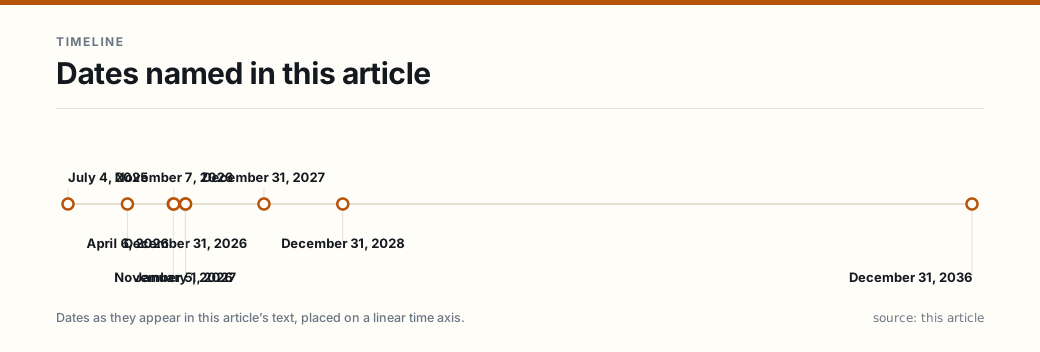
On November 5, 2026, the Treasury Department and the Internal Revenue Service designated 6,576 census tracts across all 50 states, the territories and the District of Columbia as Qualified Opportunity Zones (QOZs), for a ten-year term beginning January 1, 2027 — and the tax deferral those zones unlock applies to money invested after December 31, 2026, not before. That date, not the designation, is the one that decides which set of rules your money gets.
The designations themselves are simple. The transition is not, because two rulebooks are running at once and one widely linked IRS page still describes the older one.
What did Treasury actually designate?
The release, numbered IR-2026-132, is short and the numbers in it are worth reading closely, because several of them are easy to confuse:
| Item | Figure |
|---|---|
| Eligible tracts published for nomination, April 6, 2026 | 25,332 (8,334 of them rural) |
| Additional eligible tracts added during the nomination window | 130 (28 rural) |
| Tracts nominated by governors and the Mayor of the District of Columbia | 6,576 (2,594 rural) |
| Tracts designated | all 6,576 |
| Effective date | January 1, 2027 |
| Designation term | ten years, through December 31, 2036 |
| Private investment in the program since 2017, per Treasury | more than $110 billion |
Two things about that table are easy to misread. The national total is not a national merit ranking: section 1400Z-1(d) caps designations at 25% of a state’s low-income communities, with a floor of 25 tracts for a state with fewer than 100 of them, so 6,576 is the sum of separate state and territorial choices made inside that ceiling. And the rural share is higher than the rural share of the menu — 39.4% of designated tracts are rural (2,594 of 6,576), against 32.9% of the eligible list (8,334 of 25,332) — which reflects both the nomination patterns and the enhanced rural benefit the 2025 law added.
One point that is routinely reported wrong: a designation is not an award, a grant, or a certification of anything. It is a line on a census map that makes a set of tax rules available to investments made inside it.
Which rules apply depends on one date — which one?
This is the part worth slowing down for. The law that renewed the program — enacted July 4, 2025 as Public Law 119-21, called the Working Families Tax Cuts in the Treasury release and the One Big Beautiful Bill Act in the IRS notice — applies its changes to amounts invested in a qualified opportunity fund after December 31, 2026. The statute’s effective date is written around the date of the investment, not the date the zone was designated.
So there are two regimes, and the dividing line runs through the middle of the 2026 tax year:
| Money invested on or before Dec 31, 2026 | Money invested after Dec 31, 2026 | |
|---|---|---|
| When the deferred gain is included | The year containing the earlier of an inclusion event or December 31, 2026 | The year containing the earlier of a sale, another inclusion event, or five years from the investment |
| Basis increase at 5 years | not available to new money — the old 5% and 10% step-ups were tied to investment dates that have passed | 10% of the deferred gain, 30% for a qualified rural opportunity fund |
| Basis increase at 7 years | 5% under the old text, which the 2025 amendment removed for post-2026 money | none |
| Ten-year election | available | available; the amended text caps it at 30 years |
Read the first row carefully, because it inverts the intuition. Investing in December 2026 buys almost no deferral at all: the gain comes back into income in the year that includes December 31, 2026, which for most people is the same year they realized it. The deferral people associate with opportunity zones now belongs to money invested from January 2027 onward, and it runs a fixed five years from the investment. The old regime’s deferral ended on one date — December 31, 2026 — for everybody, however early they invested; the new one ends five years out, and it comes with a step-up that new money previously could not reach.
Can you still use a gain you realized in 2026?
The election must be made within 180 days of the sale or exchange, and the 180 days do not have to end before January 1, 2027.
Notice 2026-40 addresses exactly this case. If the gain was realized on or before December 31, 2026 but the investment is made on or after January 1, 2027, the deferral election can still be made after that date, and the gain is included at the earlier of a sale, another inclusion event, or five years from the investment. A gain realized in, say, November 2026 therefore has a window running into 2027 — and money put in during that window is treated as 2027 money.
Three conditions ride along, all of them in the statute and the IRS investor guidance: the sale or exchange must be to an unrelated person, the investment must be equity in the fund, not debt, and where you contribute property instead of cash the deferrable amount is limited to the basis of what you contribute, even if the property is worth more. The gain has to be a capital gain or a qualified section 1231 gain recognized for federal income tax purposes.
Note the one place this does not reach. There is a category the notice calls deemed included gain, arising when a deferral ends, and that amount cannot itself be deferred again into a new fund. The rollover stops there. The notice adds that the ten-year election under section 1400Z-2(c) is not affected by that limit — the exclusion of appreciation is a separate benefit from the deferral.
What does the deferral actually save?
Deferral is not forgiveness, and the difference is where most of the disappointment lives. A worked example, using a $100,000 long-term gain invested in January 2027:
| Standard fund | Qualified rural fund | |
|---|---|---|
| Gain deferred | $100,000 | $100,000 |
| Basis increase after 5 years | $10,000 (10%) | $30,000 (30%) |
| Amount included in income at year 5 | $90,000 | $70,000 |
| Tax on that amount | at the rates and brackets in force in that year | same |
| Appreciation after the investment | excluded if held ten years and the (c) election is made | same |
Two things follow. The step-up is real money — it permanently removes $10,000 or $30,000 of the original gain from tax — but it is a fraction of the gain, not the gain. And the deferral ends on a fixed date, five years out, whether or not you have sold the fund interest. If the investment has not worked by then, you owe tax on a gain you deferred from an asset that may since have fallen. That is the risk the arrangement actually carries, and it does not appear in the marketing.
The qualified rural opportunity fund in the right-hand column is a defined term, not a label a manager can adopt: under section 1400Z-2(b)(2)(C) it must hold at least 90% of its assets in opportunity zone property located in a rural area, and the same subsection writes the rural test around population — areas outside a city or town of more than 50,000 people, and outside any urbanized area contiguous and adjacent to one. Ask a fund to show which definition it is relying on. Notice 2025-50 sets a separate substantial-improvement standard for property in rural areas, and it is the notice to read if a project involves renovating an existing building rather than building new.
Does the ten-year exclusion still work?
The largest benefit in the program was never the deferral. It is section 1400Z-2(c): hold the investment at least ten years and elect to treat its basis as equal to fair market value on the date of sale, which excludes the appreciation earned during those ten years.
The 2025 amendment kept that and added a limit. The election now produces fair market value on the sale date only if the sale happens within 30 years of the investment; sell later and the basis is fixed at fair market value on the 30-year date, so appreciation after that point is taxed. For an investor, the practical reading is that the ten-year horizon is a floor and thirty years is a ceiling, and both are long enough that the decision is really about whether the underlying project works.
How do you check a property against the zone list?
By census tract. A street address does not answer the question, because tract boundaries follow census geography and can run down the middle of a block.
- The CDFI Fund publishes the designated tract list and an interactive map; it is the link Treasury’s own release points to.
- Treasury’s data transparency page carries the eligible-tract list with each tract’s poverty rate and median family income.
- HUD hosts a separate map, useful as a second read when a boundary looks ambiguous.
Check the tract number on the designation file itself rather than a property listing, a broker’s map, or a fund’s own marketing material. And check the date: a tract designated for the 2027 round is not the same as a tract in the 2018 round, and the two have different end dates — December 31, 2028 for the 2018 round, December 31, 2027 for zones in Puerto Rico.
Two IRS pages now disagree — which is right?
Checked on November 7, 2026, the IRS page titled Invest in a Qualified Opportunity Fund still states the pre-2027 regime as the general rule: deferral until an inclusion event or December 31, 2026, eligible gains recognized before January 1, 2027, and an additional 5% basis increase at seven years. None of that is wrong for money invested by the end of 2026. It is simply silent about the regime that starts the next day, and the seven-year step-up it describes was removed for post-2026 money.
Notice 2026-40 is where the new rules are written down, and it is the page to read rather than the summary. The same habit is worth applying to any tax figure: if a page does not say which year it is describing, find the notice or revenue procedure behind it.
What a designation does not mean
Because “government-designated zone” is a phrase that sells, it is worth being blunt about what the designation is not.
- It is not an endorsement of any project, and it is not a finding that an investment is sound. The IRS describes the program as an economic development tool; nothing in the release evaluates a deal.
- It is not a change in zoning, building rules, or title. Those remain local.
- It is not a return. The tax benefit is a deferral plus a step-up; if the project loses money, the tax treatment does not make you whole.
- Neither Treasury nor the IRS markets funds or contacts investors about them. Both publish lists. An unsolicited call, message or social-media pitch that invokes an “opportunity zone allocation” is not a government program, and a request to move money quickly to hold a place in one is the standard shape of an investment fraud.
What should you do next?
- Establish the date first. If you are considering an investment in the next few weeks, understand that a December 2026 investment falls under the old regime and produces essentially no deferral. The planning question is a 2027 one.
- Check the tract, not the address, against the CDFI Fund list or Treasury’s data page, and note whether it belongs to the 2018 round or the 2027 round.
- Ask any fund three questions: is it a qualified opportunity fund, is it a qualified rural fund under section 1400Z-2(b)(2)(C), and what happens at the five-year inclusion date if the asset has not appreciated.
- Match the horizon to the money. This is a ten-year commitment for the main benefit, in an illiquid vehicle. Money you may need earlier is the wrong money, whatever the tax arithmetic says — the same principle that governs an emergency fund.
- Expect more guidance. Proposed regulations on information reporting and on fund certification and decertification (REG-116506-25) are pending, and Notice 2026-55 is a request for comments, which means some operational detail is not final.
What this page does not cover
This is federal income tax only. Whether your state conforms to the federal treatment of a deferred gain depends on its own law, and this page does not model it — a state that does not conform can tax the gain in the year you realized it, which removes much of the point. The page also does not model the interaction with the net investment income tax, state and local incentives layered on top of the zones, or the passive activity rules that apply to most fund structures. A deferred gain also changes the income figure that other thresholds read, including marketplace premium credits and Medicare premiums two years later, which is the same spillover described in our page on capital gains. The figures here are current as of November 7, 2026 and will need re-checking when the pending regulations are finalized.
Frequently asked questions
- How many opportunity zones are there now, and when do they start?
- 6,576 census tracts, designated by the Treasury Department and the IRS on November 5, 2026 (IR-2026-132). They take effect January 1, 2027 and hold that designation for ten years, through December 31, 2036. Of the total, 2,594 are in rural areas. The previous round of zones, designated in 2018, runs through December 31, 2028.
- Do I have to invest before December 31, 2026 to use the new rules?
- No — the opposite. The 2025 amendments apply to amounts invested in a qualified opportunity fund after December 31, 2026. Money invested on or before that date still falls under the old rules, where the deferred gain is included in income in the year that includes the earlier of an inclusion event or December 31, 2026. That leaves essentially no deferral for a December 2026 investment.
- I sold stock in 2026 and have not reinvested the gain. Is it too late?
- Not necessarily. The election has to be made within 180 days of the sale, and the rules that apply are keyed to the date you invest, not the date you sold. Notice 2026-40 addresses this case directly: a gain realized on or before December 31, 2026 but invested on or after January 1, 2027 gets the new treatment — inclusion at the earlier of a sale, another inclusion event, or five years from the investment.
- Is the tax on the deferred gain cancelled?
- No. Deferral moves the tax; it does not erase it. The deferred gain is included in gross income at the inclusion date and taxed under the rules in force that year, which nobody can know now. Three things reduce it: the basis step-up of 10% of the deferred gain after five years, 30% for a qualified rural opportunity fund; the exclusion of appreciation earned after the investment, if you hold ten years and make the election under section 1400Z-2(c); and any change in your bracket by the time of inclusion.
- How do I check whether a property is actually in a zone?
- By census tract, not by street address. The CDFI Fund publishes the designated tract list and map, and Treasury publishes the eligibility data with each tract's poverty rate and median family income. HUD hosts a separate map. A designation follows census geography, so two buildings on the same street can sit on different sides of the line, and a designation does not change zoning, building rules or title.
Sources
Each source is a primary or official reference, checked before publication. Links open the original.
- Internal Revenue Service and U.S. Department of the Treasury — news release IR-2026-132, 'Treasury, IRS Announce Opportunity Zones Designations for Over 6,500 Communities Across America', November 5, 2026: irs.gov/newsroom/treasury-irs-announce-opportunity-zones-designations-for-over-6500-communities-across-america
- Internal Revenue Service — Notice 2026-40, 'Transitional Guidance on Qualified Opportunity Zones', Internal Revenue Bulletin 2026-28 (July 6, 2026): the source for the 2027 deferral period, the 10% and 30% basis step-ups, the end dates of the 2018 round, the 'applicable start date' rule, and the 2047 transitional safe harbor — irs.gov/irb/2026-28_irb
- 26 U.S.C. section 1400Z-2 (designation of qualified opportunity zones; the 180-day investment window at subsection (a)(1); inclusion events at (b)(1); the 10% and 30% basis increases at (b)(2)(B) and the qualified rural opportunity fund definition at (b)(2)(C); the ten-year election and its 30-year cap at (c)), as amended by Public Law 119-21, title VII, section 70421, July 4, 2025 — law.cornell.edu/uscode/text/26/1400Z-2
- 26 U.S.C. section 1400Z-1 (the 25% per-state cap on designations at subsection (d)(1) and the 25-tract floor at (d)(2); the 10-year designation period measured from the applicable start date at (e); the decennial determination date of July 1, 2026 at (c)(2)(C)) — law.cornell.edu/uscode/text/26/1400Z-1
- Public Law 119-21, 'An act to provide for reconciliation pursuant to title II of H. Con. Res. 14' (H.R. 1), approved July 4, 2025: the enacted text behind the opportunity zone amendments in title VII, section 70421 — govinfo.gov/app/details/PLAW-119publ21
- Internal Revenue Service — 'Invest in a Qualified Opportunity Fund', the investor-facing summary page, which as of November 6, 2026 still states the pre-2027 rules (deferral until December 31, 2026; eligible gains recognized before January 1, 2027; an additional 5% basis increase at seven years) — irs.gov/credits-deductions/businesses/invest-in-a-qualified-opportunity-fund
- Internal Revenue Service — 'Opportunity zones', the program index page, listing Notice 2026-40, Revenue Procedure 2026-14 (nomination procedure), Notice 2025-50 (substantial improvement of property in rural areas), Notice 2026-55 (request for comments) and proposed regulations REG-116506-25 — irs.gov/credits-deductions/businesses/opportunity-zones
- Internal Revenue Service — Revenue Procedure 2026-14, 'Procedure for nominating census tracts to be designated as qualified opportunity zones', Internal Revenue Bulletin 2026-20: irs.gov/irb/2026-20_IRB
- CDFI Fund — designated Opportunity Zones list and map, linked from the November 5 release: cdfifund.gov/opportunity-zones
- U.S. Department of the Treasury — Qualified Opportunity Zones data transparency page, with the eligible-tract list, poverty rate and median family income by tract: home.treasury.gov/policy-issues/tax-policy/data-transparency/qualified-opportunity-zones
- U.S. Department of Housing and Urban Development — Opportunity Zones map: opportunityzones.hud.gov/resources/map
- Internal Revenue Service — Form 8949, Sales and Other Dispositions of Capital Assets (where the deferral election is made), and Form 8997, Initial and Annual Statement of Qualified Opportunity Fund (QOF) Investments (annual reporting): irs.gov/forms-pubs/about-form-8949 and irs.gov/forms-pubs/about-form-8997