The IRS will charge 8% interest from January 1, 2027 — what an unpaid balance costs
The IRS will charge 8% a year, compounded daily, on unpaid individual tax from January 1, 2027, up from 7%. What that costs, and how penalties stack on top.
For the calendar quarter beginning January 1, 2027, the Internal Revenue Service charges 8% a year, compounded daily, on unpaid individual tax — and pays the same 8% on refunds it is late in issuing. The rate is up from 7% for the quarter that ends December 31, 2026, and it is the highest the individual rate has been since the fourth quarter of 2024. The IRS announced it on November 24, 2026 in news release IR-2026-144 and set it out in Revenue Ruling 2026-25.
The change is one percentage point on paper and about 1.08 points in practice, because the interest compounds: 7% a year compounded daily behaves like 7.25%, and 8% behaves like 8.33%. On a $10,000 balance that is roughly $108 a year more than the rate that applied in the last quarter of 2026 — before the late-payment penalty, which keeps running alongside it.
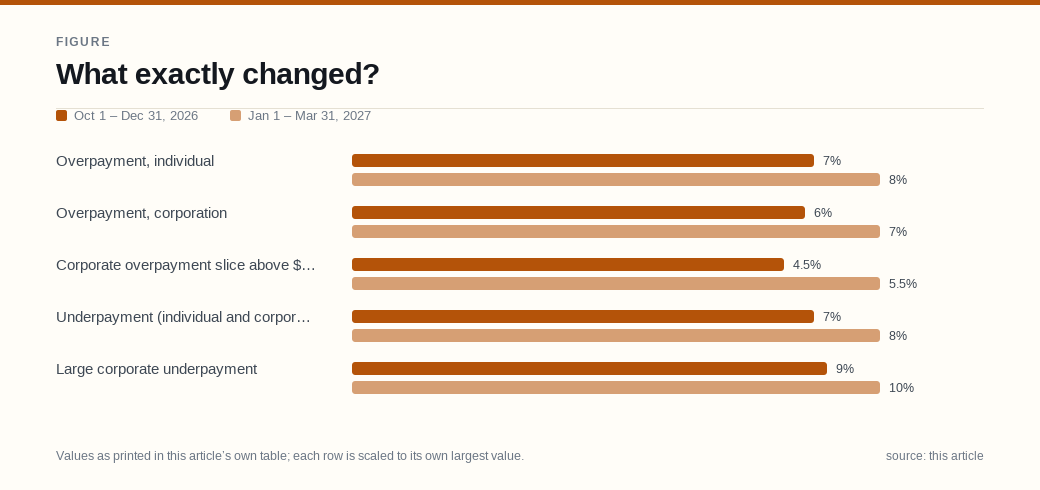
What exactly changed?
The whole table moved, not just the individual line:
| Rate, per year compounded daily | Oct 1 – Dec 31, 2026 | Jan 1 – Mar 31, 2027 |
|---|---|---|
| Overpayment, individual | 7% | 8% |
| Overpayment, corporation | 6% | 7% |
| Corporate overpayment slice above $10,000 | 4.5% | 5.5% |
| Underpayment (individual and corporate) | 7% | 8% |
| Large corporate underpayment | 9% | 10% |
Two things about that table matter more than the numbers. First, the 8% is a quarterly setting, not a permanent one: it applies to “amounts bearing interest during that calendar quarter”, so it covers January 1 through March 31, 2027, and the determination made in January 2027 governs from April 1. Second, overpayments and underpayments carry the same rate for individuals — the same 8% that costs you money if you owe it is what the IRS owes you if it is late paying you.
The rate history from the IRS’s own quarterly table puts the move in context: 2026 ran 7%, 6%, 7% and 7%; every quarter of 2025 was 7%; every quarter of 2024 was 8%. So this is a return to the 2024 level, not a new high.
How is the 8% built?
The statute is mechanical, and knowing the parts tells you when it will move again. Under 26 U.S.C. § 6621(a)(2), the underpayment rate is the federal short-term rate plus 3 percentage points. Subsection (b)(1) has the Secretary determine that short-term rate in the first month of each calendar quarter, and (b)(2)(A) applies it during the first quarter that begins after that month — which is why an October 2026 determination produces a rate for January 1, 2027. Subsection (b)(3) rounds the short-term rate to the nearest full percent, and sends an exact half-percent up to the next full percent.
Revenue Ruling 2026-25 states the result: the short-term rate determined during October 2026, rounded on a daily-compounding basis, is 5%. Add the statutory three points and the individual rate is 8%.
The arithmetic checks itself across the table, which is a useful way to read these releases: 5 + 3 = 8 for individuals, 5 + 2 = 7 for corporate overpayments, 5 + 0.5 = 5.5 for the slice above $10,000, 5 + 5 = 10 for large corporate underpayments, and the section 6603 deposit rate is stated as 5%. Every row subtracts to the same short-term rate — 5%, up from 4% a year earlier. When the short-term rate moves a full point, the whole table moves with it; when it drifts inside a point, the rounding rule can hold rates flat for several quarters, which is what happened through 2025.
What does 8% compounded daily cost on a real balance?
Daily compounding is the part people underestimate. Here is the interest alone — no penalty — on three balances, at 8% for the January 2027 quarter onward, using a quarter-year of 91.25 days, a half-year of 182.5 and a full year of 365 so the columns are directly comparable:
| Balance owed | 3 months | 6 months | 12 months |
|---|---|---|---|
| $5,000 | $101.00 | $204.03 | $416.39 |
| $10,000 | $201.99 | $408.06 | $832.78 |
| $25,000 | $504.98 | $1,020.16 | $2,081.94 |
At this rate a $10,000 balance accrues about $2.19 a day, or roughly $66 a month, in interest alone. The same three rows at the old 7% rate come to $176.52, $356.16 and $725.01 — the one-point move is worth $25.47, $51.90 and $107.77 respectively over those periods.
Two cautions on the arithmetic. The cells use a standard quarter-year rather than the calendar: the first quarter of 2027 is 90 days, which would put the $10,000 cell at about $199.20 instead of $201.99, and the rate is re-set each quarter, so a balance carried across 2027 will blend quarterly rates. The IRS also computes interest with published daily factors rather than a formula like ours, so an actual notice can differ by cents. The order of magnitude, which is what a decision turns on, is not in doubt.
Does the penalty stack on top of the 8%?
Yes, and this is where the real annual cost comes from. Interest and penalties are separate charges that run at the same time on the same unpaid tax.
- Failure to pay — 0.5% of the unpaid tax for each month or part of a month, capped at 25% (§ 6651(a)(2)). That is 6% in the first year.
- Failure to file — 5% a month, also capped at 25% (§ 6651(a)(1)), reduced by the failure-to-pay amount for any month in which both apply, so the combined charge for a non-filer does not simply add to 5.5%.
- With an installment agreement — for an individual who filed on time, the failure-to-pay rate drops to 0.25% a month for months in which an agreement under § 6159 is in effect (§ 6651(h)). That halves the penalty; it does not touch the interest.
For a filer who filed on time and did not pay, the first twelve months on $10,000 therefore come to about $832.78 of interest plus $600 of penalty — roughly $1,432.78, or 14.3% of the balance. The penalty stops climbing at 25%; the interest does not stop at all until the balance is zero. That asymmetry is the argument for paying down principal early rather than settling into a plan and treating the monthly figure as fixed.
Does the same 8% apply to estimated tax?
Yes. § 6654(a) applies “the underpayment rate established under section 6621” to the amount of each underpayment for the period of the underpayment, and Revenue Ruling 2026-25 says explicitly that the 8% rate applies to estimated tax underpayments for the quarter beginning January 1, 2027.
The population this touches is wider than it sounds. The IRS says individuals generally must make estimated payments if they expect to owe $1,000 or more when the return is filed, and the year is split into four payment periods with their own due dates. Two consequences follow: a charge can apply even when the return ends up showing a refund, and the rate on that charge rose on January 1 whether or not anything else about your return changed.
There is one structural difference from ordinary interest. § 6622(b) exempts the § 6654 and § 6655 additions from daily compounding — the charge is computed on the underpayment for the period, not on interest on interest. The 8% is the same; the compounding is not.
When the IRS owes you: the 8% cuts the other way
The overpayment rate is also 8%, which means a late refund is paid at the same rate that a late payment costs. But the clock starts later than most people assume. The IRS says interest on an overpayment runs from the later of the return due date, the date a late return is received, the date the return is in a form the agency can process, or the date the payment was made — and it has “typically 45 days” of administrative time to issue a refund without paying interest on it. A refund that arrives three weeks after you e-file is not a refund that earned interest.
If you believe the IRS underpaid interest it owed you, the agency’s stated route is an informal claim or Form 843.
Is 8.33% cheap money or expensive money?
That depends entirely on what you would otherwise do with the cash, and the comparison is unusually clean because the return is certain:
- Against saving. If your cash earns less than about 8.33% after tax, paying the IRS is the better use of the dollar. Very few insured deposits clear that bar, which is why carrying a balance while holding the same amount in savings is a losing trade even though it feels safer.
- Against other borrowing. Replacing IRS debt with a loan makes sense only if the loan’s true annual cost — including fees, and after any tax treatment — is below 8.33%. Moving a tax balance onto a high-rate revolving card is the wrong direction, and it is the most common version of the mistake.
- Against the penalty. Because the 0.5% monthly penalty sits on top, the marginal return on paying early is higher than 8.33% for as long as the penalty is still accruing.
- On the tax side, note the asymmetry. Under § 163(h)(1) personal interest is not deductible, and interest on an individual’s income-tax balance is personal interest — so the 8.33% is paid in after-tax dollars, unlike mortgage interest. Interest attributable to a trade or business is treated separately under § 163(h)(2)(A); a business balance should be discussed with a preparer.
We would put it plainly: for a household with an unpaid federal balance and cash on hand, this is about the best risk-free use of that cash available to most people right now, and the case strengthens every month the penalty is still running.
What should you do if you cannot pay in full?
- File on time regardless. The failure-to-file charge is ten times the monthly failure-to-pay charge, and it accrues from the due date until a return is filed — not from the date you file. Filing with a balance due is far cheaper than not filing.
- Pay what you can now, not later. Every dollar reduces both the interest base and the penalty base, and the interest is daily.
- Ask for the short-term plan if you can clear it in 180 days. The IRS lists a $0 setup fee for a short-term payment plan of up to 180 days, applied for online, by phone, by mail or in person.
- Use the long-term plan if you need longer. A Direct Debit Installment Agreement carries a $29 setup fee online or $107 by phone, mail or in person, with the fee waived for low-income taxpayers. Entering a plan lowers the monthly penalty to 0.25% for a timely filer, but the agency’s own page is explicit that the plan carries “accrued penalties and interest until the balance is paid in full” — a plan is a schedule, not a discount.
- Do not confuse an extension to file with an extension to pay. They are separate reliefs, and the ordinary extension covers only the first.
- Check withholding before January, not after April. The cheapest way to deal with the § 6654 charge is to stop accruing it; a new Form W-4 with additional withholding, or a corrected estimated payment, changes the base for the rest of the year.
How do you tell a real IRS notice from a pitch?
Any change in rates brings out the same script: a call, a text, or an email claiming to be the IRS about a balance that must be paid today by gift card, wire or cryptocurrency. The IRS’s own tax scams page sets three markers — it says the agency never asks for or accepts gift cards as payment, never sends direct messages by social media, and, in its disaster-relief section, does not call without notifying you by mail first. It also lists the shape of the approach: an unexpected message that rushes or threatens you.
Three habits are enough:
- Verify in the IRS online account, not through a link. Log in from irs.gov directly; a link in an unexpected message can go anywhere.
- Treat “we can settle this for pennies” as a sales pitch, not a program. No private firm can suspend the interest that started on the due date.
- Check the notice number against the IRS site before responding to a letter that quotes a balance, a deadline and a payment method.
Bottom line
The Internal Revenue Service will charge 8% a year, compounded daily — about 8.33% in practice — on unpaid individual tax for the quarter beginning January 1, 2027, up from 7%, per Revenue Ruling 2026-25 and news release IR-2026-144 of November 24, 2026. With the failure-to-pay penalty running alongside it, a timely filer carrying a balance pays roughly 14.3% of that balance over the first year — about $1,432.78 on $10,000 — and only the penalty half of that stops climbing. This is general information about federal tax administration, not tax, legal or accounting advice; state interest and penalty rules differ, and a balance that arises from a business or a state return is a separate calculation. Our research library collects the primary sources behind this page, and the 2027 inflation adjustments explain the other set of IRS numbers that changed for 2027.
Frequently asked questions
- What interest rate will the IRS charge in 2027?
- 8% a year, compounded daily, for the calendar quarter beginning January 1, 2027 — on both underpayments and overpayments for individuals. The rate is not an annual setting: it is re-determined every quarter under 26 U.S.C. § 6621, so the 8% covers January 1 through March 31, 2027 and the next determination applies from April 1, 2027.
- Is 8% the same as an 8% loan?
- No — it is slightly more, because the interest compounds daily. On a 365-day year, 8% compounded daily works out to about 8.33% of the balance over twelve months. A $10,000 balance left unpaid for a year therefore costs about $832.78 in interest at this rate, against about $725.01 at the 7% rate that applied in the fourth quarter of 2026.
- Does the penalty replace the interest?
- No, they run at the same time. Interest accrues from the original due date, and the failure-to-pay penalty adds 0.5% of the unpaid tax for each month or part of a month, capped at 25%. For an individual who filed on time and did not pay, the first twelve months therefore cost roughly 14.3% of the balance — about $1,432.78 on $10,000 — before any state charge.
- Does an extension to file also extend the time to pay?
- No. An extension moves the filing date, not the payment date; 26 U.S.C. § 6651(a)(2) measures the failure to pay from the date prescribed for payment, 'determined with regard to any extension of time for payment' — a separate relief the ordinary filing extension does not grant. Interest and the late-payment penalty run from the original April due date either way.
- If the IRS owes me a refund, do I get 8% too?
- The same 8% overpayment rate applies, but not from the day you file. The IRS says it has administrative time — 'typically 45 days' — to issue a refund without paying interest on it, and interest on an overpayment generally starts from the later of the due date, the date a late return is received, the date the return is processable, or the date the payment was made.
- Does the 8% apply to the estimated-tax penalty as well?
- Yes, at the same 8% rate: 26 U.S.C. § 6654 applies 'the underpayment rate established under section 6621' to each missed installment. One difference is that § 6622(b) exempts the § 6654 addition from daily compounding, so the charge is computed on the underpayment for the period rather than on interest on interest.
Sources
Each source is a primary or official reference, checked before publication. Links open the original.
- Internal Revenue Service — news release IR-2026-144, 'Interest rates increase for the first quarter of 2027' (November 24, 2026): the 8% individual overpayment and underpayment rate, 7% for corporations, 5.5% on the portion of a corporate overpayment over $10,000, 10% for large corporate underpayments, and the statement that the rates are computed from the federal short-term rate determined during October 2026 — irs.gov/newsroom/interest-rates-increase-for-the-first-quarter-of-2027
- Internal Revenue Service — Revenue Ruling 2026-25 (22 pages), the operative determination: the federal short-term rate determined during October 2026, rounded to the nearest full percent on a daily-compounding basis, is 5%; an overpayment rate of 8% (7% for corporations) and an underpayment rate of 8% are established for the calendar quarter beginning January 1, 2027; the section 6603 deposit rate is 5%; and the 8% rate also applies to estimated tax underpayments under sections 6654 and 6655 for that quarter — irs.gov/pub/irs-drop/rr-26-25.pdf
- Internal Revenue Service — news release IR-2026-98, 'Interest rates remain the same for the fourth quarter of 2026' (August 21, 2026): the 7% individual rate, 6% corporate overpayment, 4.5% on the corporate overpayment slice over $10,000, 7% underpayment and 9% large corporate underpayment that apply to the quarter beginning October 1, 2026, the comparison quarter used throughout this article — irs.gov/newsroom/interest-rates-remain-the-same-for-the-fourth-quarter-of-2026
- Internal Revenue Service — 'Quarterly interest rates', the agency's own table of every quarter back to 2017: 2026 ran 7%, 6%, 7% and 7% for non-corporate overpayments; 2025 was 7% in all four quarters; 2024 was 8% in all four quarters — the basis for saying 8% is the highest since the fourth quarter of 2024 — irs.gov/payments/quarterly-interest-rates
- Internal Revenue Service — 'Interest', on when interest starts (the later of the return due date, the date a late return is received, the date the return is in processable form, or the date the payment is made), on the agency's administrative time of 'typically 45 days' to issue a refund without paying interest on it, and on Form 843 as the route to dispute underpaid interest — irs.gov/payments/interest
- Internal Revenue Service — 'Payment plans; installment agreements' (page text updated March 3, 2026): the $0 setup fee for a short-term plan of up to 180 days, the $29 online and $107 phone, mail or in-person setup fees for a long-term Direct Debit Installment Agreement, the fee waiver for low-income taxpayers, and the warning that a plan carries 'accrued penalties and interest until the balance is paid in full' — irs.gov/payments/payment-plans-installment-agreements
- Internal Revenue Service — 'Estimated taxes': the $1,000 threshold at which individuals generally must make estimated payments, the four payment periods, the postmark rule, and the warning that an underpayment charge can apply 'even if you are due a refund when you file' — irs.gov/businesses/small-businesses-self-employed/estimated-taxes
- Cornell Legal Information Institute — 26 U.S.C. § 6621, 'Determination of rate of interest': the overpayment rate of the federal short-term rate plus 3 percentage points (2 for corporations), the underpayment rate of the short-term rate plus 3 points, the 0.5-point rule for the corporate overpayment slice over $10,000, the quarterly determination in subsection (b)(1), and the rounding rule in (b)(3) that sends a rate ending in one-half of 1 percent up to the next full percent — law.cornell.edu/uscode/text/26/6621
- Cornell Legal Information Institute — 26 U.S.C. § 6622, 'Interest compounded daily': subsection (a) requires daily compounding of interest computed under the title, and subsection (b) carves out the additions to tax under sections 6654 and 6655, which are therefore not compounded daily — law.cornell.edu/uscode/text/26/6622
- Cornell Legal Information Institute — 26 U.S.C. § 6651, 'Failure to file tax return or to pay tax': 5% a month for failure to file and 0.5% a month for failure to pay, each capped at 25%, and subsection (h), which substitutes 0.25% for 0.5% for months in which an installment agreement under section 6159 is in effect for an individual who filed on time — law.cornell.edu/uscode/text/26/6651
- Cornell Legal Information Institute — 26 U.S.C. § 6654, 'Failure by individual to pay estimated income tax': the addition is the section 6621 underpayment rate applied to the amount of the underpayment for the period of the underpayment — law.cornell.edu/uscode/text/26/6654
- Cornell Legal Information Institute — 26 U.S.C. § 163, 'Interest': subsection (h)(1) disallows personal interest, and (h)(2)(A) treats trade or business interest separately — the basis for the note that interest on an individual's income-tax balance is generally paid in after-tax dollars — law.cornell.edu/uscode/text/26/163
- Internal Revenue Service — 'Tax scams', the agency's index of impersonation and refund-fraud warnings, which states that the IRS never asks for or accepts gift cards as payment, that it never sends direct messages by social media, that it does not call without notifying by mail in the disaster-relief context, and that an unexpected email, call or message that rushes or threatens you is a warning sign — irs.gov/help/tax-scams