Capital gains brackets for 2027: two thresholds per filing status decide what your gain pays
The 2027 long-term capital gains breakpoints for every filing status, and the arithmetic that decides whether a gain pays 0%, 15% or 20%.
The short answer: For tax years beginning in 2027, a long-term capital gain is taxed at 0% to the extent your taxable income stays at or below $51,050 (single), $102,100 (married filing jointly), $68,350 (head of household) or $51,050 (married filing separately); at 15% up to $563,200, $633,600, $598,400 and $316,800 respectively; and at 20% above that line, per section 3.03 of Revenue Procedure 2026-35, published November 5, 2026.
Those four numbers are not allowances on your gain. They are ceilings on taxable income, and the gain is what sits on top of everything else on the return.
What are the 2027 capital gains brackets, filing status by filing status?
| Filing status | 0% applies up to | 15% applies up to | Above the second line |
|---|---|---|---|
| Single | $51,050 | $563,200 | 20% |
| Married filing jointly, or surviving spouse | $102,100 | $633,600 | 20% |
| Head of household | $68,350 | $598,400 | 20% |
| Married filing separately | $51,050 | $316,800 | 20% |
| Estates and trusts | $3,400 | $16,750 | 20% |
Read a row as a single sentence: a long-term gain that keeps your taxable income under the first figure is taxed at 0%, the part that falls between the two figures is taxed at 15%, and anything above the second figure is taxed at 20%.
Three things about that table are worth saying out loud, because they are where the numbers get misread:
- The columns are taxable income, not gain. A gain of $200,000 does not get a $51,050 free slice. A gain of $200,000 realized by someone whose other income already exceeds $51,050 gets no free slice at all.
- The 20% rate has no threshold in the table. It begins exactly where the 15% line ends, so the second column is the only breakpoint that matters above the middle of the income range.
- Estates and trusts reach 20% almost immediately. At $16,750 of taxable income, a trust is already at the top rate. That is not an anomaly in the revenue procedure; it is the compressed schedule in section 1(e) of the Code, and it is why gains are rarely left inside a trust that is not distributing.
Why is the bracket measured on taxable income instead of on the gain?
Because the statute taxes the gain as the top slice of your income. Section 1(h)(1) of the Internal Revenue Code computes the tax in layers: first the ordinary part of taxable income at ordinary rates, then the gain at the capital rates, with the 0% and 15% amounts measured against taxable income reduced by the adjusted net capital gain — that is, against the income you had before the gain.
The practical version of that rule is one subtraction:
0% room = 0% ceiling − (taxable income before the gain)
“Taxable income before the gain” is your income after deductions. For most households that means after the standard deduction, which is also set annually:
| Filing status | 2027 standard deduction |
|---|---|
| Single | $16,600 |
| Married filing jointly | $33,200 |
| Head of household | $24,925 |
| Married filing separately | $16,600 |
A single filer with $60,000 of wages has $43,400 of taxable income before any gain. The 0% room is $51,050 − $43,400 = $7,650. The ceiling was $51,050; the room is about 15% of it. That gap is the single most common error in coverage of these brackets, and it is the reason two neighbors with identical portfolios can pay very different tax on the same sale.
What does the same gain cost at three income levels?
All three households below are single or joint filers with the standard deduction, no other deductions, and a gain held more than one year. The 2027 figures are applied exactly as the statute orders them.
| Household | Taxable income before the gain | Long-term gain | Federal tax on the gain, including the 3.8% surtax | Effective rate on the gain |
|---|---|---|---|---|
| Single, $60,000 of wages | $43,400 | $40,000 | $4,852.50 | 12.1% |
| Single, $22,000 of interest, retired | $5,400 | $120,000 | $11,152.50 | 9.3% |
| Married filing jointly, $420,000 of income | $386,800 | $300,000 | $59,060 ($47,660 income tax plus $11,400 surtax) | 19.7% |
- Row 1. $7,650 of the gain falls in the 0% band. The remaining $32,350 is taxed at 15%, which is $4,852.50. Nothing reaches 20%.
- Row 2. The retiree has almost no ordinary income, so $45,650 of the $120,000 gain is taxed at 0% and $74,350 at 15%. Total taxable income is $125,400, far below the 15% ceiling. The gain is large; the bill is 9.3% of it.
- Row 3. Ordinary income has already passed the 0% ceiling, so no part of the gain is free. The 15% band runs from $386,800 to $633,600 — $246,800 of it — and the last $53,200 is taxed at 20%. The 3.8% surtax then applies to the gain as net investment income, because modified adjusted gross income of $720,000 is well over the $250,000 joint threshold in 26 U.S.C. section 1411. The 20% headline rate is never the whole bill.
The middle row is the one worth studying. A retiree living on interest and a modest pension can realize a six-figure gain at a rate below what a working household pays on $60,000 of salary, because ordinary income has left most of the 0% band unoccupied. That is the bracket structure working as written, not a loophole.
Do qualified dividends compete for the same room?
Yes, and this is the part most bracket tables omit. Section 1(h)(3) defines adjusted net capital gain to include qualified dividend income, so a dividend and a stock gain draw on the same 0% and 15% space. Realize $40,000 of gain and collect $10,000 of qualified dividends in the same year, and the two together are stacked into the bands in the order the worksheet prescribes.
Whether a dividend is qualified depends on a holding-period test in the statute — more than 60 days during the 121-day period beginning 60 days before the ex-dividend date — which is covered with the rest of the holding-period rules in our guide to how the capital gains rate is set.
Which gains are outside these brackets entirely?
Four categories are. Section 1(h)(3) removes them from the adjusted net capital gain before the 0/15/20 bands are applied, and each is capped separately:
| Category | Cap | Where it comes from |
|---|---|---|
| Collectibles gain (art, coins, gold, and the other items the statute lists) | 28% | 26 U.S.C. sections 1(h)(4) and 1(h)(5); IRS Topic no. 409 |
| Taxable part of a gain on section 1202 qualified small business stock | 28% | IRS Topic no. 409 |
| Unrecaptured section 1250 gain (depreciation on real property coming back as gain) | 25% | 26 U.S.C. section 1(h)(6); IRS Topic no. 409 |
| Short-term gain, on an asset held one year or less | Ordinary rates, up to 37% in 2027 | 26 U.S.C. section 1(h); IRS Topic no. 409 |
The word capped is doing work in that table. These slices are not automatically taxed at 28% or 25%; those are ceilings, and the ordering rules can produce a lower result. What is certain is that a collectible gain does not get the 0% band the way a stock gain does.
What does the 3.8% surtax add on top?
Section 1411 imposes a 3.8% tax on the lesser of net investment income or the excess of modified adjusted gross income over a threshold: $250,000 for a joint return or a surviving spouse, $125,000 for a married person filing separately, and $200,000 in any other case — which includes a head of household, a group that often assumes its threshold is higher than it is.
The thresholds are dollar amounts written into the statute. They do not appear among the items Revenue Procedure 2026-35 adjusts for 2027, so they do not move with the brackets. A long-term gain at the top rate therefore costs 23.8% federal, plus whatever the state charges.
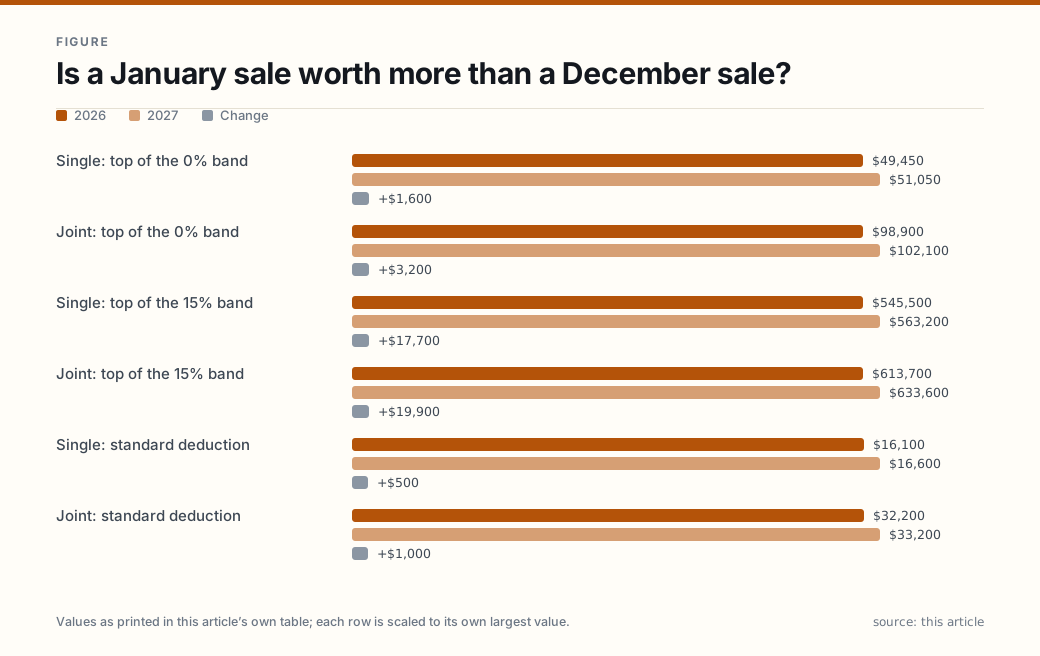
Is a January sale worth more than a December sale?
Slightly, and only for the slice that actually crosses a line. Every 2027 figure is higher than its 2026 counterpart, because the revenue procedure indexes them:
| Measure | 2026 | 2027 | Change |
|---|---|---|---|
| Single: top of the 0% band | $49,450 | $51,050 | +$1,600 |
| Joint: top of the 0% band | $98,900 | $102,100 | +$3,200 |
| Single: top of the 15% band | $545,500 | $563,200 | +$17,700 |
| Joint: top of the 15% band | $613,700 | $633,600 | +$19,900 |
| Single: standard deduction | $16,100 | $16,600 | +$500 |
| Joint: standard deduction | $32,200 | $33,200 | +$1,000 |
For a single filer with unchanged income, the bigger deduction lowers taxable income before the gain by $500, and the 0% ceiling rises $1,600. The two together move $2,100 of gain from 15% to 0%, which is worth $315. On a joint return the equivalent figure is $4,200 of room, worth $630. At the top end, the 15% band widens by $17,700 for a single filer and $19,900 for a couple, worth $885 and $995 respectively to someone who would otherwise pay 20%.
That is the honest size of the timing decision: hundreds of dollars, not thousands, and only if your gain is large enough to sit exactly on one of those lines. Against it, deferring keeps the position exposed to the market for another month, and if the asset falls the tax saved is irrelevant. If the sale would land in a year when you also have capital losses to absorb, the bracket question is secondary to the netting.
What the brackets do not cover
Four things are outside this page, and three of them are the ones that surprise people.
- State tax. This is federal only, and state treatment varies by state. The Tax Foundation’s 2026 survey counts thirty states and the District of Columbia taxing capital gains on the same schedule as ordinary income, eight states applying a lower effective rate or an exclusion, Missouri exempting gains, three states — Maryland, Minnesota and Washington — applying higher rates to some gains, and eight states with no individual income tax at all. A federal 0% rate is not a 0% total rate in most of the country.
- Income-tested programs. A gain raises modified adjusted gross income even when the federal rate on it is zero. That figure drives marketplace premium tax credits, the income-related Part B and Part D premium amounts, and how much of a Social Security benefit is taxable under section 86. Each has its own thresholds, and none of them is the capital gains bracket.
- The alternative minimum tax, the netting order on Schedule D, and the qualified business income deduction all interact with a large gain, and none is modeled above.
- Estimated tax. A gain realized in December is generally too late to fix through withholding alone; the safe harbor in Publication 505 and Form 2210 is the mechanism, and it is a separate calculation.
Bottom line
The 2027 long-term capital gains brackets are 0% up to $51,050 of taxable income for a single filer and $102,100 for a married couple, 15% up to $563,200 and $633,600, and 20% above those lines (Revenue Procedure 2026-35, section 3.03) — and the number that decides which of the three you pay is not the size of your gain but how much taxable income you already have before it.
The figures in this page are for tax years beginning in 2027, which means the return most people file in 2028. A gain realized in 2026 uses the 2026 breakpoints, set out in the guide to how the rate is set; the rate tables, standard deduction and other 2027 amounts that move alongside these brackets are collected in the inflation-adjustment guide. This is a general explanation of federal law, not tax advice for a specific return; the arithmetic of your own sale belongs with a preparer who can see the whole return.
Frequently asked questions
- What are the 2027 capital gains tax brackets?
- For tax years beginning in 2027 there are three rates on long-term gains: 0%, 15% and 20%. The 0% rate applies up to $51,050 of taxable income for a single filer, $102,100 for a married couple filing jointly, $68,350 for a head of household and $51,050 for a married person filing separately. The 15% rate runs to $563,200, $633,600, $598,400 and $316,800 respectively; above that line the rate is 20% (Revenue Procedure 2026-35, section 3.03).
- Is $51,050 a tax-free allowance for capital gains?
- No. It is a ceiling on total taxable income, not an amount of gain you can realize tax-free. The gain is stacked on top of your other income, so the 0% room is the $51,050 ceiling minus the taxable income you already have before the gain. A single filer with $60,000 of wages has $43,400 of taxable income after the standard deduction, leaving $7,650 of room at 0% — not $51,050.
- Does a capital gain push my salary into a higher ordinary bracket?
- No. The worksheet that computes the tax separates the two: the ordinary part of taxable income is taxed at ordinary rates, then the gain is taxed at the capital rates. A gain can raise the rate that applies to the gain itself, and it raises adjusted gross income, but it does not re-price your wages.
- Are qualified dividends taxed in the same brackets?
- Yes, and they compete for the same room. The statute folds qualified dividend income into the adjusted net capital gain that the 0%, 15% and 20% bands apply to, so a dividend and a stock gain both draw down the same $51,050 (single) or $102,100 (joint) of 0% space. Dividends count as qualified only if the holding-period test in the statute is met.
- Do collectibles get the 0% or 15% rate?
- No. Long-term gain on a collectible — art, coins, gold, and other items the statute lists — is capped at 28%, and the taxable part of a gain on section 1202 qualified small business stock is also capped at 28%. Depreciation taken on real property that comes back as unrecaptured section 1250 gain is capped at 25%. Those slices are removed from the adjusted net capital gain the 0/15/20 bands apply to.
- Should I wait until January 2027 to sell?
- Only if the slice that moves crosses a threshold. Every 2027 figure is higher than its 2026 counterpart, but the amount at stake is small: a single filer with unchanged income gains about $2,100 of 0% room, worth $315 at the 15% rate. Deferring also leaves the asset exposed to the market for another month, and it does not help at all if your taxable income already sits above the 15% line.
Sources
Each source is a primary or official reference, checked before publication. Links open the original.
- Internal Revenue Service — Revenue Procedure 2026-35 (released November 5, 2026), section 3.03 for the maximum zero rate and maximum 15 percent rate amounts by filing status and for estates and trusts, section 3.01 for the ordinary rate tables, section 3.15 for the standard deduction, and section 4.01 for the rule that the procedure applies to taxable years beginning in 2027 — irs.gov/pub/irs-drop/rp-26-35.pdf
- Internal Revenue Service — news release IR-2026-133, 'IRS releases tax inflation adjustments for tax year 2027; taxpayers continue to benefit from the Working Families Tax Cuts' (November 5, 2026) — irs.gov/newsroom/irs-releases-tax-inflation-adjustments-for-tax-year-2027-taxpayers-continue-to-benefit-from-the-working-families-tax-cuts
- Internal Revenue Service — Revenue Procedure 2025-32 (the 2026 figures used here as the comparison year), section 4.03 for the 2026 capital gains breakpoints and section 4.14 for the 2026 standard deduction — irs.gov/pub/irs-drop/rp-25-32.pdf
- Internal Revenue Service — Topic no. 409, 'Capital gains and losses', for the more-than-one-year holding period, the rule that net short-term capital gain is taxed as ordinary income, and the sentences capping collectibles gain and the taxable part of section 1202 gain at 28 percent and unrecaptured section 1250 gain at 25 percent — irs.gov/taxtopics/tc409
- Internal Revenue Code — 26 U.S.C. section 1(h), particularly paragraph (1) for the 0/15/20 percent structure, paragraph (3) for the definition of adjusted net capital gain (which excludes unrecaptured section 1250 gain and 28-percent rate gain and includes qualified dividend income), paragraph (4) for 28-percent rate gain, paragraph (5) for collectibles gain and paragraph (11) for qualified dividend income and its holding-period test; and section 1(j)(5) for the maximum zero rate and maximum 15-percent rate amounts used in paragraph (1) — law.cornell.edu/uscode/text/26/1
- Internal Revenue Code — 26 U.S.C. section 1411, the 3.8 percent tax on net investment income, with threshold amounts of $250,000 for a joint return or surviving spouse, half that for a married person filing separately, and $200,000 in any other case — law.cornell.edu/uscode/text/26/1411
- Internal Revenue Code — 26 U.S.C. section 86, which makes part of a Social Security benefit taxable once provisional income passes the thresholds in that section — law.cornell.edu/uscode/text/26/86
- Tax Foundation — 'State Tax Rates on Long-Term Capital Gains, 2026', by Nicole Fox and Cole Kellison, November 9, 2026, for the count of states that tax capital gains on the same schedule as ordinary income, the states that apply lower or higher rates, and the states with no individual income tax — taxfoundation.org/data/all/state/state-capital-gains-tax-rates/
- Social Security Administration — 'Medicare premiums: rules for higher-income beneficiaries', for the income-related monthly adjustment amount that is computed from the modified adjusted gross income on a return filed two years earlier — ssa.gov/benefits/medicare/medicare-premiums.html
- HealthCare.gov — 'Income and household information', for the rule that marketplace premium tax credits are computed from modified adjusted gross income, the same figure a realized gain increases — healthcare.gov/income-and-household-information/income/