The non-itemizer charitable deduction is permanent from 2026: $1,000 single, $2,000 joint, cash gifts only
Filers who take the standard deduction can deduct up to $1,000 of cash gifts for 2026 ($2,000 joint) — public charities only, and mailed by December 31.
For the 2026 tax year, an individual who does not itemize deductions can deduct up to $1,000 of cash gifts to public charities — $2,000 on a joint return — in addition to the standard deduction. The Internal Revenue Service restated the rule on November 10, 2026, in news release IR-2026-135, and 2026 is the first year it applies.
That single sentence describes a deduction most households have never had. Apart from a one-year version in 2021, a taxpayer who took the standard deduction got no federal income tax benefit from charitable giving at all; the deduction existed only on Schedule A, which most filers never reach.
What changed, and when does it take effect?
The provision is old, and it is the amendment that matters. Section 170(p) of the Internal Revenue Code was created for 2021 only, as pandemic-era relief, and capped at $300 ($600 on a joint return). It expired.
Section 70424 of Public Law 119-21, enacted July 4, 2025, made two changes to that text and nothing else:
- It replaced “$300 ($600” with “$1,000 ($2,000”.
- It struck the words “beginning in 2021”, which was the entire sunset.
The effective date in the statute is taxable years beginning after December 31, 2025 — which is why the IRS describes this as beginning with tax year 2026, and why the first return that can claim it is the one filed in early 2027. The 2025 return filed in 2026 cannot.
Two consequences follow, and both are easy to miss:
- It is permanent in the sense that it has no expiry date. It is not permanent in the sense of keeping pace with prices: the dollar amounts are fixed in the statute and §170(p) contains no inflation adjustment. A $1,000 cap set in 2025 dollars will be worth less every year it survives.
- It is not indexed to your income either. There is no phase-out and no income test. A household earning $40,000 and one earning $400,000 face the same cap.
Who qualifies?
The test is one sentence long: you do not elect to itemize deductions for the year. Section 63(b)(4) then subtracts the §170(p) amount from adjusted gross income, alongside the standard deduction, in arriving at taxable income.
That placement has a practical consequence worth stating plainly: the deduction is below the line. It lowers taxable income; it does not lower adjusted gross income. So it does not move any number built on AGI or MAGI — the income figure behind Marketplace premium tax credits, or the Medicare income-related premium thresholds revisited in the 2027 COLA walkthrough — and it does not disturb an AGI-tested credit or phase-out.
There is one wrinkle in the eligibility wording. Publication 6196 notes that qualifying taxpayers “may take the standard deduction but are not required to do so,” and gives the example of a married taxpayer filing separately whose spouse itemizes. That filer cannot take the standard deduction at all, and still qualifies for this one, because the statute’s condition is not itemizing, not taking the standard deduction. The cap is still $1,000 in that case: the statute gives $2,000 only “in the case of a joint return,” so married filing separately and head of household both sit at $1,000.
What counts as a qualifying gift?
Section 170(p) is narrow, and the narrowness is where most of the mistakes happen. The deduction equals what §170 would allow if the only contributions counted were cash contributions made during the year to an organization described in §170(b)(1)(A), and not:
- to an organization described in §509(a)(3) — a supporting organization, which carries out its exempt purpose by supporting another public charity rather than running programs; or
- for the establishment of a new, or maintenance of an existing, donor advised fund (defined in §4966(d)(2)).
Laid out as a checklist:
| Gift | Counts toward the $1,000 / $2,000 cap? |
|---|---|
| Cash, check, card or electronic transfer to a church, school or other public charity | Yes |
| Cash to a donor-advised fund | No |
| Cash to a supporting organization under §509(a)(3) | No |
| Appreciated stock, clothing, a used car, household goods | No |
| A carryover of an excess gift from an earlier year | No |
| A gift to a private non-operating foundation | No — it is not a §170(b)(1)(A) organization |
The carryover row is the one that surprises people who itemize. Section 170(p) tells you to compute the amount without regard to a short list of provisions — §170(b)(1)(G)(ii), the new floor in §170(b)(1)(I), and the five-year carryover rule in §170(d)(1). The third of those rules out pouring last year’s unused excess into this year’s $1,000. The second is the reason the 0.5% floor discussed below bites itemizers and not you: Public Law 119-21 inserted that cross-reference into §170(p) in the same section that created the floor.
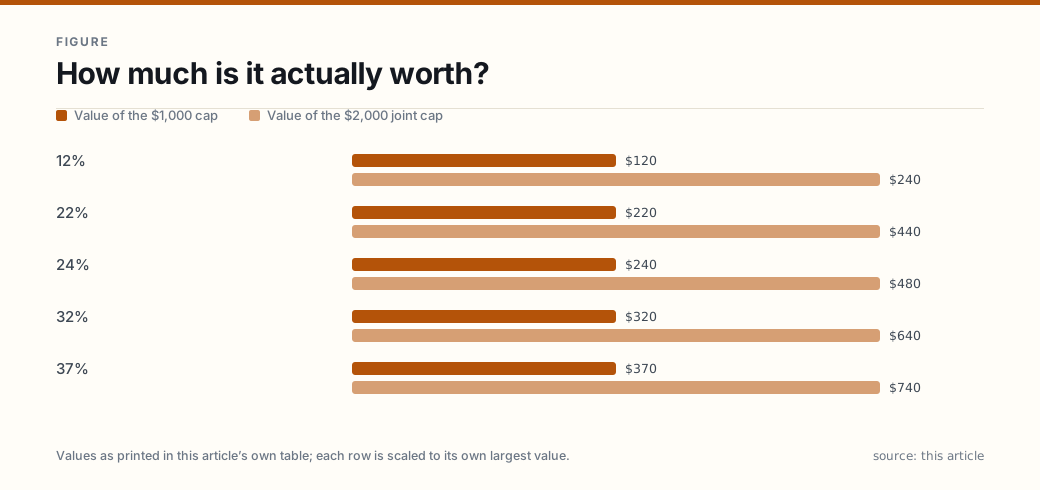
How much is it actually worth?
The cap is a ceiling on the gifts you deduct, not an allowance you receive. Give $400 and you deduct $400. Give $4,000 and you deduct $1,000 — the rest simply does not participate unless itemizing turns out to be better.
What the deduction is worth depends on your marginal rate:
| Marginal federal rate | Value of the $1,000 cap | Value of the $2,000 joint cap |
|---|---|---|
| 12% | $120 | $240 |
| 22% | $220 | $440 |
| 24% | $240 | $480 |
| 32% | $320 | $640 |
| 37% | $370 | $740 |
Those figures are our arithmetic — the cap multiplied by the rate — and they are federal only. Whether a state gives you anything depends on where its return starts, which the state section below covers.
The honest way to describe the size of this: for a household in the 22% bracket that already gives $2,000 a year to its church, the change is worth about $440 in federal income tax that did not exist before 2026. That is real money and it is not a reason to change how much you give — a deduction returns a fraction of the gift, so giving more to capture it always costs more than it saves.
What has to happen by December 31, 2026?
Four things, in order of how often they go wrong.
The money has to be paid in 2026. The deduction is for contributions made during the taxable year. Treasury Regulation §1.170A-1(b) provides that the unconditional delivery or mailing of a check that subsequently clears in due course is an effective contribution on the date of delivery or mailing — so a check mailed December 30 counts for 2026 even if the charity deposits it in January. A pledge does not count, and neither does a gift you schedule for January.
You need records for every gift. IR-2026-135 lists what to keep: receipts, canceled checks, bank records, or written communications from the charity showing its name, the date and the amount. Publication 6196 says the same thing in fewer words.
A single gift of $250 or more needs a written acknowledgment. Section 170(f)(8) denies the deduction for any contribution of $250 or more without a contemporaneous written acknowledgment from the donee, and it specifies what the letter must contain: the amount of cash contributed, whether the charity provided any goods or services in return, and a description and good-faith estimate of their value — or a statement that the only benefit was an intangible religious one. “Contemporaneous” has a deadline: you must have the acknowledgment on or before the earlier of the date you file the return or the due date including extensions. Asking for it in April is late if you file in February.
Check the charity before you give, not after. The IRS Tax Exempt Organization Search tool, filtered to Pub. 78 data, shows a deductibility code for each organization; Publication 6196 treats codes such as 50% (60% for cash), PC, POF and FED as eligible. This is also the cheapest fraud control available: a charity that cannot be found in the IRS database, or that pressures you for a gift card, a wire transfer or cryptocurrency, is not a charity you should be funding in December. Legitimate organizations do not ask for payment in gift cards.
Should you itemize instead?
If your itemizable deductions — mortgage interest, state and local taxes up to the cap, medical expenses above the floor, and charitable gifts — already exceed the standard deduction plus the non-itemizer deduction you would give up (up to $1,000, or $2,000 on a joint return), Schedule A is the better route and this provision does not apply to you. The two are alternatives, not a stack.
That adjustment to the usual break-even is the part worth re-reading. Electing to itemize forfeits §170(p) entirely, so a single filer whose itemizable deductions beat the standard deduction by $500 — and who gave at least $1,000 in qualifying cash — is still $500 ahead by not itemizing and taking the $1,000 instead.
Itemizing brings its own rule for 2026, and it cuts the other way: §70425 of Public Law 119-21 added a floor at §170(b)(1)(I) under which an itemized charitable deduction is allowed only to the extent total contributions exceed 0.5 percent of the taxpayer’s contribution base. It carries the same effective date — taxable years beginning after December 31, 2025 — so it applies to the same 2026 return. For a household with $150,000 of AGI, the first $750 of giving produces no itemized deduction at all.
That is what makes the “bunching” decision less automatic than it used to be. Concentrating two years of gifts into one year to clear the standard deduction still works, and a donor-advised fund is still the usual vehicle for it — but a DAF contribution made to enable bunching earns nothing under the non-itemizer provision in the years you take the standard deduction. The two strategies pull in opposite directions, and the comparison has to be run on your own numbers rather than on a rule of thumb.
Does any of this reach your state return?
It depends on where the state’s form starts, and states differ. Because the deduction is taken after adjusted gross income, a state return that begins with federal AGI does not see it and will not pick it up automatically; a state that begins with federal taxable income may. There is no national answer here — check the instructions for your state’s return before assuming the $1,000 shows up twice.
What to do next
- Confirm the gifts you have already made in 2026 were cash, to public charities, and not into a donor-advised fund.
- Collect the receipts now, while the December bank statements are still easy to find.
- Request any missing $250 acknowledgment before you file, not after.
- If your itemizable total is close to that combined figure — the standard deduction plus $1,000 or $2,000 — run the comparison before making a large December gift, because the answer may be “give less and take the $1,000” or “bunch and itemize”, and it will not be the same for two households with the same income.
- Treat the December 31 date as the only hard deadline in this article. Everything else can be reconstructed from records in April; the date of the gift cannot.
This is a description of how the rules work, not tax advice, and it is federal only. Your own facts — filing status, state, the mix of your giving — decide the outcome, and a preparer or the IRS is the right place to confirm anything consequential. For the wider set of year-end deadlines that actually expire with the calendar, see which money moves are real deadlines; for the 2027 figures that apply to next year’s return rather than this one, see the 2027 inflation adjustments.
Frequently asked questions
- Can I claim this deduction and still take the standard deduction?
- Yes. That is the point of the provision. Section 63(b)(4) of the tax code lists the §170(p) deduction as a separate subtraction from adjusted gross income for people who do not itemize, so it sits alongside the standard deduction rather than replacing it. You do not file Schedule A to claim it.
- Does a gift to a donor-advised fund count?
- No. Section 170(p) excludes contributions to an organization described in §509(a)(3) — a supporting organization — and contributions for the establishment of a new, or the maintenance of an existing, donor-advised fund. A gift into a Fidelity Charitable or Schwab Charitable account therefore gets nothing under this provision, even though an itemizer can deduct the same gift on Schedule A.
- What if I give more than $1,000?
- The cap is a ceiling, not an allowance, and the excess does not carry forward. Section 170(p) computes the deduction without regard to the carryover rule in §170(d)(1), so unused cash gifts above the cap are simply not deductible that year — unless itemizing produces a bigger deduction overall.
- Does this apply to the return I file in April 2027?
- Yes — that is the first return that can claim it. A return filed in early 2027 reports tax year 2026, and the provision applies to taxable years beginning after December 31, 2025. What it cannot do is reach backwards: the 2021 version of the deduction was limited to that single year, so the 2025 return filed in 2026 had nothing to claim.
- Is the $1,000 amount adjusted for inflation?
- No. The dollar figures are written into the statute and §170(p) contains no inflation adjustment, so the cap stays at $1,000 and $2,000 until Congress changes it. That is the difference between a permanent provision and an indexed one: it does not disappear, but it shrinks in real terms every year.
- Do I have to give to a charity the IRS lists?
- The gift has to go to an organization described in §170(b)(1)(A) — the public charity category that covers most churches, schools and hospitals. The IRS Publication 6196 walkthrough says to check the Tax Exempt Organization Search tool using its Pub. 78 data and look at the deductibility code; organizations coded 50% (60% for cash), PC, POF or FED qualify. Some eligible churches and group-exemption organizations do not appear separately, so a missing record is not proof that a gift is ineligible.
Sources
Each source is a primary or official reference, checked before publication. Links open the original.
- Internal Revenue Service — news release IR-2026-135, 'IRS reminder: Permanent charitable contribution deduction begins for returns filed next year for taxpayers who do not itemize' (November 10, 2026): the $1,000 and $2,000 caps, the cash-only and public-charity conditions, the donor-advised fund and supporting organization exclusions, and the recordkeeping list — irs.gov/newsroom/irs-reminder-permanent-charitable-contribution-deduction-begins-for-returns-filed-next-year-for-taxpayers-who-do-not-itemize
- Internal Revenue Service — Publication 6196, 'Charitable Contribution Deduction Tips for Non-Itemizers' (October 2026): who qualifies, including taxpayers who are not required to take the standard deduction, the Pub. 78 deductibility codes, and the records to keep — irs.gov/pub/irs-pdf/p6196.pdf
- Public Law 119-21, section 70424, 'Permanent and expanded reinstatement of partial deduction for charitable contributions of individuals who do not elect to itemize' (enacted July 4, 2025): the two textual amendments to section 170(p) — $300 ($600) replaced by $1,000 ($2,000), and 'beginning in 2021' struck — with an effective date of taxable years beginning after December 31, 2025. Section 70425, the 0.5 percent floor for itemized charitable deductions, carries the same effective date — govinfo.gov/content/pkg/PLAW-119publ21/html/PLAW-119publ21.htm
- United States Code — 26 U.S.C. §170(p), 'Special rule for taxpayers who do not elect to itemize deductions', including the cash-only limitation, the reference to organizations described in §170(b)(1)(A), the exclusions for §509(a)(3) organizations and donor advised funds under §4966(d)(2), and the instruction to compute the amount without regard to §170(d)(1) carryovers — law.cornell.edu/uscode/text/26/170
- United States Code — 26 U.S.C. §63(b)(4), which subtracts the §170(p) deduction from adjusted gross income in arriving at the taxable income of an individual who does not elect to itemize — law.cornell.edu/uscode/text/26/63
- Internal Revenue Service — Treasury Regulation §1.170A-1(b), 'Time of making contribution': an unconditional delivery or mailing of a check that clears in due course is an effective contribution on the date of delivery or mailing — law.cornell.edu/cfr/text/26/1.170A-1
- United States Code — 26 U.S.C. §170(f)(8), the contemporaneous written acknowledgment required for any contribution of $250 or more, its required contents, and the deadline defined as the earlier of the filing date or the due date including extensions — law.cornell.edu/uscode/text/26/170