401(k) auto-enrollment: the IRS finalizes the rules behind the 3% default that has applied since 2025
The IRS finalized the SECURE 2.0 auto-enrollment rules November 17, 2026: a 3% default, one-point annual rises to 10%, and a 90-day refund window.
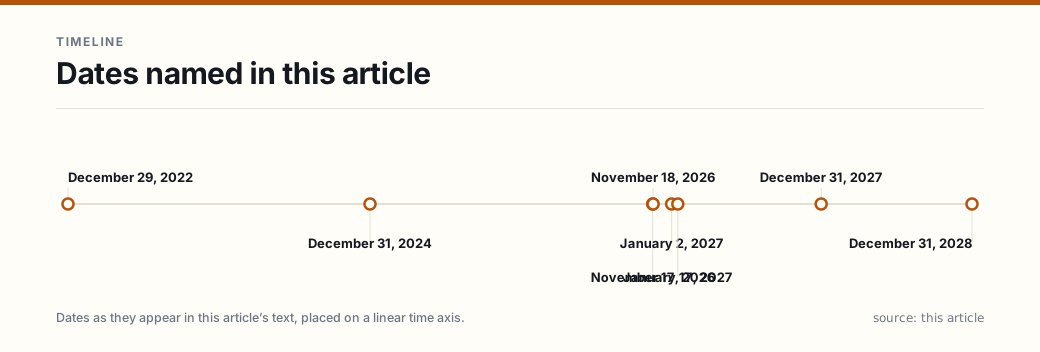
Automatic enrollment means your employer puts you into a workplace retirement plan at a default contribution rate unless you choose a different rate or opt out. On November 17, 2026 the Treasury Department and the Internal Revenue Service (IRS) issued the final regulations that govern it — Treasury Decision 10061, covering section 414A of the Internal Revenue Code, the provision added by section 101 of the SECURE 2.0 Act of 2022. The Federal Register prints the text the next day, November 18, 2026, and that publication date is the one every deadline here is counted from.
The obligation itself is not new. Section 414A has applied to covered plans for plan years beginning after December 31, 2024 — the 2025 plan year, for a calendar-year plan. What the regulations add is the machinery: how the initial rate becomes a rising rate, how exceptions are tested, what happens after a merger, and when you can take the money back. Those details bind for plan years beginning after December 31, 2027, with a reasonable, good-faith reading of the statute required in the years before that.
For a reader, the practical question is narrower than the policy debate: if I do nothing, what comes out of my paycheck, and for how long? The answer, in the agency’s own description, is a 3% default rising one point a year toward 10% — a design that quietly turns inaction into a savings rate, and one that is worth checking against your own budget and your employer’s match before the next plan year starts.
What did the IRS publish, and which date applies to what?
Three dates do different jobs, and most coverage collapses them into one.
| Instrument | Published | What it governs | When it bites |
|---|---|---|---|
| Section 414A (SECURE 2.0 § 101) | Enacted December 29, 2022 | The statutory duty to auto-enroll | Plan years beginning after December 31, 2024 |
| Treasury Decision 10061 (final regulations) | November 18, 2026 | How the duty is measured, tested and administered | Plan years beginning after December 31, 2027 |
| Effective date of the regulations | — | When the regulatory text is in force | 60 days after publication, which by our count is January 17, 2027 |
Two footnotes to that table matter. First, the statute’s own start date means an employee hired into a covered plan in 2025 or 2026 was already subject to automatic enrollment; nothing in the new regulations reaches back to restart that clock. Second, for plan years after 2024 and before the regulatory applicability date, §1.414A-1(f)(2) tells plans to apply “a reasonable, good faith interpretation” of the statute — which is why the agency’s earlier guidance, Notice 2024-2, still shapes what many plans did in 2025 and 2026.
The IRS’s news release frames the change in aggregate terms: Treasury estimates the automatic enrollment expansion raises retirement savings by an average of $4.2 billion a year over 2023-2032, and the regulation’s own regulatory-impact section puts the directly affected population at roughly 1.5 million taxpayers and 25,000 plans a year.
Which plans must enroll people automatically?
Section 414A applies to a qualified cash or deferred arrangement — the 401(k) inside a profit-sharing, stock bonus or pre-ERISA money-purchase plan — and to a 403(b) plan funded by salary reduction. If the arrangement is not covered by an exception, it is not a qualified arrangement unless it satisfies the automatic enrollment rules, which is the statute’s enforcement mechanism rather than a fine.
| Exception | Condition | Practical effect |
|---|---|---|
| Pre-enactment plan | 401(k) or 403(b) terms adopted before December 29, 2022 | A plan whose terms predate that date is outside the rule; adoption date, not effective date, controls |
| SIMPLE 401(k) | Plan described in § 401(k)(11) | Excluded outright |
| Governmental and church plans | § 414(d) and § 414(e) plans | Excluded outright |
| New business | Employer, including any predecessor, in existence less than three years | Deferred, not waived — the duty starts the next plan year after the three years run |
| Small business | Employer normally employed 10 or fewer employees | Deferred until one year after the close of the first tax year in which it normally employed more than 10 |
The regulations turn three of those rows into tests with edges:
- Related employers are aggregated. For the new-business and small-business exceptions, §1.414A-1(d)(4)(iv) treats all members of a controlled group under § 414(b), (c), (m) or (o) as one employer. A five-person startup owned by a company with 4,000 employees does not get the small-business exception.
- The 10-employee count uses the COBRA method. “Normally employed” is measured under Q&A-5 of § 54.4980B-2, and the agency declined a request to let employers use the simpler SIMPLE-IRA or startup-credit counting rules instead.
- Crossing 10 employees is one-way. The preamble agrees with a commenter that once an employer normally employs more than 10 in a tax year, the requirement keeps applying in later years even if headcount falls back — including after a corporate transaction.
A plan that loses the pre-enactment exception through a merger is the other trap. Merging two pre-enactment plans keeps the status; merging a pre-enactment plan into a post-enactment one generally loses it, unless the deal fits a § 410(b)(6)(C) transition and the pre-enactment plan is designated as the ongoing plan. For a reader, this is the reason an acquisition can change your plan’s enrollment behaviour without anyone changing your job.
What percentage comes out, and how fast does it rise?
The first period of participation carries a uniform default between 3% and 10%. The regulation’s words: the default percentage “for each employee’s initial period must be a uniform percentage that is not less than 3 percent and not more than 10 percent.” The IRS release describes covered plans as generally enrolling at three percent, the floor the statute allows; our reading is that a plan has little reason to default above the floor, since every extra point is a larger payroll change an employer has to explain.
The initial period is defined by two endpoints:
- It begins when you first become eligible to defer, or when section 414A first applies to the plan if that is later.
- It ends on the last day of the plan year that follows the plan year in which it began.
After that, §1.414A-1(c)(3)(ii)(B) requires that “not later than the first day of each plan year beginning after an employee’s initial period,” the default rate “be increased by at least 1 percentage point,” with annual increases continuing “until the employee’s percentage contribution is at least 10 percent.” The plan may keep escalating past 10%, but the regulation forbids increases once the rate reaches 15%.
Two flexibilities are easy to miss: the increase may be larger than one point and may be applied earlier than the first day of the plan year, so long as it is not later. A plan that wants to move everyone to 10% in one step may do so.
Here is the ramp for someone hired on January 2, 2027, into a calendar-year plan with a 3% default and one-point steps:
| Plan year | Default rate | Note |
|---|---|---|
| 2027 | 3% | Initial period begins at eligibility |
| 2028 | 3% | Initial period runs through December 31, 2028 |
| 2029 | 4% | First increase, due by the first day of the plan year |
| 2030 | 5% | |
| 2031 | 6% | |
| 2032 | 7% | |
| 2033 | 8% | |
| 2034 | 9% | |
| 2035 | 10% | Statutory minimum reached; plan may stop here |
Eight years from hire to reach 10% is the statute’s design, not a plan’s stinginess — and it is slower than the “escalate to 15%” shorthand suggests. On a $60,000 salary the difference between the 3% start and the 10% destination is $1,800 versus $6,000 a year, or $4,200 of deferral. That $4,200 is also $4,200 less taxable income if the contributions are pre-tax, which is why a rate you did not choose still changes your April.
Can you get the money back?
Yes — once, early, and with a cost. Section 414A(b)(2) requires the arrangement to allow permissible withdrawals under § 414(w), and the regulation describes it as the existing EACA feature: an automatically enrolled employee “must be allowed to withdraw default contributions (plus earnings) within a 90-day window after the first default contribution.”
The mechanics, from § 414(w):
- The window is 90 days from the first elective contribution, not from enrollment or from the first paycheck.
- The amount is the contributions plus attributable earnings, measured through the payroll period before your election takes effect.
- It is taxable, but not penalized. The withdrawal is included in gross income for the year you take it, and the 10% additional tax under § 72(t) does not apply.
- The match does not come with it. Employer matching contributions tied to the withdrawn deferrals are “forfeited or subject to such other treatment as the Secretary may prescribe.”
That last line is the part people miss. Taking the 90-day refund can cost you the employer money that was contributed on the same dollars — a reason to compare the refund against the match before requesting it, not after.
What else did the regulations settle?
Beyond the percentages, five clarifications change how plans behave:
- The arrangement must cover all eligible employees, not only new hires and not only employees outside a collective bargaining unit. That is the sentence that pulls long-tenured employees without an election into the default when a plan first becomes subject to § 414A.
- An existing election is protected. Employees who already have an affirmative election in effect — including an election to contribute zero — do not have to be defaulted.
- Rehires can get a fresh initial period. If an employee had an entire plan year with no default contributions, the plan may redetermine the initial period to start again, which restarts the low default rather than resuming at the escalated rate.
- Defaulted dollars go into a qualified default investment alternative — typically a target-date fund, balanced fund or managed account — but only where the plan is subject to ERISA title I and lets participants direct investments. In a trustee-directed plan the QDIA rule does not apply.
- Notices get simpler. The regulations implement the SECURE 2.0 provisions that let certain required notices be combined, and reduce the annual disclosure owed to unenrolled participants who receive an annual reminder and any plan documents they ask for.
What does doing nothing cost?
The default is a savings rate, not a recommendation, and the gap between the two is measurable. Three checks, each using the 2027 deferral limit of $25,500 covered in our guide to the 2027 retirement limits:
- Against the match. A plan matching 50% of the first 6% of pay pays 3% of salary at a 6% employee rate and 1.5% at the 3% default. On $60,000 that is $1,800 versus $900 of employer money a year — our arithmetic on a hypothetical formula, and the single largest avoidable loss in this article.
- Against your own target. If your household plan is to save 15% of income and 3% is coming from the plan, the remaining 12% has to come from somewhere. The emergency-fund side of that question is worked through in how much cash to hold.
- Against the tax treatment. Pre-tax deferrals lower this year’s taxable income and Roth deferrals do not. If the plan offers both, the default is not a decision about which one you want — that comparison is in Roth versus traditional.
One limit on all of this: 401(k) and 403(b) plans are governed by federal tax law and, for most private employers, ERISA — not by state retirement rules. State income tax treatment of deferrals and of withdrawals still follows state law and varies by state, so a contribution that is pre-tax federally is not automatically pre-tax on a state return.
What should you do before the next plan year?
- Find your current rate and your match formula. Both are in the plan’s summary description or the enrollment site; the rate matters less than the pair. A 3% default under a 6%-of-pay match is a half-collected benefit.
- Decide whether the escalation is on. Some plans let you decline the annual increase while staying enrolled. If you want the increase, the cheapest action is none at all — which is the point of the design.
- Use the 90-day window only as intended. It refunds contributions and earnings and taxes them as income, and it can strip the match. If the problem is cash flow, a lower rate elected now beats a refund requested in month three.
- Ask about the plan’s own start date if you joined a small or new employer. If the plan was adopted after December 29, 2022 and the employer has more than 10 employees, the duty applies; if the employer is under three years old or under the 10-employee line, it is deferred, not waived.
- Check the numbers against the 2027 limits. A default rate plus catch-up can still leave room under the $25,500 deferral cap, and payroll systems often carry the prior year’s figure until someone updates it.
A word on the fraud side, because “refund” and “withdrawal” are words that attract impersonation. The permissible withdrawal is requested through the plan, not through the IRS, and no agency calls to “release” auto-enrolled money or to confirm a contribution rate. The pattern to recognise — an urgent call, a link, a request for a code — is catalogued in the America.gov scam checklist.
Bottom line
On November 17, 2026 the Treasury Department and the IRS issued Treasury Decision 10061, the final regulations for section 414A: covered 401(k) and 403(b) plans must default employees into an eligible automatic contribution arrangement at 3% to 10%, raise that rate by at least one percentage point a year until it reaches at least 10% and never past 15%, and allow a 90-day permissible withdrawal of the defaulted dollars and their earnings, taxable as income and without the 10% penalty, minus any employer match. The statute has applied since the 2025 plan year; the regulatory detail binds for plan years beginning after December 31, 2027, with the text effective January 17, 2027 by our count from its November 18 Federal Register publication.
This article explains a federal tax regulation in general terms; it is not personal tax or investment advice. Whether a particular plan is covered, and what it has adopted as its default, are questions for the plan administrator and the plan document, not for a summary. State tax treatment of contributions and withdrawals varies by state.
Frequently asked questions
- Does auto-enrollment start in 2028?
- No. Section 414A has applied to covered plans for plan years beginning after December 31, 2024 — the 2025 plan year for a calendar-year plan. The regulations issued on November 17, 2026 apply to plan years beginning after December 31, 2027, and for earlier years a plan is held to a reasonable, good-faith reading of the statute. 2028 is when the detailed rules bind, not when contributions start.
- What percentage will be taken out of my paycheck?
- Whatever the plan sets as its default, within a statutory floor of 3% and ceiling of 10% for your first period of participation. The agency describes covered plans as generally enrolling at three percent, the statutory floor. After that initial period the rate must rise by at least one percentage point each plan year until it reaches at least 10%, and the plan may keep raising it but not past 15%.
- Can I get the money back if I did not want to be enrolled?
- Yes, within 90 days after your first default contribution, through a permissible withdrawal under section 414(w). You get the contributions and their earnings back, you owe income tax on the amount in the year you take it, and the 10% early-distribution penalty does not apply — but any employer match that went with those contributions is forfeited or adjusted as the plan provides.
- Can I opt out completely?
- Yes. The statute requires the arrangement to be an eligible automatic contribution arrangement, and that kind of arrangement lets you elect a different percentage or elect not to contribute at all. An opt-out is usually permanent until you change it, so an employee who opts out in year one does not get re-enrolled automatically each year.
- Does this apply to my employer's plan?
- It applies to 401(k) and 403(b) plans established on or after December 29, 2022, unless an exception fits. Excluded: plans whose 401(k) or 403(b) terms were adopted before that date, SIMPLE 401(k) plans, governmental plans, church plans, businesses in existence less than three years, and employers that normally employed 10 or fewer employees until a year after the first tax year in which they employed more than 10.
- What if my employer offers a match?
- The default rate is not designed around your match. A 3% default against a plan that matches 50% of the first 6% of pay collects half the available match; moving your own rate to 6% collects all of it, which on a $60,000 salary is about $900 a year more from the employer — our arithmetic on a hypothetical plan, not a figure from the regulations.
- Does the IRS contact me about my enrollment?
- No. Enrollment is between you, your payroll system and the plan administrator. The IRS does not call, text or email to confirm a contribution rate, release a withdrawal or “refund” auto-enrolled money, and a message offering to do any of those is following the impersonation pattern catalogued in the America.gov scam checklist.
Sources
Each source is a primary or official reference, checked before publication. Links open the original.
- Department of the Treasury, Internal Revenue Service — Treasury Decision 10061, 'Automatic Enrollment Requirements Under Section 414A', 26 CFR Parts 1 and 602, RIN 1545-BR08, FR Doc. 2026-23530, final regulations published in the Federal Register on November 18, 2026 (Volume 91, Number 221): the 3%-to-10% initial default in §1.414A-1(c)(3)(ii)(A)(1), the initial period in (A)(2) and (A)(3), the annual increase in (B), the QDIA rule in (c)(4), the new-business and small-business exceptions in (d)(4), the pre-enactment exception in (e), the statutory applicability date in (f)(1) and the regulatory applicability date in (f)(2), and the estimate that about 2.2 million taxpayers and 31,600 plans benefit from the clarity while about 1.5 million taxpayers and 25,000 plans a year are directly affected — https://www.federalregister.gov/d/2026-23530
- Internal Revenue Service — news release IR-2026-141, 'Treasury, IRS issue final rules to help hardworking Americans build a financially secure retirement' (November 17, 2026): the agency's own summary of the three percent default, the one-point annual increase to at least ten percent with a fifteen percent maximum, the plan-year applicability, the notice simplification, and the Treasury estimate that the expansion raises retirement savings by an average of $4.2 billion a year over 2023-2032 — https://www.irs.gov/newsroom/treasury-irs-issue-final-rules-to-help-hardworking-americans-build-a-financially-secure-retirement
- 26 U.S.C. § 414A, 'Automatic enrollment requirements': subsection (a) makes the requirement a condition of a qualified cash or deferred arrangement and of a 403(b) salary reduction agreement; (b)(3)(A) sets the 3% floor, the 10% ceiling for the first year of participation, the one-point increase and the 10%-to-15% band; (c) lists the exceptions for SIMPLE plans, pre-enactment plans, governmental and church plans, new businesses under three years and employers normally employing 10 or fewer employees — https://www.law.cornell.edu/uscode/text/26/414A
- 26 U.S.C. § 414(w), 'Special rules for certain withdrawals from eligible automatic contribution arrangements': (w)(1) taxes the withdrawal as income, waives the section 72(t) additional tax, and provides that employer matching contributions are forfeited or treated as the Secretary prescribes; (w)(2)(B) sets the 90-day election deadline measured from the first elective contribution — https://www.law.cornell.edu/uscode/text/26/414
- eCFR, 29 CFR 2550.404c-5, 'Selection of default investment alternatives in participant-directed individual account plans' — the qualified default investment alternative rule that §1.414A-1(c)(4) points to for defaulted dollars in ERISA plans that let participants direct investments — https://www.ecfr.gov/current/title-29/section-2550.404c-5
- Internal Revenue Service — Notice 2026-66, '2027 Amounts Relating to Retirement Plans and IRAs, as Adjusted for Changes in Cost-of-Living' (released November 12, 2026): the section 402(g)(1) elective deferral limit “increased from $24,500 to $25,500” for 2027, the figure this article uses as the annual ceiling a default rate sits under — https://www.irs.gov/pub/irs-drop/n-26-66.pdf
- Internal Revenue Service — Notice 2024-2, 2024-2 IRB 316 (December 20, 2023), the initial SECURE 2.0 guidance whose section 101 questions and answers addressed section 414A before the regulations existed; and the guidance the regulations refer to for what plans applied in 2025 and 2026 under the good-faith standard — https://www.irs.gov/pub/irs-drop/n-24-02.pdf