2027 retirement limits: 401(k) deferrals of $25,500, an IRA cap held at $7,500, and a Roth catch-up test at $155,000
The IRS set the 2027 retirement limits on November 12: 401(k) deferrals of $25,500, an IRA limit frozen at $7,500, and a Roth catch-up test set at $155,000.
The Internal Revenue Service (IRS) published the 2027 retirement plan limits on November 12, 2026, in Notice 2026-66, announced by news release IR-2026-136: the elective deferral limit for 401(k), 403(b), governmental 457 plans and the federal Thrift Savings Plan rises to $25,500 from $24,500, the IRA contribution limit stays at $7,500, and the catch-up contribution for participants 50 and older rises to $8,500. In our reading, the figure most likely to force a decision before January is none of those — it is the Roth catch-up wage threshold, which moves to $155,000 for 2027 and is measured against what you earned in 2026.
What did the IRS publish, and when does it apply?
Two documents, and they do different jobs. IR-2026-136 is the readable summary. Notice 2026-66 is the operative determination — six pages of statutory citations that set every retirement-related dollar figure for the year, including the ones the release leaves out.
Three mechanics decide how you use the numbers:
- The dollar limits take effect January 1, 2027. The notice opens by stating the section 415(b) limit is increased “effective January 1, 2027”; the deferral limits apply to contributions made in 2027, which show up on the return you file in 2028.
- This is a separate announcement from the tax-bracket notice. The IRS published the 2027 brackets, standard deduction and gift limits on November 5 in Revenue Procedure 2026-35, covered in our guide to those figures. Retirement plan limits are a different notice with a different set of tables, and a household can be affected by one and not the other.
- The adjustment is indexation, not a new policy. No rate or rule changed here. What moved is the dollar level at which existing rules bite — which is why most figures rise by roughly 3% to 4% while several jump further: the age-50 catch-up and the highly compensated employee threshold by 6.25%, the starter 401(k) limit by 8.33%.
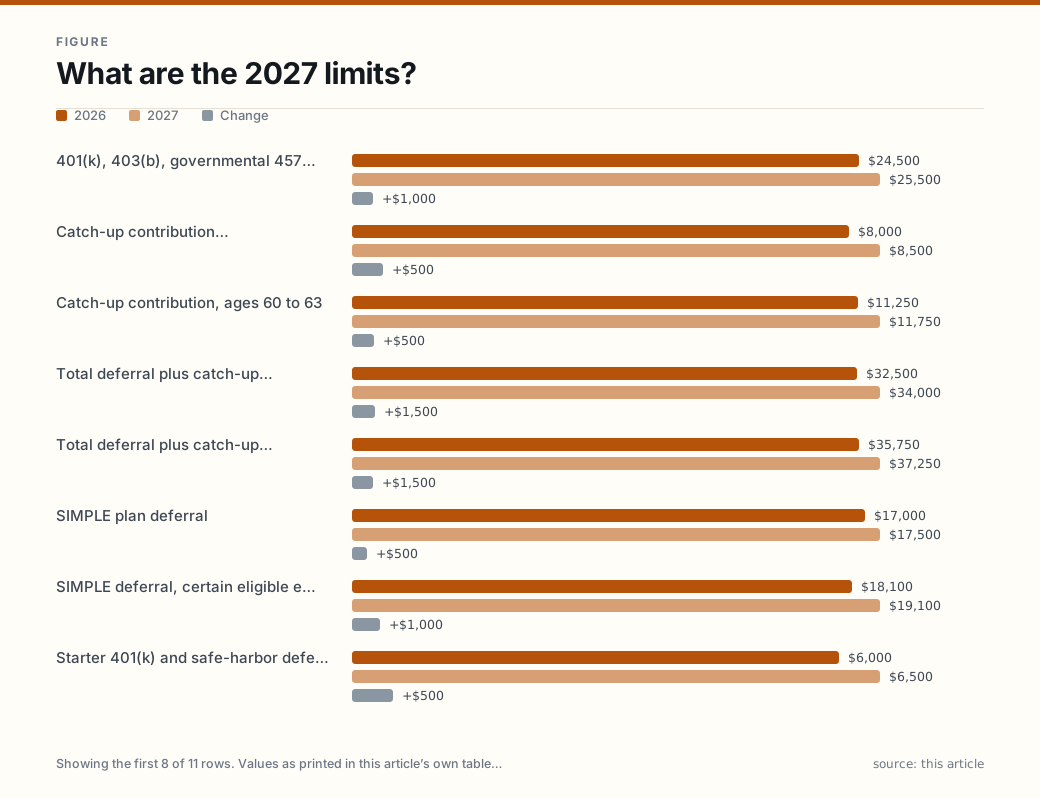
What are the 2027 limits?
| Limit | 2026 | 2027 | Change |
|---|---|---|---|
| 401(k), 403(b), governmental 457, TSP elective deferral | $24,500 | $25,500 | +$1,000 |
| Catch-up contribution, age 50 and over | $8,000 | $8,500 | +$500 |
| Catch-up contribution, ages 60 to 63 | $11,250 | $11,750 | +$500 |
| Total deferral plus catch-up, age 50 and over | $32,500 | $34,000 | +$1,500 |
| Total deferral plus catch-up, ages 60 to 63 | $35,750 | $37,250 | +$1,500 |
| Traditional and Roth IRA contribution | $7,500 | $7,500 | none |
| IRA catch-up, age 50 and over | $1,100 | $1,100 | none |
| SIMPLE plan deferral | $17,000 | $17,500 | +$500 |
| SIMPLE deferral, certain eligible employers | $18,100 | $19,100 | +$1,000 |
| SIMPLE catch-up, age 50 and over | $4,000 | $4,000 | none |
| SIMPLE catch-up, ages 60 to 63 | $5,250 | $5,250 | none |
| Starter 401(k) and safe-harbor deferral-only plans | $6,000 | $6,500 | +$500 |
| Defined contribution annual additions, section 415(c) | $72,000 | $75,000 | +$3,000 |
| Defined benefit annual benefit, section 415(b) | $290,000 | $300,000 | +$10,000 |
| Annual compensation limit, section 401(a)(17) | $360,000 | $375,000 | +$15,000 |
Every 2026 and 2027 figure in that table is stated in Notice 2026-66 or IR-2026-136; the two “total” rows are additions of the rows above them. The $34,000 total for age 50 and over also appears in the release in words — participants “generally can contribute up to $34,000 each year, starting in 2027.” The $37,250 total for ages 60 to 63 is our arithmetic: $25,500 plus $11,750. Both SIMPLE catch-up limits are left unchanged for 2027, and a third SIMPLE catch-up — $3,850 for catch-up contributions to certain SIMPLE 401(k) and SIMPLE IRA plans — also stays at its 2026 level.
The 415(c) and 401(a)(17) rows are not personal limits in the way the deferral cap is. They cap what can go into a defined contribution account from all sources combined, and what portion of your pay a plan may count when it calculates contributions or a match — figures that matter most to business owners, partners and anyone whose employer contributes a percentage of salary.
What is the Roth catch-up rule, and why is $155,000 the number to watch?
Section 603 of the SECURE 2.0 Act of 2022 added section 414(v)(7) to the tax code. In the words of the final regulations, where a catch-up eligible participant’s FICA wages “for the preceding calendar year from the employer sponsoring the plan exceeded” the threshold, the catch-up exception “applies only if any catch-up contributions made by the participant are designated Roth contributions.”
Plainly: if you are 50 or older and your 2026 wages from the employer that runs your plan topped $155,000, then the extra $8,500 you put in during 2027 has to be Roth. You pay income tax on it now; qualified withdrawals later come out tax-free. The choice between pre-tax and Roth — the trade-off worked through in Roth versus traditional — stops being yours.
Four details do most of the work, and each one is narrower than the headline suggests:
- It is FICA wages, from that employer, in the prior year. Not adjusted gross income, not household income, not investment income. The regulations describe FICA wages as wages “for purposes of the Federal Insurance Contributions Act,” which is Box 3 of your W-2. A high-earning spouse does not push you over the line, and a second job generally does not either.
- No FICA wages means no requirement. The regulations state that an individual with no FICA wages from the plan-sponsoring employer for the preceding year — “a partner who had only self-employment income,” a railroad employee covered by a different tax, or a state or local employee whose service was excluded — “would not be subject to the Roth catch-up requirement.” The regulations’ own examples run the boundary at $155,000, so this is the figure they expect plans to apply for 2027.
- The threshold moves in $5,000 steps. The statute set $145,000 and indexed it, rounding down to the next lower multiple of $5,000. That is why it went to $150,000 for 2026 and to $155,000 now, rather than tracking inflation precisely.
- 2027 is when the detailed rules bind, not when the requirement starts. The requirement itself has applied since 2026: the IRS’s administrative transition period covered only the first two tax years after 2023, and for years before the regulations’ applicability date a “reasonable, good faith interpretation standard” applies. The regulations “generally apply with respect to contributions in taxable years beginning after December 31, 2026” — which is 2027. Collectively bargained plans and governmental plans (a category that includes governmental 457(b) plans) have later applicability dates.
One consequence deserves its own paragraph, because it is the one readers cannot fix in January. Section 414(v)(7)(B) provides that if the Roth catch-up requirement applies to any participant in a plan for a plan year, the catch-up exception “does not apply to the plan unless the plan provides that any catch-up eligible participant may make catch-up contributions as designated Roth contributions.” A 401(k) with no Roth feature therefore cannot accept catch-up contributions from affected participants at all — for anyone in the plan. The regulations soften the mechanics in one respect: a plan may treat a pre-tax catch-up election as Roth automatically, a “deemed Roth election,” provided the participant had an effective opportunity to elect otherwise. That protects against a payroll error, not against a plan that never added the feature.
What the switch costs in the current year. Take a single filer whose 2026 FICA wages were $200,000 — above the threshold, so the requirement applies — who expects the same $200,000 in 2027 and makes the full $8,500 catch-up. The 2027 24% bracket runs from $109,125 to $208,325 of taxable income, and $200,000 minus the $16,600 standard deduction lands inside it. At 24%, deferring $8,500 pre-tax would have reduced 2027 taxable income by $8,500 and tax by $2,040; as a Roth contribution it reduces neither. On a joint return at the same wage level the 22% bracket applies, so the same switch costs $1,870. For someone aged 60 to 63 taking the $11,750 catch-up, the 24% figure is $2,820.
That is a timing difference, not a loss: the Roth balance is after-tax money, and the comparison depends on the rate you expect to pay when you withdraw. The point for December is narrower — a larger share of your 2027 contribution is now locked into one tax treatment, so the size of the catch-up is worth revisiting rather than defaulting.
How do the IRA phase-out ranges move?
| Rule | 2026 | 2027 |
|---|---|---|
| Traditional IRA deduction, single or head of household covered by a workplace plan | $81,000–$91,000 | $83,000–$93,000 |
| Traditional IRA deduction, joint return, contributing spouse covered | $129,000–$149,000 | $133,000–$153,000 |
| Traditional IRA deduction, joint return, contributor not covered but spouse is | $242,000–$252,000 | $250,000–$260,000 |
| Roth IRA contributions, single or head of household | $153,000–$168,000 | $158,000–$173,000 |
| Roth IRA contributions, joint return | $242,000–$252,000 | $250,000–$260,000 |
A married individual filing separately who is covered by a workplace plan stays at $0 to $10,000 for the deduction, and at $0 to $10,000 for Roth contributions; both ranges are excluded from the annual adjustment. The ranges are modified adjusted gross income, and they apply to the year of the contribution — a 2026 contribution is tested against the 2026 ranges even if you make it in April 2027.
A row in that table is where the numbers sit; it is not the whole rule. Inside the Roth range the limit is prorated rather than cut off, rounded up to the next $10, and floored at $200 for any result above zero, and the income figure being tested is a worksheet figure rather than the adjusted gross income on your return. Those four mechanics, with the 2027 arithmetic worked out line by line, are on the Roth IRA income limits page for 2027.
What else moved that most coverage skips?
These are the figures in Notice 2026-66 that rarely make the press release. Most are employer-side, or matter to a narrow group of savers, but each is a real 2027 number:
| Item | 2026 | 2027 |
|---|---|---|
| Highly compensated employee threshold, section 414(q)(1)(B) | $160,000 | $170,000 |
| Key employee threshold for top-heavy plans, section 416(i)(1)(A)(i) | $235,000 | $245,000 |
| Qualified charitable distribution limit, section 408(d)(8)(A) | $111,000 | $114,000 |
| One-time QCD to a split-interest entity, section 408(d)(8)(F)(i)(II) | $55,000 | $57,000 |
| Qualifying longevity annuity contract premium limit | $210,000 | $220,000 |
| Pension-linked emergency savings account limit, section 402A(e)(3)(A)(i) | $2,600 | $2,700 |
| Domestic abuse victim distribution, section 72(t)(2)(K)(ii)(I) | $10,500 | $10,900 |
| ESOP maximum balance for a five-year distribution, section 409(o)(1)(C)(ii) | $1,455,000 | $1,505,000 |
| SIMPLE additional nonelective contribution, section 408(p)(2)(A)(iv) | $5,300 | $5,400 |
Two of these are worth naming for households rather than employers. The qualified charitable distribution limit is the annual amount someone 70½ or older can send from an IRA directly to a charity and exclude from income; it rises to $114,000, and the one-time election for a split-interest entity rises to $57,000. And the domestic abuse distribution — a penalty-free withdrawal from an eligible retirement plan — rises to $10,900. The ESOP figure governs how a departing employee’s stock account is paid out.
What happens to the Saver’s Credit in 2027?
It is replaced, for retirement contributions, by the Saver’s Match. For tax years beginning after December 31, 2026, the match replaces the Saver’s Credit under section 25B “with respect to elective contributions to qualifying retirement plans and IRAs,” according to Notice 2026-48 — but the credit “continues to be available after December 31, 2026, with respect to contributions made to ABLE accounts.”
The mechanics, from the IRS program page:
- The match is 50% of the first $2,000 contributed, up to $1,000 per person per year. On a joint return the match applies to each spouse.
- It is paid into the retirement account, not applied against tax. That is the substantive difference from a credit: it works even for someone who owes no income tax.
- It is claimed, not automatic. You file Form 8880-A with your 2027 return in 2028 and designate where the match goes.
- Income limits for 2027:
| Filing status | Full 50% match | Partial match | No match |
|---|---|---|---|
| Married filing jointly, qualifying surviving spouse | up to $41,000 | $41,001–$70,999 | $71,000 and above |
| Head of household | up to $30,750 | $30,751–$53,249 | $53,250 and above |
| Single, married filing separately | up to $20,500 | $20,501–$35,499 | $35,500 and above |
The income test uses modified adjusted gross income, which for this purpose starts with adjusted gross income and adds back certain excluded or deducted amounts, including pre-tax retirement contributions and certain foreign earned income. Eligibility also requires being 18 by the end of the tax year, not a full-time student, not claimed as a dependent, and a U.S. resident for tax purposes.
For 2027 the Saver’s Credit’s own income limits, which now apply only to ABLE contributions, are $83,000 for a joint return, $62,250 for head of household and $41,500 for single filers and married individuals filing separately. Executive Order 14403 directs the Treasury Secretary, by January 1, 2027, to establish TrumpIRA.gov — a site the IRS expects to list financial institutions that offer IRAs and accept Saver’s Match contributions. Plans and IRAs are not obliged to accept match contributions, so whether your account can receive one is a question for your provider.
What should you do before December 31, 2026?
- Estimate your 2026 FICA wages now. Your W-2 arrives in January, but your pay stubs and Box 3 of last year’s W-2 are close enough to see whether you are near $155,000. If you are, the question is not how much to contribute but whether your plan can accept a Roth catch-up at all.
- Ask your plan administrator one specific question. Not “do you offer Roth?” — many plans do, for elective deferrals. Ask whether the plan permits catch-up contributions as designated Roth contributions, which is the narrower thing section 414(v)(7)(B) requires.
- Set the 2027 deferral percentage against the right ceiling. $25,500 if you are under 50, $34,000 if you are 50 or older, $37,250 if you turn 60 to 63 in 2027. Payroll systems often carry the prior year’s cap until someone updates it. And if your plan automatically enrolled you, the default rate it chose deserves the same check — the mandate behind it, with its 3% default and annual one-point rises, is covered in our guide to the 2026 auto-enrollment rules.
- Do not move a 2026 contribution into 2027 to use a bigger limit. The limit belongs to the year the contribution is made; a January 2027 contribution counts against 2027 and cannot be attributed back.
- If you are 70½ or older, date the charitable distribution. $111,000 can be excluded from income for 2026, $114,000 for 2027, and the transfer must be completed in the year you intend to use.
- Read the notice, not the summary, for anything that matters. Notice 2026-66 is a public PDF and each figure sits in a labelled paragraph with its statutory cite attached.
None of this involves a phone call from the IRS. The agency does not call, text or email to “confirm” a contribution limit or a Saver’s Match deposit, and a message that asks you to verify a figure or a bank detail is following the impersonation pattern catalogued in the America.gov scam checklist.
Bottom line
On November 12, 2026 the IRS set the 2027 retirement limits in Notice 2026-66: $25,500 for 401(k), 403(b), governmental 457 and Thrift Savings Plan deferrals, $8,500 for the age-50 catch-up ($34,000 in total), $11,750 for the ages 60 to 63 catch-up, and an IRA limit unchanged at $7,500 — while the Roth catch-up wage threshold rises to $155,000, tested against 2026 FICA wages, so that a 50-or-older employee above that line must make 2027 catch-up contributions as Roth or, if the plan lacks a Roth option, cannot make them at all.
This article explains federal retirement plan figures published by the IRS in general terms; it is not personal tax or investment advice, and it does not account for state tax treatment, which each state sets under its own law. The figures are federal and apply to contributions made in 2027 unless stated otherwise.
Frequently asked questions
- How much can I put in a 401(k) in 2027?
- The elective deferral limit for 401(k), 403(b), governmental 457 plans and the federal Thrift Savings Plan is $25,500 for 2027, up from $24,500. If you are 50 or older, the catch-up contribution limit is $8,500, which the IRS describes as a total of up to $34,000. Employees who turn 60, 61, 62 or 63 in 2027 get a higher catch-up of $11,750, which comes to $37,250 in total — that second total is our arithmetic, not a figure the IRS states.
- Did the IRA limit go up for 2027?
- No. The IRA contribution limit stays at $7,500 and the IRA catch-up for people 50 and over stays at $1,100. What moved are the income ranges where the deduction and the Roth contribution phase out — for a single filer covered by a workplace plan, the traditional IRA deduction now phases out between $83,000 and $93,000 of modified adjusted gross income, up from $81,000 to $91,000.
- What is the Roth catch-up wage threshold for 2027?
- $155,000, up from $150,000, and it is tested against your 2026 FICA wages from the employer that sponsors the plan — Box 3 of your W-2, not your adjusted gross income. Above that figure, catch-up contributions made in 2027 must be designated Roth contributions, so they are taxed now instead of later.
- Does the Roth catch-up rule apply to IRAs and SIMPLE plans?
- No. The statute excludes SEP arrangements and SIMPLE IRA plans, and it does not reach IRAs at all. It applies to 401(k), 403(b) and eligible governmental 457(b) plans, and the final regulations give collectively bargained plans and governmental plans later applicability dates.
- What if my 401(k) does not offer Roth contributions?
- That is the case to raise with your employer before December. Under the statute, if the Roth catch-up requirement applies to any participant in a plan for a plan year, the catch-up exception does not apply to that plan for the year unless the plan permits catch-up contributions as designated Roth contributions. A plan with no Roth option therefore cannot let affected participants make catch-up contributions at all until it adds one.
- Is the Saver's Credit still available in 2027?
- Not for retirement contributions. For tax years beginning after December 31, 2026, the Saver's Match replaces the Saver's Credit for contributions to retirement plans and IRAs: a 50% match on the first $2,000 contributed, up to $1,000 per person, paid into the retirement account and claimed on Form 8880-A with the 2027 return filed in 2028. Contributions to ABLE accounts can still use the Saver's Credit.
- What happens if I contribute more than the $25,500 limit?
- The deferral limit applies across every plan you participate in during the year, so two jobs means two combined deferrals — the IRS instructs savers to aggregate all elective deferrals to test against the limit. If you still over-contribute, notify your plan administrator before April 15 of the following year to have the excess, adjusted for earnings, distributed to you. Withdrawn by that April 15, a pre-tax excess is taxed in the year contributed and the earnings in the year distributed, with no 10% early-distribution tax; an excess of designated Roth contributions is not taxed at withdrawal, because Roth deferrals were never excluded from income in the first place. Left in the plan, a pre-tax excess is taxed twice — once when contributed and again when distributed — and the plan reports the correction on Form 1099-R.
- Do these 2027 figures apply to the return I file in April 2027?
- No. The return filed in early 2027 reports tax year 2026, and the 2026 limits — $24,500 for a 401(k), $7,500 for an IRA, $8,000 for the age-50 catch-up — apply to it. The 2027 amounts apply to contributions made in 2027 and to the return filed in 2028.
Sources
Each source is a primary or official reference, checked before publication. Links open the original.
- Internal Revenue Service — news release IR-2026-136, '401(k) limit increases to $25,500 for 2027, IRA limit remains $7,500' (November 12, 2026): the deferral, IRA, catch-up, SIMPLE, Roth and traditional IRA phase-out ranges, and Saver's Credit income limits — irs.gov/newsroom/401k-limit-increases-to-25500-for-2027-ira-limit-remains-7500
- Internal Revenue Service — Notice 2026-66, '2027 Amounts Relating to Retirement Plans and IRAs, as Adjusted for Changes in Cost-of-Living' (released November 12, 2026), the operative six-page determination: section 415(b) and 415(c) limits, the Roth catch-up wage threshold, the highly compensated employee and key employee thresholds, the section 401(a)(17) compensation limit, qualified charitable distributions, QLAC premiums and the Saver's Credit figures — irs.gov/pub/irs-drop/n-26-66.pdf
- Internal Revenue Service — Treasury Decision 10033, 'Catch-Up Contributions', final regulations published in the Federal Register on September 16, 2025 (document 2025-17865): the text of section 414(v)(7)(A) through (E), the rule in section 414(v)(7)(B) that a plan must permit Roth catch-up contributions, the general applicability date of contributions in taxable years beginning after December 31, 2026, and the reasonable good-faith standard for earlier years — federalregister.gov/documents/2025/09/16/2025-17865/catch-up-contributions
- Internal Revenue Service — 'Saver's Match' program page, for the 50% match on the first $2,000, the $1,000 annual maximum, the eligibility conditions, the modified adjusted gross income bands for 2027 and Form 8880-A — irs.gov/credits-deductions/savers-match
- Internal Revenue Service — Notice 2026-48, 'Notice of Intent to Issue Regulations with Respect to Saver's Match Contributions' (2026), for the rule that Saver's Match contributions replace the Saver's Credit for elective contributions to qualifying retirement plans and IRAs for taxable years beginning after December 31, 2026, while the Saver's Credit continues for ABLE account contributions — irs.gov/pub/irs-drop/n-26-48.pdf
- Internal Revenue Code — 26 U.S.C. § 414(v)(7), the Roth catch-up requirement, including the exclusion of SEP and SIMPLE IRA plans in subparagraph (C) and the inflation adjustment of the wage limitation in subparagraph (E) — law.cornell.edu/uscode/text/26/414
- Internal Revenue Code — 26 U.S.C. § 402(g)(2), the distribution of excess deferrals: allocation among plans by March 1 of the following year, distribution by April 15, exclusion of the corrective distribution from gross income, taxation of its earnings in the year distributed, and no section 72(t) penalty — law.cornell.edu/uscode/text/26/402
- Internal Revenue Service — 'Retirement topics - 401(k) and profit-sharing plan contribution limits', for the participant-side correction rules: aggregating elective deferrals across all plans, notifying the plan administrator before April 15 of the following year, the tax treatment of excess withdrawn versus not withdrawn by that date ('taxed twice, once when contributed and again when distributed'), and Form 1099-R reporting of corrective distributions — irs.gov/retirement-plans/plan-participant-employee/retirement-topics-401k-and-profit-sharing-plan-contribution-limits