Roth IRA income limits for 2027: $158,000 and $250,000 are where the $7,500 starts to shrink
In 2027 a single filer keeps the full $7,500 Roth IRA contribution below $158,000 of modified AGI and loses it at $173,000; joint filers: $250,000 to $260,000.
The short answer: for tax year 2027, the Roth IRA contribution limit is $7,500, and you can contribute all of it while your modified adjusted gross income stays below $158,000 as a single filer or head of household, or $250,000 on a joint return. The allowance is $0 at $173,000 and $260,000. Between those figures it falls in proportion to how far into the range you are. The numbers are in Notice 2026-66, which the Internal Revenue Service (IRS) released on November 12, 2026 alongside news release IR-2026-136.
The two thresholds are the part every summary quotes, and they are the part that decides almost nothing on its own. They tell you which side of a line you are on. They do not tell you how much of the $7,500 survives at $165,000, which income items are counted in the figure being compared, which tax year a January contribution should be attached to, or what to do when the year ends better than planned. Those four questions are what this page answers, in that order.
What are the Roth IRA income limits for 2027?
| Filing status | 2026 range | 2027 range | Width of the range |
|---|---|---|---|
| Single | $153,000–$168,000 | $158,000–$173,000 | $15,000 |
| Head of household | $153,000–$168,000 | $158,000–$173,000 | $15,000 |
| Married filing jointly, or qualifying surviving spouse | $242,000–$252,000 | $250,000–$260,000 | $10,000 |
| Married filing separately, lived with a spouse during the year | $0–$10,000 | $0–$10,000 | $10,000 |
Read a row as one sentence: below the first figure you may contribute the full limit, at or above the second figure you may not contribute directly at all, and inside the range the limit is reduced by the share of the range you have used.
Four things about that table are worth saying out loud.
- The dollar limit did not move. It stays at $7,500 for 2027, and the catch-up for someone 50 or older stays at $1,100, for a total of $8,600. Both are stated in IR-2026-136.
- The ranges did move, and not by the same amount. The single range rose $5,000 and the joint range $8,000. The width did not change, because the widths are fixed in the statute: $15,000 for everyone except joint filers and married people filing separately, who get $10,000 (section 408A(c)(3)(A)(ii)). Only the starting point is indexed, under section 408A(c)(3)(D).
- Age is not a bar. The IRS is explicit that contributions “can be made to your Roth IRA regardless of your age” (Publication 590-A), so a 78-year-old with compensation can still contribute.
- The limit is per person but shared across account types. A dollar contributed to a traditional IRA for the same year reduces the Roth room dollar for dollar, because the $7,500 ceiling covers all of your IRAs, not each of them.
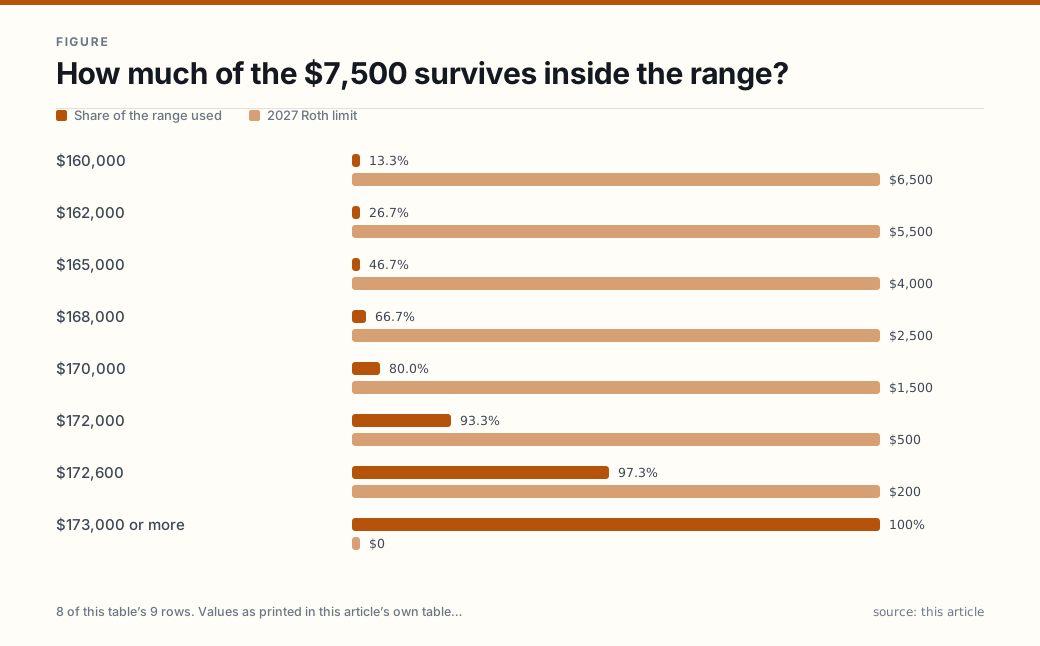
How much of the $7,500 survives inside the range?
The statute does not step the limit down; it prorates it. One line reproduces the whole rule:
2027 limit = $7,500 − ($7,500 × (modified AGI − the first figure in your row) ÷ the width of your row)
Two adjustments then apply, and both are in the IRS worksheet rather than in the statute. The result is rounded up to the next $10, and if it is more than $0 but less than $200, it becomes $200 (Publication 590-A, Worksheet 2-2 line 8 and the tip that follows it). For a single filer under 50, the curve looks like this:
| Modified AGI (single) | Share of the range used | 2027 Roth limit |
|---|---|---|
| $158,000 or less | none | $7,500 |
| $160,000 | 13.3% | $6,500 |
| $162,000 | 26.7% | $5,500 |
| $165,000 | 46.7% | $4,000 |
| $168,000 | 66.7% | $2,500 |
| $170,000 | 80.0% | $1,500 |
| $172,000 | 93.3% | $500 |
| $172,600 | 97.3% | $200 |
| $173,000 or more | 100% | $0 |
On a joint return the same arithmetic uses $250,000 as the starting point and $10,000 as the width, which makes the slope steeper: $255,000 leaves $3,750, and $258,000 leaves $1,500.
Two details in that table are worth more than the other six rows.
The rounding runs upward. Whatever the fraction produces, the answer is rounded to the next $10 rather than the nearest one, so the rule never works against you by more than $9. It is a small kindness, but it is why a hand calculation that lands on $6,503 should be written down as $6,510.
The $200 floor is real, and it covers the last $400 of the range. Once the proportional reduction would take the limit below $200 but not to zero, the limit is $200. On a single return that band starts at $172,600, so an income of $172,900 still permits a $200 contribution while $173,000 permits none. Whether a $200 contribution is worth the paperwork is a separate judgement; the point here is that the range does not hand you a cliff edge.
If you are 50 or older, substitute $8,600 for $7,500 as the number being reduced, and keep the same range. At $165,000 on a single return the answer becomes $4,590 rather than $4,000, because the reduction is a percentage of the larger total.
Which income figure is being tested?
The figure is modified adjusted gross income for Roth IRA purposes, and it is not the adjusted gross income on your return. Worksheet 2-1 in Publication 590-A builds it in a specific order — one subtraction and six add-backs — and the order matters because two of those adjustments are counter-intuitive:
- Start with adjusted gross income (Form 1040, line 11a).
- Subtract any amount included from converting a traditional IRA, or rolling over a workplace plan balance, into a Roth IRA.
- Add back the traditional IRA deduction, the student loan interest deduction, the foreign earned income and housing exclusion, the foreign housing deduction, excludable savings bond interest under the education exclusion, and excluded employer-provided adoption benefits.
Four consequences follow, and each one changes a decision a reader might otherwise make in the wrong month.
A conversion does not disqualify you. Section 408A(c)(3)(B)(i) requires that amounts included in income on a conversion be left out of this particular figure, and the worksheet carries that out. Converting $100,000 in December does not push you over the Roth range for a contribution made for the same year. It does raise adjusted gross income for everything else built on it — the Medicare income-related premiums two years later, marketplace premium credits, the taxation of Social Security — which is the argument for modelling a conversion before running it, as our year-end money moves page sets out.
A deductible traditional contribution buys no Roth room. The traditional IRA deduction is added back, so deducting $7,500 does not lower the figure that decides Roth eligibility by $7,500. The two accounts compete for one ceiling; they do not relieve each other.
A capital gain counts. Realized gains sit in adjusted gross income, so they raise the figure being tested. If you are near a threshold and planning a December sale, the contribution decision comes before the sale, not after it; the mechanics of the gain itself are in capital gains basics.
Tax-exempt interest does not count. Municipal bond interest is excluded from adjusted gross income and is not one of the add-backs, so it does not enter this test at all — unlike the Social Security and Medicare tests, where it does.
And one timing rule that is easy to state and easy to forget: the test uses the income of the year the contribution is for, not the year it is made. A 2026 contribution made in April 2027 is measured against 2026 income.
Which tax year should a January contribution be attached to?
From January 1 until the due date of the previous year’s return, two contribution years are open at once. Publication 590-A allows a contribution for a year up to the due date for filing that year’s return, not counting extensions, and section 6072(a) sets that date at April 15. In 2027, April 15 falls on a Thursday, so the 2026 window closes on April 15, 2027 with no weekend shift.
That gives a saver two years and two different ranges to choose between, and the custodian will ask which year the money is for.
- A single filer with $170,000 of modified AGI in both years gets nothing for 2026, because $170,000 is above that year’s $168,000 ceiling, and $1,500 for 2027, because $170,000 is 80 percent of the way through the 2027 range. Designating the contribution for 2027 is worth $1,500; designating it for 2026 is worth nothing.
- A single filer with $150,000 in 2026 and $170,000 in 2027 should fill 2026 first: $150,000 is below the 2026 floor, so the full $7,500 is available for that year, while 2027 offers only $1,500. Doing both is not double-dipping — each year carries its own $7,500.
The asymmetry that catches people is the deadline. You may contribute for a year only until the unextended due date, so a shortfall cannot be made up afterwards; Publication 590-A says so bluntly for the traditional account, and the shared ceiling means the same deadline governs the Roth side.
What if the year ends above the line?
Contributing in January against an estimated income and finding out in March that a bonus pushed you past the threshold is the most common version of this problem, and it has an orderly fix.
| Route | What it does | Deadline |
|---|---|---|
| Withdraw the excess with its earnings | Treated as never contributed | Due date of the return, including extensions |
| Recharacterize to a traditional IRA | The contribution is treated as having been made to the other account | Due date, including extensions |
| Apply it to a later year | Absorbs an under-contribution in a later year | When that later year’s contribution is made |
| Leave it | 6% excise tax for each year it remains | Until it is removed |
| Amend after filing | Return the contribution within 6 months of the unextended due date, with “Filed pursuant to section 301.9100-2” on the amended return | 6 months after the unextended due date |
Three things about that table are usually left out of shorter explanations.
The earnings are taxed in the year of the contribution, not the year of the withdrawal. Publication 590-A is explicit that the earnings on a withdrawn excess contribution “are considered earned and received in the year the excess contribution was made”. A correction made in 2028 for a 2027 excess therefore adjusts the 2027 return, not the 2028 one.
The correction window is longer than the contribution window. You may contribute for a year only until the unextended due date, but you may withdraw an excess until the extended one. The gap exists because the second deadline is tied to when the return is actually filed.
The 6 percent is annual, and it is not a one-off penalty. Section 4973(a) imposes the tax “for each taxable year” on the excess still in the account at the close of the year, capped at 6 percent of the account’s value, and it is reported on Form 5329. An excess left alone for three years costs roughly 18 percent of the amount in total, which is why the correction routes exist.
A conversion is not a contribution for any of this. Recharacterization of a conversion has been barred for conversions made after 2017, so a conversion made in a year that turns out badly cannot be unwound; only the contribution that preceded it can.
What if your income is above the top of the range altogether?
Direct contributions stop; conversions do not. The income test lives in section 408A(c)(3) and limits contributions. A conversion is governed by section 408A(d)(3), and the two are separate mechanisms.
The route most readers have heard of is a nondeductible traditional IRA contribution followed by a conversion. Read plainly, it is two ordinary steps, not a product: contribute to a traditional IRA without taking a deduction, then convert the balance. If the contribution was nondeductible and the account earned nothing in between, the conversion is taxable on the gain only.
The trap is the pro-rata rule. When you convert, the taxable share is computed from your basis divided across the year-end value of all your traditional, SEP and SIMPLE IRAs plus everything you converted or distributed during the year — Form 8606, line 9 — not from which dollars you chose to move. An old pre-tax rollover IRA therefore turns a mostly tax-free conversion into a mostly taxable one, and the fix — rolling that pre-tax balance into a workplace plan first — depends on whether the plan accepts rollovers. Our Roth or traditional page works through the fraction and Form 8606; the practical point for this page is that the backdoor is a straightforward move with a specific, computable cost, and that the cost is set by accounts you may have forgotten about.
Who cannot contribute at all?
Four groups, and only one of them is about income.
- Anyone with no taxable compensation. The contribution limit is the lesser of $7,500 (or $8,600 at 50 or older) and your taxable compensation, so a retiree living on withdrawals and Social Security has no room. The spousal exception covers a joint return where one spouse has compensation: the working spouse’s earnings support both contributions, subject to a joint modified AGI below the top of the joint range.
- A married person filing separately who lived with a spouse at any time during the year. The range is $0 to $10,000, so any income above zero is already inside the phase-out, and any income at $10,000 or more eliminates the contribution. Filing separately and living apart for the whole year is treated differently; Publication 590-A Table 2-1 puts that filer in the single row.
- Anyone above the top of the range, for direct contributions only. The conversion route above remains available.
- Nobody else. Age, employment status and the existence of a workplace plan do not affect Roth IRA eligibility; the workplace plan question belongs to the traditional IRA deduction, not to this test.
What should you do, in order?
- Find your row. Filing status first, then the 2027 range: $158,000 to $173,000 single or head of household, $250,000 to $260,000 joint, and $0 to $10,000 for a married person filing separately who lived with a spouse during the year.
- Build the modified AGI figure before you compare it, using the seven adjustments above — and remember that the traditional IRA deduction is added back and a conversion is subtracted.
- If you are inside the range, compute the share rather than guessing, then round up to the next $10 and apply the $200 floor.
- If two contribution years are open, decide which year the money is for before it leaves your account. The 2026 range is lower, so a year with lower income is usually the better target.
- If you are above the top, decide between no contribution and the conversion route, and price the pro-rata fraction first if you hold a pre-tax IRA.
- If you have already contributed and the year moved against you, use the correction table rather than waiting for the excise tax to find you.
The 2027 figures are set. What remains is arithmetic on your own return, and the arithmetic is more forgiving than the headlines suggest: at $165,000 a single filer still has $4,000 of room, and at $172,900, $200.
Scope. Federal income tax only. State income tax treatment of Roth contributions and qualified distributions is set by state law and is not addressed here; a state that does not follow the federal treatment can change the after-tax comparison, so check your own state’s guidance before assuming the federal answer carries over. The figures are for tax year 2027 and will be restated again in late 2027 for 2028.
Frequently asked questions
- What are the Roth IRA income limits for 2027?
- The phase-out runs from $158,000 to $173,000 of modified adjusted gross income for a single filer or a head of household, and from $250,000 to $260,000 for a married couple filing jointly or a qualifying surviving spouse. Below the first figure the full $7,500 is available; at or above the second the direct contribution limit is zero. A married person filing separately who lived with a spouse at any time during the year has a range of $0 to $10,000, which puts any income above zero inside the phase-out and eliminates the contribution at $10,000 or more. The figures are in Notice 2026-66, released November 12, 2026.
- Do I lose the whole $7,500 the moment I cross $158,000?
- No. Crossing the first figure starts a proportional reduction, not a cliff. At $160,000 of modified AGI a single filer keeps $6,500; at $165,000, $4,000; at $170,000, $1,500. The reduction is rounded in the taxpayer's favor to the next $10, and there is a floor of $200 for any result that is above zero but below $200, so the top $400 of the range is still worth $200 rather than nothing.
- Does a Roth conversion count against the income limit?
- Not for this test. The statute requires income from a conversion or a Roth rollover to be left out of the modified adjusted gross income figure, and Worksheet 2-1 in Publication 590-A subtracts it before the comparison. A large December conversion therefore does not disqualify a contribution made for the same year. It does raise adjusted gross income for other tests, including the Medicare income-related premiums two years later.
- Can I still contribute for 2026 after January 1, 2027?
- Yes, until the due date of the 2026 return, not counting extensions, which is April 15, 2027. But it is a different test: the 2026 range is $153,000 to $168,000 for a single filer, so someone with $170,000 of income in both years gets nothing for 2026 and $1,500 for 2027. The year the contribution is designated for decides which range applies, and the custodian asks which year when the money arrives.
- What if I already contributed the full $7,500 and my income came in higher?
- The excess is a 6 percent excise tax for each year it stays in the account. Withdraw it along with the earnings it produced by the due date of your return including extensions and it is treated as never contributed, with the earnings taxed in the year the contribution was made. Recharacterizing the contribution to a traditional IRA is the other route. A conversion cannot be recharacterized, only a contribution.
- Does the $155,000 Roth catch-up threshold apply to IRAs?
- No. That threshold is in section 414(v)(7) and applies to catch-up contributions in workplace plans such as a 401(k), not to IRAs. For a Roth IRA the only income test is the phase-out above, and the catch-up for someone 50 or older is $1,100 — but it is not tested separately: the $8,600 total goes through the same reduction, which is why the same income leaves an older saver with $4,590 where a younger one keeps $4,000.
Sources
Each source is a primary or official reference, checked before publication. Links open the original.
- Internal Revenue Service — Notice 2026-66, '2027 Amounts Relating to Retirement Plans and IRAs, as Adjusted for Changes in Cost-of-Living' (released November 12, 2026): the IRA limit held at $7,500 and the $1,100 catch-up under section 219(b)(5), the 2027 Roth IRA phase-out ranges of $158,000 to $173,000 for singles and heads of household and $250,000 to $260,000 for joint returns, the $0 floor for a married individual filing separately, and the 2026 figures quoted for comparison — irs.gov/pub/irs-drop/n-26-66.pdf
- Internal Revenue Service — news release IR-2026-136, '401(k) limit increases to $25,500 for 2027, IRA limit remains $7,500' (November 12, 2026), which restates the phase-out ranges in the agency's own words, including that the single and head-of-household range applies to both and that the separate-return range is not indexed — irs.gov/newsroom/401k-limit-increases-to-25500-for-2027-ira-limit-remains-7500
- Internal Revenue Service — Publication 590-A (2025 edition), Contributions to Individual Retirement Arrangements, chapter 2: Worksheet 2-1 for modified adjusted gross income for Roth IRA purposes (line 2 removing conversion and rollover income, lines 4 through 9 adding back the traditional IRA deduction, student loan interest, the foreign earned income and housing exclusion, the foreign housing deduction, excludable savings bond interest and excluded adoption benefits), Worksheet 2-2 line 8 with the instruction to round the reduced limit up to the nearest $10 and to use $200 where the result is more than zero but less than $200, Table 2-1, the statement that contributions can be made regardless of age, the spousal contribution condition, the rule that a contribution may be made by the due date of the return not including extensions, the excess contribution and 6 percent excise tax discussion, and the recharacterization rules including the bar on recharacterizing conversions made after 2017 — irs.gov/pub/irs-pdf/p590a.pdf
- Internal Revenue Service — Form 8606, Nondeductible IRAs (2025), and the instructions for it: line 6 (the December 31 value of all traditional IRAs plus outstanding rollovers), line 8 (the net amount converted) and line 9 ('Add lines 6, 7, and 8'), which together give the denominator of the pro-rata fraction at line 10 ('Divide line 5 by line 9') — irs.gov/pub/irs-pdf/f8606.pdf and irs.gov/instructions/i8606
- 26 U.S.C. section 408A(c)(3), the statutory reduction formula: the limit is reduced by the ratio of the excess of adjusted gross income over the applicable dollar amount to $15,000 ($10,000 on a joint return or a separate return), with subparagraph (B)(i) directing that any amount included in gross income on a conversion not be taken into account, and subparagraph (D) indexing the dollar amounts — law.cornell.edu/uscode/text/26/408A
- 26 U.S.C. section 4973(a) and (f), the 6 percent excise tax imposed for each taxable year on excess contributions, capped at 6 percent of the account value, and the definition of an excess Roth contribution by reference to the amounts allowable under section 408A(c)(2) and (c)(3) — law.cornell.edu/uscode/text/26/4973
- 26 U.S.C. section 6072(a), which sets the due date for a calendar-year return at the 15th day of April following the close of the year, and so fixes the last day on which a contribution for that year may be made — law.cornell.edu/uscode/text/26/6072