Labor proposes to strip ESG language and the 'tiebreaker' from the 401(k) investment rule
On November 23, 2026 Labor proposed rewriting ERISA's investment-duties rule: an explicit duty to maximize, no tiebreaker, no participant-preference clause.
The ERISA duty of loyalty is the rule that whoever chooses investments for your workplace retirement plan must do it for one reason only: the financial benefit you get from the plan. On November 23, 2026 the U.S. Department of Labor’s Employee Benefits Security Administration (EBSA) proposed to rewrite the regulation that spells that duty out — 29 CFR 2550.404a-1, known as the investment-duties rule — in a 122-page notice that would delete the sentence naming climate change and other environmental, social or governance (ESG) effects as possible risk-return factors, remove the provision known as the tiebreaker, remove the provision that let a plan weigh participants’ preferences, and replace “may not subordinate” with a duty to maximize participants’ interests.
The notice is signed November 20, 2026, released on November 23 and printed on November 24 — the last of those dates is the one every deadline here runs from.
The proposal is not a rule. It binds nobody until a final rule is issued, and it says so itself: it “will apply only prospectively” and does not require a fiduciary to “divest or terminate any existing investment”. Comments run for 60 days after its November 24, 2026 Federal Register publication — by our count, January 23, 2027, since the notice prints a placeholder date rather than the deadline.
For a reader, the question is narrower than the argument that surrounds it: if this is finalized, what would change in the fund menu I was auto-enrolled into, and who decides how the shares behind it get voted? The short answer is that the menu would not have to change at all, but the justification a plan has to be able to produce for each fund on it would.
What is being replaced, and what came before it?
Three regulations and one executive order set this up, and the dates matter more than the labels.
| Instrument | Date | What it did |
|---|---|---|
| 2020 investment-duties rule | November 13, 2020 | Required decisions based “solely” on pecuniary factors, and barred any fund with a non-pecuniary objective from serving as a default investment |
| 2020 proxy-voting rule | December 16, 2020 | Said the duty to manage shareholder rights does not require voting every proxy; added a proxy-voting-policy safe harbour |
| 2022 rule (the one being amended) | December 1, 2022 | Added the climate/ESG sentence, restated the tiebreaker, added the participant-preference provision, and dropped the “not every proxy” statement |
| Executive Order 14366 | December 11, 2025 | Directed the Labor Secretary to strengthen ERISA fiduciary standards and assess whether proxy advisers act solely in participants’ financial interest |
| This proposal | November 24, 2026 (publication) | Would remove the ESG sentence, the tiebreaker and participant preference; add a duty to “maximize”; restore “not every proxy” |
One detail in that table is worth holding onto: the 2022 rule’s core requirement never changed. It still tells a fiduciary to base decisions on “factors that the fiduciary reasonably determines are relevant to a risk and return analysis”, with the weight given to any factor reflecting “a reasonable assessment of its impact on risk-return”. The proposal keeps that sentence and deletes only the following one, which named climate and other ESG effects as examples.
What would the amended paragraphs actually say?
The amendatory instruction is narrow: it revises paragraph (b)(4), paragraph (c), and paragraphs (d)(2)(i) and (ii). Everything else in § 2550.404a-1 stays as printed today.
| Paragraph | Current text | Proposed |
|---|---|---|
| (b)(4) Risk-return factors | Facts-and-circumstances test, plus “Risk and return factors may include the economic effects of climate change and other environmental, social, or governance factors” | Same test, ESG sentence deleted |
| (c)(1) Loyalty | A fiduciary “may not subordinate” participants’ interests “to other objectives”, and may not sacrifice return or add risk to promote unrelated goals | A fiduciary “shall discharge his duties … with the exclusive purpose of maximizing the interests of the participants and beneficiaries in their retirement income or financial benefits under the plan”, plus the same prohibition on sacrificing return |
| (c)(2) Tiebreaker | If a fiduciary “prudently concludes” that competing investments “equally serve the financial interests of the plan”, it may choose on “collateral benefits other than investment returns” | Deleted |
| (c)(3) Participant preference | No violation of the duty of loyalty “solely because the fiduciary takes into account participants’ preferences” | Deleted |
| (d)(2)(i) Shareholder rights | Duties when deciding whether to exercise shareholder rights; no statement about the frequency of voting | Adds that the duty “does not require the voting of every proxy or the exercise of every shareholder right”, and names “shareholder engagement” and “any other related investment courses of action” |
| (d)(2)(ii)(C) and (E) | “Not subordinate” the participants’ interests; monitor advisers and service providers | Conforms to the “maximize” language; adds shareholder engagement and “all other rights accompanying share ownership” to the monitoring duty |
Two paragraphs that people assume are being touched are not. Paragraph (d)(2)(iii) still says a fiduciary “may not adopt a practice of following the recommendations of a proxy advisory firm or other service provider without a determination” that the firm’s guidelines are consistent with the fiduciary’s obligations, and paragraph (d)(3) still lets a plan adopt proxy-voting policies with pre-set parameters, subject to periodic review. The proposal also does not restore the 2020 rule’s separate, stricter test for default funds: paragraph (c) as proposed is a single loyalty paragraph with no default-fund provision in it.
Does this remove ESG funds from 401(k) plans?
Not by its terms, and the department is explicit about that. The proposal “would not create a categorical prohibition on considering any type of information”, and a fiduciary “may consider any factor that the fiduciary reasonably determines is relevant to the risk-and-return analysis”. A fund with a sustainability mandate that a plan can justify on expected return and risk at least as well as the alternatives would still clear paragraph (b)(4) as proposed.
What changes is the vocabulary and the paper trail. Three specifics:
- Labels stop doing work in either direction. The department’s stated aim is that “ERISA neither favors nor disfavors any investment label or ideology.” A plan could not argue that a fund belongs in the menu because it is sustainable, and could not exclude one because of the label either.
- The decision must be justifiable on financial grounds alone. In the department’s framing, the fiduciary “may not start with an ulterior motive or consider any factors collateral to plan participants’ financial interests during any part of the process”.
- No forced sales. The proposal says it does not “necessarily require fiduciaries to divest or terminate any existing investment, investment course of action, or designated investment alternative”, and that compliance for existing holdings happens through the ongoing monitoring ERISA already requires.
The honest limit on all three: the department also says the prospective application “does not immunize fiduciaries’ actions and investment selections prior to the rule’s effectiveness”, and asks for comment on the reliance interests of plans that made decisions under the 2022 text. A plan that added a fund in 2024 is not promised a safe harbour for having done so.
What would change about proxy voting?
This is the half of the proposal that reaches furthest into a plan’s actual behaviour, and it is the half the executive order was written about.
- Voting every proxy is not the standard, again. The 2022 rule deleted the sentence saying the duty to manage shareholder rights “does not require the voting of every proxy”. The proposal puts it back, on the department’s view that the older guidance left “a misplaced belief among some stakeholders that fiduciaries must always and in every case vote proxies”.
- Shareholder engagement is named. Engagement — talking to management, joining other shareholders — now appears in the regulatory text alongside voting, together with “any other related investment courses of action”, so the duties apply to it on the face of the rule rather than by inference.
- The selection and monitoring duty is spelled out. Proposed paragraph (d)(2)(ii)(E) requires prudence and diligence in choosing and overseeing “persons … selected to exercise shareholder rights or otherwise advise on or assist with exercises of shareholder rights”, listing research, vote recommendations, engagement, administrative voting services and recordkeeping.
- Who votes is unchanged in law. Where your plan offers a mutual fund, the fund’s adviser votes the shares the fund holds; the proposal itself puts “investment managers of mutual funds” among the service providers who are not ERISA fiduciaries. The plan’s own duty applies where it holds stock directly, or through a separate account or a manager voting on its behalf — which is why the operative change is about how plans pick and monitor those managers and any proxy adviser behind them.
Who would this reach?
The department’s own count, from the notice’s affected-entity table:
| Measure | Estimate |
|---|---|
| ERISA pension plans affected | 837,000 |
| Plans the department expects to review or revise their investment policy statement | 30% |
| Plans it expects may need to change a menu or investment | about 15% |
| Participants in those plans | 6,146,000 |
| Service providers (plan administrators, investment managers, proxy advisers) | 6,950 |
| ESG-related holdings as a share of plan assets | about 0.2% |
Those last two figures are the reason the practical effect is smaller than the argument. The department puts ESG-related funds at roughly 0.2% of the $15.2 trillion held by ERISA-covered pension plans, assumes half of that would move, and therefore models about $15.2 billion of assets being allocated differently. It also notes that ESG-focused default funds are rare: a 2024 survey of defined-contribution consultants it cites found slightly less than 1% of plans with ESG funds on the menu had an ESG-focused default.
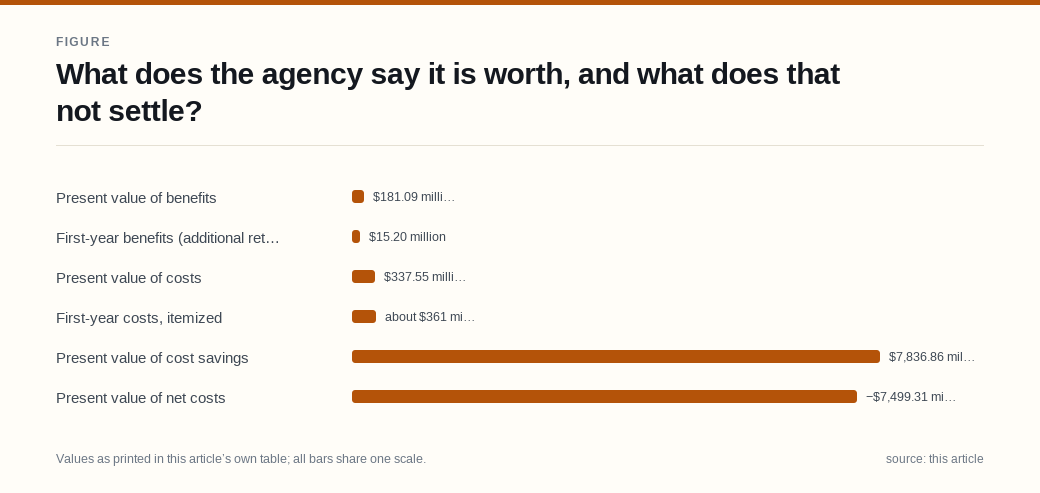
What does the agency say it is worth, and what does that not settle?
The regulatory-impact analysis is unusually lopsided, and worth reading before either side quotes it:
| Figure (7% discount, 2026-2035) | Amount |
|---|---|
| Present value of benefits | $181.09 million |
| First-year benefits (additional returns) | $15.20 million |
| Present value of costs | $337.55 million |
| First-year costs, itemized | about $361 million |
| Present value of cost savings | $7,836.86 million |
| Present value of net costs | −$7,499.31 million |
The savings do most of the work: about $618 million a year of reduced spending on proxy voting, $254 million a year on shareholder engagement at investment managers, and about $241 million a year at publicly traded corporations. Two cautions belong next to those numbers. First, some of that “saving” is money no longer spent by public companies, not by plans — a benefit to the corporation’s shareholders generally rather than to a given plan. Second, the department’s own comment request asks “whether the reductions in resources … should be characterized as benefits of the proposed rule rather than as cost savings”, which is an admission that the accounting is a choice.
The benefits rest on an assumption the department calls conservative: that the assets which move earn 10 basis points more a year, against the 63 basis points of underperformance one study it cites found for sustainable funds, with the department noting that the research findings “are mixed”.
Why is this contested?
Because the same text has already been litigated, and both readings survive contact with a court.
- The 2022 rule was challenged and upheld twice. A federal district court in the Northern District of Texas granted summary judgment for the department in 2023, relying on Chevron deference. After the Supreme Court decided Loper Bright in 2024, the Fifth Circuit vacated that judgment and remanded; on remand the court applied its independent judgment and again upheld the rule, reasoning that the 2022 text “does not permit a fiduciary to act for other interests than the beneficiaries’ or for other purposes than the beneficiaries’ financial benefit”.
- Its analogy is the dispute in miniature. The court compared a fiduciary to a driver told to take the fastest route who picks the more scenic of two equally fast roads: the destination and the time are the same, so the purpose was met. The department rejects that reading, arguing that ERISA’s loyalty duty is about process, not only outcome — that “exclusive means exclusive, and single means single”.
- Congress tried to disapprove the rule and failed. A joint resolution under the Congressional Review Act passed in 2023 and was vetoed; the department’s own summary of the history appears in this proposal.
- States are legislating around it. Several states have enacted measures on ESG investing, ESG-related proxy voting and boycotts of certain industries. The department notes that state law does not control the interpretation of ERISA; those statutes govern public pension systems, which ERISA does not reach.
Where that leaves a reader: the 2022 text itself said a fiduciary “may not … accept expected reduced returns or greater risks to secure such additional benefits”, which is the ground its defenders stand on; the department’s answer is that the tiebreaker gave a plan a defensible way around that very sentence. Both propositions are in the record above. Which one a final rule adopts is a question for the comment docket and, probably, the courts again.
What can you do before January 23, 2027?
- Comment, if you have something specific to say. Comments go to regulations.gov under file code 1210-AC37, or by mail to the Office of Regulations and Interpretations, EBSA, Room N-5655, 200 Constitution Avenue NW, Washington, DC 20210. The department asks for data — how often plans use proxy advisers, what engagement costs, whether ties occur — rather than positions.
- Ask for the plan’s investment policy statement. That is the document the department expects 30% of plans to review and revise, and the one that would have to explain why each fund on your menu is there.
- Find out how your plan holds its shares. A mutual-fund menu means the fund company votes; a separate account or company stock means the plan does. The answer decides whether this proposal touches anything you own.
- Do not act on a rumour that a fund is being removed. Nothing binds a plan until a final rule exists, and the proposal says compliance for existing investments runs through ordinary monitoring rather than divestment. A plan that tells you a fund must go in 2027 is ahead of the regulation.
- If you are choosing between funds, the menu question is unchanged. Cost and diversification still decide most of it — the comparison in index fund basics and the deferral limits in the 2027 plan limits do not depend on this rule.
One jurisdictional note, because this is a federal fiduciary standard and not a state one: which investments a plan may offer is governed by ERISA and the Internal Revenue Code, but the state tax treatment of your contributions and withdrawals still follows state law and varies by state. Nothing in this proposal changes that.
Bottom line
On November 23, 2026 the Labor Department proposed amending 29 CFR 2550.404a-1 so that plan fiduciaries must act “with the exclusive purpose of maximizing” participants’ retirement interests, deleting the sentence that named climate and other ESG effects as possible risk-return factors, removing the tiebreaker and the participant-preference provisions, and restoring the statement that fiduciaries need not vote every proxy. It is a proposal, not a rule: it binds no plan until a final rule issues, it applies prospectively, and it does not by its terms ban an ESG fund or require one to be sold. Comments run 60 days from the November 24, 2026 Federal Register publication — January 23, 2027 by our count — and the agency’s own estimate is that about 15% of 837,000 ERISA pension plans may need to change a menu or an investment, and 30% may need to revise an investment policy statement.
This article explains a proposed federal regulation in general terms; it is not legal, tax or investment advice. Whether a particular plan must change anything, and what its documents say, are questions for the plan administrator and the plan’s own counsel. State tax treatment of contributions and withdrawals varies by state.
Frequently asked questions
- Does this proposal ban ESG funds from 401(k) plans?
- No, on its face. The proposal says it 'would not create a categorical prohibition on considering any type of information', keeps the facts-and-circumstances test in paragraph (b)(4), and states that it applies only prospectively and does not require a fiduciary to divest or terminate an existing investment. What it removes is the sentence that named climate and other environmental, social or governance effects as possible risk-return factors, and the two provisions that let a plan choose on non-financial grounds — the tiebreaker and participant preference.
- When would any of this take effect?
- Not yet, and not automatically. This is a proposed rule; it binds nobody until the department issues a final rule, and the proposal states no applicability date of its own. Comments are due 60 days after the November 24, 2026 Federal Register publication, which by our count is January 23, 2027 — the notice itself carries a placeholder rather than a date.
- Can I still ask my employer to add a fund I want?
- You can ask, and the department says removing the participant-preference provision 'is not intended to signal that fiduciaries are prohibited from listening to participant preferences'. What the proposal removes is the regulatory sentence saying a fiduciary does not violate the duty of loyalty solely because it takes preferences into account. If the provision is finalized as proposed, acting on a preference would have to be justified by the plan's own risk-and-return analysis.
- Who actually votes the shares in my 401(k)?
- It depends on how the plan holds them. Where the plan offers a mutual fund, the fund's adviser votes the shares the fund holds, and the proposal itself notes that investment managers of mutual funds are generally not ERISA fiduciaries for that act. The plan's own voting duty bites where the plan holds stock directly or through a separate account or a manager that votes on the plan's behalf — which is why the proposal's proxy changes are about how plans select and monitor those managers and any proxy advisers.
- Did a court already rule on the 2022 version of this rule?
- Yes. A federal district court in Texas upheld the 2022 rule twice, first relying on Chevron deference and then, on remand after Loper Bright, on its own reading — concluding that 'the 2022 Rule does not permit a fiduciary to act for other interests than the beneficiaries' or for other purposes than the beneficiaries' financial benefit'. The department says in this proposal that it disagrees with that reasoning, and the case has been to the Fifth Circuit and back once already.
- Does this touch my pension if I am in a defined-benefit plan?
- The rule covers ERISA plans generally, defined-benefit plans included, but the department states that the new 'maximizing' language is not meant to bar a defined-benefit fiduciary from using a liability-driven investment strategy to reduce the risk of underfunding, nor to convert the duty into a demand for the highest possible return regardless of risk, diversification or plan terms.
Sources
Each source is a primary or official reference, checked before publication. Links open the original.
- U.S. Department of Labor, Employee Benefits Security Administration — 'Loyalty and the Exclusive Purpose Rule in Selecting Plan Investments and Exercising Shareholder Rights', proposed rule, 29 CFR Part 2550, RIN 1210-AC37, FR Doc. 2026-23936, signed November 20, 2026, filed for public inspection November 23, 2026 and published in the Federal Register on November 24, 2026 (122 pages): the amendatory text revising § 2550.404a-1(b)(4), (c) and (d)(2)(i) and (ii); the removal of the ESG sentence, the tiebreaker in (c)(2) and the participant-preference provision in (c)(3); the 'exclusive purpose of maximizing' language in new (c); the restored 'does not require the voting of every proxy' in (d)(2)(i); the affected-entity table (837,000 plans, 6,146,000 participants, 6,950 service providers); and the regulatory-impact figures — https://public-inspection.federalregister.gov/2026-23936.pdf
- U.S. Department of Labor — news release 26-1721-NAT, 'US Department of Labor proposes to update fiduciary rule to affirm Employee Retirement Income Security Act's exclusive purpose rule' (November 23, 2026), including Secretary of Labor Keith Sonderling's statement that plan fiduciaries 'must make investment decisions solely in the financial interests of workers and retirees', Assistant Secretary Daniel Aronowitz's statement on proxy advisers, the agency's description of the tiebreaker and participant-preference provisions as 'two departmental inventions', and its note that the rule publishes November 24 with comments due 60 days later — https://www.dol.gov/newsroom/releases/ebsa/ebsa20261123
- Federal Register — 'Prudence and Loyalty in Selecting Plan Investments and Exercising Shareholder Rights', final rule, FR Doc. 2022-25783, published December 1, 2022: the rule this proposal would amend, which added the climate and ESG sentence to paragraph (b)(4), restated the tiebreaker, added the participant-preference provision, and removed the statement that fiduciaries need not vote every proxy — https://www.federalregister.gov/documents/2022/12/01/2022-25783/prudence-and-loyalty-in-selecting-plan-investments-and-exercising-shareholder-rights
- eCFR — 29 CFR 2550.404a-1, 'Investment duties', current text of paragraphs (b)(4), (c)(1)–(3), (d)(2)(i)–(iii) and (d)(3), and the applicability notes at (g), which put the 2022 amendments into effect for investments made after January 30, 2023 (printed at the end of the 2022 rule's regulatory text) — https://www.ecfr.gov/current/title-29/subtitle-B/chapter-XXV/subchapter-F/part-2550/subpart-A/section-2550.404a-1
- 29 U.S.C. § 1104(a)(1)(A), the statutory duty of loyalty: a fiduciary must discharge duties 'solely in the interest of the participants and beneficiaries and … for the exclusive purpose of (i) providing benefits to participants and their beneficiaries; and (ii) defraying reasonable expenses of administering the plan' — https://www.law.cornell.edu/uscode/text/29/1104
- Federal Register — Executive Order 14366, 'Protecting American Investors From Foreign-Owned and Politically-Motivated Proxy Advisors' (signed December 11, 2025), FR Doc. 2025-23093, published December 16, 2025, section 4 of which directed the Secretary of Labor to strengthen ERISA's fiduciary standards and assess whether proxy advisers act solely in participants' financial interest — https://www.federalregister.gov/documents/2025/12/16/2025-23093/protecting-american-investors-from-foreign-owned-and-politically-motivated-proxy-advisors
- Federal Register — 'Financial Factors in Selecting Plan Investments', final rule, FR Doc. 2020-24515, published November 13, 2020, the 'pecuniary factors' rule and its separate, stricter treatment of qualified default investment alternatives, which the 2022 rule removed — https://www.federalregister.gov/documents/2020/11/13/2020-24515/financial-factors-in-selecting-plan-investments
- Federal Register — 'Fiduciary Duties Regarding Proxy Voting and Shareholder Rights', final rule, FR Doc. 2020-27465, published December 16, 2020, which added the statement that the duty to manage shareholder rights does not require voting every proxy, along with a proxy-voting-policy safe harbour the 2022 rule later removed — https://www.federalregister.gov/documents/2020/12/16/2020-27465/fiduciary-duties-regarding-proxy-voting-and-shareholder-rights