Social Security's Claiming Ages Get New Names: 'Full Retirement Age' Becomes 'Standard Monthly Benefit Age' by November 2027
H.R. 5284, signed November 20, 2026, renames Social Security's claiming-age terms by November 2027. The labels change; the 30% cut at 62 and 8% a year stay.
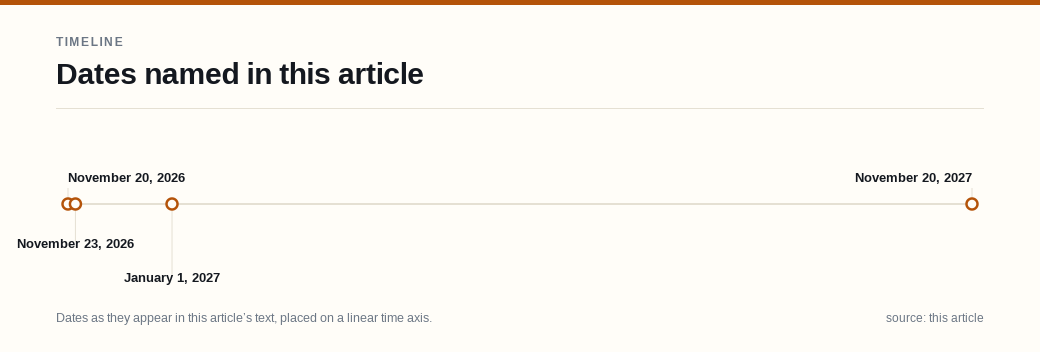
The Claiming Age Clarity Act, H.R. 5284, requires the Social Security Administration (SSA) to replace three terms it uses to describe when you can start retirement benefits, and it changes nothing else. President Donald Trump signed it into law on November 20, 2026, according to the White House’s signing statement. Under the enrolled text, “early eligibility age” becomes “minimum monthly benefit age”, “full retirement age” and “normal retirement age” both become “standard monthly benefit age”, and “delayed retirement credit” may no longer be used at all, with references to age 70 as the maximum age for those credits becoming “maximum monthly benefit age”.
No benefit amount, claiming age, reduction percentage or increase percentage moves. The law’s scope is the agency’s vocabulary — “any rules, regulation, guidance, or other materials of the Social Security Administration, whether online or in print.”
What changes, term by term
| Old term | New term | Age it names | The figure that stays |
|---|---|---|---|
| Early eligibility age | Minimum monthly benefit age | 62, the earliest age retirement benefits can start | 70% of the standard-age amount for anyone born in 1960 or later — a permanent 30% reduction |
| Full retirement age / normal retirement age | Standard monthly benefit age | 67 for anyone born in 1960 or later; 66 to 66 and 10 months for birth years 1943–1959 | 100% — the reference point every other figure is measured against |
| Delayed retirement credit (phrase prohibited); age 70 as the top age for those credits | Maximum monthly benefit age | 70, the last age at which waiting still increases the check | 8% for each 12 months of delay for people born in 1943 or later |
The third row is the one most summaries get slightly wrong, and the difference matters to anyone reading an SSA page during the transition. Sponsor materials describe the swap as “‘Delayed Retirement Credits’ will become ‘Maximum Monthly Benefit Age’.” The enrolled text does two separate things: it prohibits the phrase “delayed retirement credit” outright, and it renames the age at which that increase stops. The increase itself is not amended — the bill’s only operative section is the terminology directive, and the amount the increase adds is set in 42 U.S.C. § 402(w), which nothing in H.R. 5284 touches.
The deadline is a year out, and it is arithmetic
Section 2 does not give a fixed date. It gives a formula:
“Not later than the later of the date that is 12 months after the date of enactment of this Act or January 1, 2027, the Commissioner of Social Security shall ensure that, in any rules, regulation, guidance, or other materials of the Social Security Administration, whether online or in print—”
With enactment on November 20, 2026, twelve months lands on November 20, 2027, which is later than January 1, 2027. That makes November 20, 2027 the operative deadline — our arithmetic from the statutory formula, not a date the statute prints. The practical reading: the deadline is the earliest date the old words must be gone, not a date on which they disappear from every page — so seeing them on ssa.gov this winter is not an error, and the absence of a public announcement so far is not a sign the law was withdrawn.
As of this check, the old words are still everywhere
Two independent reads on November 23, 2026 — ours and the second, separate audit pass that every article here goes through before publication, described on our editors page — found no change yet:
- SSA’s retirement-age page, “Starting Your Retirement Benefits Early,” still says benefits are reduced for each month before “your full retirement age” and still carries the birth-year table that sets full retirement age at 67 for 1960 and later.
- SSA’s “Delayed Retirement Credits” page still uses the term in its title and still shows the 8.0% twelve-month rate for birth years 1943 or later.
- The regulation the agency’s own rules sit on, 20 C.F.R. § 404.313, is still headed “What are delayed retirement credits and how do they increase my old-age benefit amount?”
That last item is the reason the deadline is not purely a copy-editing exercise. Because the statute names “rules” and “regulation,” the Code of Federal Regulations text is in scope, and changing a regulation’s language ordinarily runs through the rulemaking process rather than a website deploy. Whether SSA finishes inside twelve months is, at this point, an open question about agency capacity — not something the text guarantees.
The math that decides your check has not moved
For anyone born in 1960 or later, the standard monthly benefit age is 67. The three numbers that matter are the same three as before November 20, 2026:
- Claim at 62: 70% of the age-67 amount. On a $1,000 standard benefit, $700 a month, permanently — SSA’s own table.
- Claim at 67: 100%, the reference point.
- Claim at 70: 124% of the age-67 amount, because the increase is 8% for each of the three 12-month periods between 67 and 70, and it stops at 70.
The gap between the ends is wider than the two percentages suggest. 124 ÷ 70 = 1.771, so waiting from 62 to 70 produces a check about 77% larger for the rest of your life — the arithmetic behind the “wait if you can” advice, unchanged by the renaming. What waiting costs is the eight years of checks you do not collect; that trade-off is the actual claiming decision, and no terminology change touches it.
Related, and also unaffected: the 2027 cost-of-living adjustment of 3.6% and the 2027 Medicare Part B premium of $209.40, both covered in our 2027 COLA and premium guide.
Three ways the new names can be misread
This section is our reading of how the labels will land, not a finding of the statute. The law says nothing about interpretation, and SSA has not published guidance on how it will phrase the accompanying explanations.
- “Minimum monthly benefit age” is an age, not a floor on your amount. The phrase describes age 62. It does not promise a minimum benefit, and it does not mean that everyone receives at least that much. Claim at 62 and you lock in 70% of your standard-age amount for life.
- “Maximum monthly benefit age” is not a cap. It names the age at which waiting stops adding to the check. It is not a ceiling on what any beneficiary can receive, and it does not mean benefits stop growing for someone who claims later than 70 for other reasons.
- A search for “delayed retirement credit” will match less over time. Once the phrase is prohibited in agency materials, the pages that explained the 8% rule under that name will be rewritten or retired. The rule will still exist, described in words that no longer include the term a reader may have written down years ago — which is the transition period’s real cost.
What to do
- If you already receive benefits: nothing. No form, no confirmation, no fee. The duty in the law runs to the Commissioner of Social Security, not to you.
- If you are still deciding when to claim: the decision is the same decision. Find your standard monthly benefit age by birth year (67 if you were born in 1960 or later), pull your own estimate from your my Social Security account rather than a table built on averages, and compare the three ages on your own numbers.
- Treat the transition as a scam opening. Any call, text or email offering to “update your record for the new benefit-age terms,” or to “register you for the maximum monthly benefit age” for a fee, is not a government process — SSA requires nothing from you under this law. The checklist in Is That Really America.gov? covers how to verify a contact before you act on it.
- Judge the letter by the source, not the vocabulary. After November 2027, SSA correspondence will use the new words. In the meantime it will use the old ones, and some letters will use both. Neither is evidence of authenticity on its own — log in at ssa.gov rather than using a phone number printed on a letter you did not expect.
Frequently asked questions
Did my benefit change? No. H.R. 5284 amends no benefit formula. It directs the Commissioner of Social Security to change terminology in agency materials.
When do the new names take effect? By November 20, 2027 at the latest, computed from the statute’s “later of 12 months after enactment or January 1, 2027” formula with enactment on November 20, 2026.
Can I still claim at 62, and does waiting to 70 still pay more? Yes to both. The earliest age remains 62 and the increase still stops at 70. Only the labels change.
Is this the same as the 2027 COLA? No. The COLA is an annual inflation adjustment to benefit amounts. This is a change of terminology and it pays nothing. Our 2027 COLA guide covers the 3.6% figure and the Part B deduction.
Bottom line
H.R. 5284, signed November 20, 2026, renames Social Security’s three claiming-age terms — 62 becomes the “minimum monthly benefit age”, 67 the “standard monthly benefit age”, 70 the “maximum monthly benefit age” — with a deadline of November 20, 2027, and it changes no benefit amount: the 30% reduction at 62 and the 8%-a-year increase to 70 continue unchanged.
This article explains a federal terminology change and a benefit formula in general terms; it is not personal advice about when to claim. The rules described here are federal — Social Security is a national program — but state tax treatment of benefits varies by state, and some states tax benefits the federal government does not.
Frequently asked questions
- Did my Social Security benefit change because of this law?
- No. H.R. 5284 changes terminology only. It contains no amendment to benefit amounts, to the ages at which benefits can start, or to the reduction and increase percentages. A benefit you already receive, or an estimate you already obtained, is still the number that applies.
- When will I see the new names?
- Not later than November 20, 2027. The statute sets the deadline as the later of 12 months after enactment or January 1, 2027; with enactment on November 20, 2026, the later date is November 20, 2027 — that date is our arithmetic from the statutory formula, not a date printed in the law. As of November 23, 2026, ssa.gov still uses the old terms.
- Is age 70 now a maximum benefit, or a cap on what I can receive?
- No. The new label 'maximum monthly benefit age' names the age at which waiting stops adding to your check; it does not put a ceiling on benefits generally. Benefits started at 70 are about 124% of the standard-age amount for someone born in 1960 or later — that comes from eight percent a year for each of the three years between 67 and 70, and it is unchanged by this law.
- Does the law abolish delayed retirement credits?
- No. It abolishes the phrase. Section 2 of the enrolled bill says the term 'delayed retirement credit' shall not be used in Social Security Administration rules, regulations, guidance or other materials, and that references to age 70 as the maximum age for those credits become 'maximum monthly benefit age'. The underlying increase is in 42 U.S.C. § 402(w), which the bill does not touch.
- Do I have to do anything, or file anything?
- Nothing. There is no form, no application, no fee and no deadline for the public. The obligation in the law runs to the Commissioner of Social Security, not to beneficiaries. Anyone who contacts you offering to 'update' your record for the new terminology is not running a government process.
Sources
Each source is a primary or official reference, checked before publication. Links open the original.
- The White House — 'Congressional Bills H.R. 5284, H.R. 8352, and H.R. 10159 Signed into Law', November 20, 2026: the signing date and the official description of H.R. 5284 as an act 'which changes certain terminology used by the Social Security Administration' — https://www.whitehouse.gov/briefings-statements/2026/11/congressional-bills-h-r-5284-h-r-8352-and-h-r-10159-signed-into-law/
- U.S. Government Publishing Office — H.R. 5284, Claiming Age Clarity Act, enrolled bill text (119th Congress, BILLS-119hr5284enr): section 1 gives the short title; section 2 sets the compliance deadline and the three term replacements quoted in this article — https://www.govinfo.gov/content/pkg/BILLS-119hr5284enr/html/BILLS-119hr5284enr.htm
- Congress.gov — H.R. 5284, 119th Congress: sponsor Rep. Lloyd Smucker (R-PA-11), introduced September 10, 2025, reported by the House Ways and Means Committee as H. Rept. 119-330, and presented to the President on November 12, 2026 — https://www.congress.gov/bill/119th-congress/house-bill/5284
- Social Security Administration — 'Starting Your Retirement Benefits Early' (Retirement Age and Benefit Reduction): the year-of-birth table showing a full retirement age of 67 for people born in 1960 or later and an age-62 benefit of $700 on a $1,000 full benefit, a 30% reduction, and the statement that benefits are reduced for each month before full retirement age — https://www.ssa.gov/benefits/retirement/planner/agereduction.html
- Social Security Administration — 'Delayed Retirement Credits': the increase is 8.0% for each 12 months of delay for people born in 1943 or later, and 'the benefit increase stops when you reach age 70' — https://www.ssa.gov/benefits/retirement/planner/delayret.html
- Legal Information Institute, Cornell Law School — 20 C.F.R. § 404.313, 'What are delayed retirement credits and how do they increase my old-age benefit amount?': the regulation that uses both 'delayed retirement credits (DRCs)' and 'full retirement age', which is why the statute's reference to 'rules, regulation, guidance' reaches it — https://www.law.cornell.edu/cfr/text/20/404.313
- Legal Information Institute, Cornell Law School — 42 U.S.C. § 402(w), 'Increase in old-age insurance benefit amounts on account of delayed retirement': the statutory increase that the Claiming Age Clarity Act does not amend — https://www.law.cornell.edu/uscode/text/42/402
- Office of Rep. Lloyd Smucker — 'Smucker's Bipartisan Claiming Age Clarity Act Signed Into Law': the sponsor's statement, the plain-language description of each renamed term, Rep. Don Beyer as the Democratic co-lead, and the supporting organizations named as AARP, Bipartisan Policy Center Action and AMAC Action — https://smucker.house.gov/media/press-releases/smuckers-bipartisan-claiming-age-clarity-act-signed-law