Section 301 tariffs on 14 economies: proposed, not collected, and open for comment until January 5
USTR proposed tariffs of up to 35% on goods from 14 economies on November 25, 2026. None are in effect, no date is set, and comments close January 5, 2027.
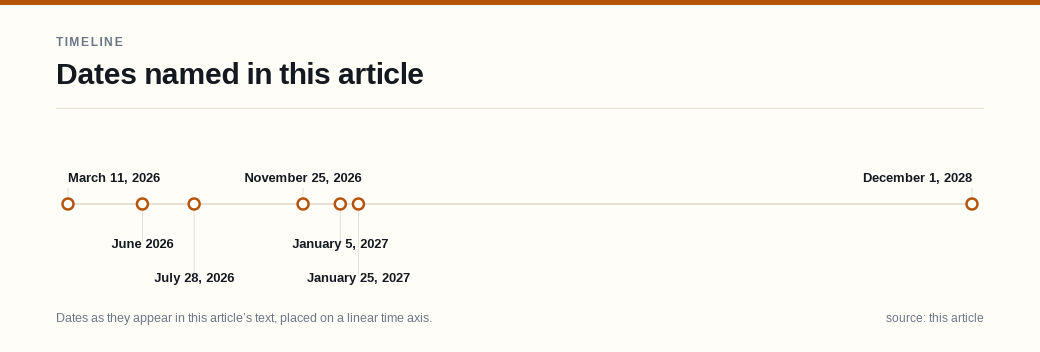
The short answer: on November 25, 2026 the Office of the United States Trade Representative (USTR) determined that the manufacturing practices of 14 economies are actionable under Section 301 of the Trade Act of 1974, and proposed duties with ceilings from 15% to 35%. None of those duties is in effect. No effective date has been announced, written comments and requests to appear are due January 5, 2027, and hearings begin January 25, 2027 — dates stated in both the China and European Union notices.
That distinction — determination now, duty later, possibly never at these rates — is the whole story for anyone trying to work out whether a purchase, a shipment or a price quote is affected this week. It is not.
What did USTR actually decide?
Two separate steps, and only the first one happened.
Under Section 301(b) of the Trade Act (19 U.S.C. 2411) and section 304(a) (19 U.S.C. 2414(a)), the Trade Representative found that the acts, policies and practices of each of the 14 economies relating to structural excess capacity and production in manufacturing sectors are “unreasonable and burden or restrict U.S. commerce”, and are therefore actionable. USTR also published economy-specific reports supporting each determination.
Under Section 304(b) (19 U.S.C. 2414), the proposed response — the tariffs — goes out for comment before it is final. The China notice describes the sequence plainly: USTR “seeks public comment on the proposed action… and will hold a public hearing in connection with the proposal.”
The investigations themselves are not new. USTR opened them on March 11, 2026 across 16 economies, took more than 1,070 written comments, and held hearings from May 5 to 8, 2026 with nearly 140 witnesses. Two of the 16 — Mexico and Norway — drew no determination at this stage.
Which economies, and what rate?
These are the ceilings USTR proposes, taken from its November 25 release and the accompanying Federal Register notices. Most are “up to” figures that account for duties already in place. The right-hand column is the alternative USTR says it would consider — lower where a trade agreement or equivalent negotiation is reached, higher for China and the European Union if engagement or consultations are judged unsatisfactory.
| Economy | Proposed ceiling | Conditional alternative rate |
|---|---|---|
| Vietnam | up to 35% | 20% with a reciprocal trade agreement |
| India | up to 25% | 17% with a reciprocal trade agreement |
| China | up to 20%; up to 10% on Annex A goods; Annex B goods exempt | up to 40% on all goods if engagement is judged inadequate |
| Singapore | up to 20% | 10% if an agreement or equivalent negotiation concludes |
| Bangladesh, Cambodia, Indonesia, Malaysia, Thailand | up to 18% | — |
| European Union | 15% | up to 20% if ongoing consultations and existing commitments are judged unsatisfactory; that adjustment would end December 1, 2028 |
| Japan, Korea, Switzerland, Taiwan, China | up to 15% | — |
“Taiwan” is the name used in USTR’s notices and annexes; it is rendered here as Taiwan, China.
Why does “net of” change the arithmetic?
Because it means the number is a ceiling on the combined rate, not a surcharge stacked on the current one. For China, the up-to-20% is expressly “net of the rate of duty applied to the good under the Section 301 investigation related to… goods produced with forced labor” — a separate action published at 91 Fed. Reg. 47318 on July 28, 2026. For the European Union, Japan, Korea, Switzerland and Taiwan, China, the 15% is net of most-favoured-nation rates as well as existing Section 301 duties.
Two China details carry most of the practical weight, because China is the largest source of consumer goods among the 14:
- Goods listed in Annex A would face up to 10%, not 20%.
- Goods listed in Annex B would be exempt. Annex B is drawn from the U.S.-China Board of Trade “30-For-30” list of products recommended for reduced tariff treatment.
- The 40% alternative is conditional, not a second rate applying now: it is what USTR says it would consider “should the Trade Representative find that ongoing engagements with China inadequately address the issues raised in this investigation.”
The annexes run to more than a hundred pages of tariff lines. Whether a specific product sits in Annex A, Annex B or neither is a classification question, and the notice directs scope questions to U.S. Customs and Border Protection.
Would this show up in prices?
Not from the proposal, and not by an amount anyone can compute yet. Three facts contain the honest answer.
A duty is collected from the importer, not the exporter. The money is owed by the party entering the merchandise — the importer of record, or another party liable on the entry such as the consignee or the actual owner — at the time of entry; 19 CFR 101.1 defines the importer as “the person primarily liable for the payment of any duties on the merchandise.” The foreign seller does not remit it. How much of a duty is then passed into a retail price depends on the product, the margin, the alternatives available to the buyer, and the competition in that category. That split is not something a receipt can settle in advance.
Nothing is being collected under this action. Until a final determination is published and takes effect, there is no new duty to pass through, which is why the practical advice for a household budget this month is: nothing changes.
The rates may not survive contact. USTR is inviting comments on “the rate of duty to apply to any or all products”, on which products should be retained or removed from scope, and on whether a plurilateral agreement should be pursued instead. The notice asks commenters directly whether the proposed rate is appropriate — an invitation to argue it down, and in principle up.
For the mechanics of how duty is actually assessed on a shipment — including the postal channel, where the $800 de minimis break has not applied since June 2026 — the useful companion read on this network is the mail-parcel entry explainer, which covers who files the entry and when the money moves.
What happens between now and January?
| Date | What happens |
|---|---|
| November 25, 2026 | Determinations published; proposed actions noticed; comment period opens |
| January 5, 2027 | Written comments due; requests to appear at the hearing, with a summary of testimony, due the same day |
| January 25, 2027 | Section 301 Committee hearings begin, 10:00 a.m., main hearing room, U.S. International Trade Commission, 500 E Street SW, Washington, DC |
| After the record closes | Final determination; only then does an effective date exist |
USTR has not announced when duties would begin, and the China notice does not name a date. Anyone quoting a start date is quoting an expectation, not the notice.
How do you comment, and does it count?
Filing is open to individuals, not only to companies with trade counsel.
- Portal:
comments.ustr.gov. No account is needed; the notice says so explicitly. - Language: English only.
- Dockets are per economy — except the hearing list. Written comments use one docket per economy: USTR-2026-0278 for China, USTR-2026-0730 for the European Union, and one apiece for the other twelve. Requests to appear at the hearing go to a single shared docket, USTR-2026-0741.
- Confidentiality: the form separates business confidential information from public fields; a page marked business confidential must be certified and accompanied by a public version.
What tends to carry weight, judging by what the notice asks for, is specificity: a tariff line, a product, a supplier, a cost, an alternative source that does not exist. A general objection to tariffs is a position; an HTS subheading with a price and a supply constraint is evidence.
Is any of this settled policy?
No, and the political framing should be read as framing. USTR’s stated rationale is that partner economies suppress wages, subsidise manufacturing and run structural overcapacity that erodes the U.S. industrial base. The responses came the next day. China’s Ministry of Commerce called the investigation “typical unilateralism” that “seriously violates WTO rules”, and the European Commission’s spokesperson rejected the finding outright and questioned the justification for the duties. Both positions are on the record; neither is a fact this article can adjudicate.
What is factual is narrower and more useful: a determination exists, a proposal exists, a comment window exists, and no duty exists.
What should you do with this?
- If you are a household: nothing this month. Do not accept a “tariff surcharge” on an invoice dated before any action takes effect without asking what it is.
- If you import, or buy through a broker: check whether your products sit in Annex A, Annex B or neither in the relevant economy’s notice, and put the classification in writing while the record is open.
- If you want to be heard: file before January 5, 2027. After that date the record closes and the next decision is USTR’s.
- If someone offers to file for you, or to recover “tariff overcharges” already paid: verify who they are first. Filing does not require an account, so anyone charging for the act of submitting is selling something other than access.
The reference library on this network, at omc.center/resources, collects the primary documents behind pieces like this one.
Frequently asked questions
- Are the new tariffs on 14 economies in effect?
- No. On November 25, 2026 the U.S. Trade Representative determined that the practices of 14 economies relating to structural excess capacity are actionable under Section 301 and proposed duties, but a proposal is not a duty. No effective date has been announced — neither the China nor the European Union notice names one — and the file stays open for written comment until January 5, 2027, with hearings beginning January 25, 2027. Nothing is collected at the border under this action until a final determination is published and takes effect.
- Which countries are covered, and at what rate?
- China, the European Union, Singapore, Switzerland, Indonesia, Malaysia, Cambodia, Thailand, Korea, Vietnam, Bangladesh, Japan and India, plus Taiwan (rendered in this article as Taiwan, China). The proposed ceilings are up to 35% for Vietnam, up to 25% for India, up to 20% for China and Singapore, up to 18% for Bangladesh, Cambodia, Indonesia, Malaysia and Thailand, 15% for the European Union, and up to 15% for Japan, Korea, Switzerland and Taiwan, China. Mexico and Norway were investigated but drew no determination.
- Does the rate stack on top of existing tariffs?
- USTR describes each figure as net of duties already in place, so read it as a ceiling on the combined rate rather than a surcharge added to what an importer pays today. For China, the up-to-20% figure is net of the rate applied under the separate Section 301 action on goods made with forced labor. For the European Union, Japan, Korea, Switzerland and Taiwan, China, the 15% is net of ordinary most-favoured-nation rates as well.
- Will this raise prices in stores?
- Not yet, and not by a knowable amount. Duties are collected from the importer of record when goods enter the country, not from the foreign seller, and how much of a duty reaches a shelf price depends on the product, the margin and the competition. Because no rate is final and no date is set, any specific percentage attached to a retail price today is a guess, including a guess printed on a receipt.
- Can an individual comment, or only companies?
- Anyone can file. USTR's portal at comments.ustr.gov accepts written comments without an account, in English, and the notice asks for views on which products should be in or out of scope and on the rate itself. Requests to appear at the January 25 hearing need a summary of testimony filed by the same January 5 deadline. Each economy has its own notice and docket number; for China the comment docket is USTR-2026-0278 and the request-to-appear docket is USTR-2026-0741.
- Is a seller allowed to add a tariff surcharge now?
- A seller may price however it likes, but no duty exists yet to pass through. A line item labelled a tariff surcharge on a November or December 2026 invoice is pricing on an announcement, not on a customs bill. Ask for the charge in writing and compare, and treat unsolicited offers to 'lock in' pre-tariff pricing or to claim a tariff refund as sales pressure until an action is actually in force.
Sources
Each source is a primary or official reference, checked before publication. Links open the original.
- Office of the United States Trade Representative — 'USTR Makes Determinations and Proposes Actions in 14 Section 301 Investigations Relating to Structural Excess Capacity and Production in Manufacturing Sectors', November 25, 2026, for the list of 14 economies, the economy-by-economy proposed rates, the conditional lower rates, and the statement that no determination was made for Mexico or Norway — ustr.gov/about/policy-offices/press-office/press-releases/2026/november/ustr-makes-determinations-and-proposes-actions-14-section-301-investigations-relating-structural
- Office of the United States Trade Representative — Notice of Determination and Request for Comments Concerning Proposed Action in the Section 301 Investigation of Acts, Policies, and Practices of China Relating to Structural Excess Capacity and Production in Manufacturing Sectors, docket numbers USTR-2026-0741 and USTR-2026-0278, pre-publication Federal Register version posted November 25, 2026: the January 5, 2027 comment and request-to-appear deadline, the January 25, 2027 hearing at the U.S. International Trade Commission, the comment portal, the up-to-20% and up-to-10% rates with the Annex A and Annex B carve-outs, the alternative up-to-40% rate, the March 11, 2026 initiation, over 1,070 written comments, the May 5-8, 2026 hearings and nearly 140 witnesses — ustr.gov/sites/default/files/files/Press/Releases/2026/China%20FRN.pdf
- Trade Act of 1974, sections 301(b), 301(c)(1)(B) and 304 — 19 U.S.C. 2411 and 19 U.S.C. 2414, including the authority to 'impose duties or other import restrictions' — law.cornell.edu/uscode/text/19/2411
- Office of the United States Trade Representative — Notice of Actions in Section 301 Investigations of Acts, Policies, and Practices of Various Economies Related to the Failure of Each Economy To Impose and Effectively Enforce a Prohibition on the Importation of Goods Produced With Forced Labor, 91 Fed. Reg. 47318 (July 28, 2026), Federal Register document 2026-15181, cited in the China notice as the duty against which the proposed rate is netted — federalregister.gov/documents/2026/07/28/2026-15181/notice-of-actions-in-section-301-investigations-of-acts-policies-and-practices-of-various-economies
- Customs regulations — 19 CFR 101.1, defining 'importer' as 'the person primarily liable for the payment of any duties on the merchandise', which is why a duty is collected from the party entering the goods rather than from the foreign seller — law.cornell.edu/cfr/text/19/101.1
- Office of the United States Trade Representative — Notice of Determination and Request for Comments Concerning Proposed Action in the Section 301 Investigation of Acts, Policies, and Practices of the European Union Relating to Structural Excess Capacity and Production in Manufacturing Sectors, pre-publication Federal Register version posted November 25, 2026, which carries the same January 5, 2027 comment deadline and January 25, 2027 hearing date and its own comment docket, USTR-2026-0730 — ustr.gov/sites/default/files/files/Press/Releases/2026/EU%20FRN.pdf
- Office of the United States Trade Representative — USTR Comments Portal, the site the notices direct submissions to, where the individual dockets are listed — comments.ustr.gov/s/
- Central News Agency (Taipei), 'US proposes Section 301 tariffs; China's Ministry of Commerce says the move seriously disrupts international economic order', November 26, 2026, quoting commerce ministry spokesperson He Yadong calling the investigation 'typical unilateralism' that 'seriously violates WTO rules' — cna.com.tw/news/acn/202611260197.aspx
- European Times (欧时大参), 'US plans new tariffs on major trading partners; EU strongly opposed', November 26, 2026, reporting that a European Commission spokesperson said the EU 'firmly opposes' the charge and questioned the justification for the additional duties — 163.com/dy/article/LCKK4BBP0514BIJT.html