The Common Cents Act: when a cash total can round to the nearest nickel
A cash total may round to the nearest 5 cents when exact change is short — and down in your favour at any time. Never on a card. What the law does.
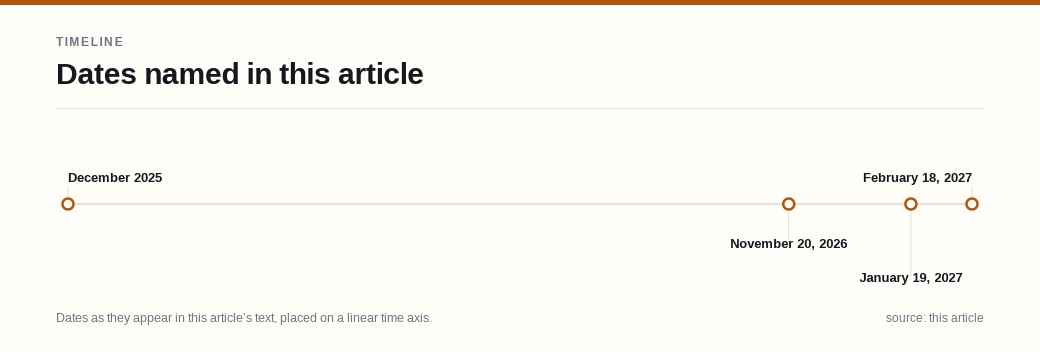
The short answer: since November 20, 2026, a cash total may legally be rounded to the nearest five cents when the business cannot give exact change at that moment — and it may be rounded in the customer’s favour at any time, whether or not exact change exists. Nothing requires rounding at all. Card, check, gift-card and electronic payments are excluded by the statute and stay exact to the cent. The Common Cents Act (H.R. 10167), signed that day, also directs the Treasury Secretary to stop producing one-cent coins for general circulation and keeps every penny already minted as legal tender, so nothing in a jar loses its face value.
Two numbers frame the trade. The Treasury’s own guidance puts the production cost of a penny at 3.69 cents and the Mint’s immediate material saving from stopping at $56 million a year; the Federal Reserve Bank of Richmond estimates that rounding cash to the nearest nickel costs consumers “on the order of $6 million per year”, concentrated on the households that still pay in cash. Those two figures are not a wash — one is a budget line, the other is money moving between a customer and a till — and the rest of this page is about which of them lands on you.
What did the Common Cents Act actually change?
Five provisions do the work, and only the first is about the coin itself.
| Change | What the Act says | Where |
|---|---|---|
| Penny production | The Secretary “shall cease production of one-cent coins for general circulation”, but may keep producing and issuing them “for sale as numismatic items” | new 31 U.S.C. 5112(bb)(1) |
| Pennies already minted | Any one-cent coin minted and issued before enactment “shall remain legal tender for all debts, public charges, taxes, and dues” | 31 U.S.C. 5112(bb)(2) |
| Cash rounding | A permissive rounding table, available only when exact change cannot be provided, plus a separate permission to round in the customer’s favour at any time, only for cash | section 3 |
| The nickel | The 5-cent coin may be struck with an inner layer of zinc and an outer layer of nickel, if testing shows it reduces production cost and has, “to the greatest extent practicable”, minimal adverse impact on coin-accepting machines | 31 U.S.C. 5112(c) |
| Other coins | Treasury may discontinue minting any other circulating coin only after 60 days’ notice to the House Financial Services and Senate Banking committees, with a briefing within 30 days | new 31 U.S.C. 5111(e) |
The penny had already stopped being manufactured — the Treasury’s FAQ states plainly that “the federal government has stopped manufacturing new pennies” — so the Act’s first provision converts an administrative decision into statute rather than starting something new. The rounding table works the same way: it takes the symmetrical-rounding arithmetic that the Treasury quoted from the National Council of State Legislators in its December 2025 guidance and gives it a statutory footing, plus a safe harbour discussed below.
Does the law require a store to round?
No, and the condition attached to the permission is narrower than the headlines suggest. Section 3(a) reads “may, if exact change cannot be provided at that time of such transaction”. Section 3(e) then removes any doubt about compulsion: “Nothing in this Act may be construed to require any person to round a payment”. The Treasury’s guidance, still in place, asks retailers to “continue accepting pennies and providing penny change for cash transactions while the coin remains in circulation”.
There is one exception to the exact-change condition, and it runs in the customer’s direction. Section 3(b) lets a business round “if such rounding is in favor of the customer” — up to the nearest five cents when it is paying cash out, down when the customer is paying in — without any reference to whether exact change is available. A till with pennies in it can therefore knock a $5.43 total to $5.40 today, and section 4 says doing so is not itself a violation of any federal, state or tribal requirement. A round-down promotion, in effect, is already lawful.
What the Act does not do is equally worth knowing. It does not say who decides that exact change cannot be provided, does not require a posted policy or a line on the receipt, and contains no penalty, no express private right of action and no enforcement mechanism across its seven sections. In practice a disputed two cents is a conversation at the counter — or a question for a state regulator, where state law supplies its own rule.
How does the rounding table work?
The rule keys off the last digit of the total, and it is symmetrical except for the two smallest amounts.
| Total ends in | What may happen | Example |
|---|---|---|
| 0 or 5 | nothing to round | $5.45 stays $5.45 |
| 1 or 2 | round down | $5.42 becomes $5.40 |
| 3 or 4 | round up | $5.43 becomes $5.45 |
| 6 or 7 | round down | $5.47 becomes $5.45 |
| 8 or 9 | round up | $5.48 becomes $5.50 |
| exactly $0.01 or $0.02 | round up to $0.05 | $0.02 becomes $0.05 |
The last row is the exception worth remembering, because it is the one that breaks the logic of “nearest”. A two-cent total would round to zero under a true nearest-five rule; section 3(a)(2)(B) sends it up to a nickel instead.
Rounding attaches to the total, not to the items. Section 3(f) defines the “covered amount” as the total transaction amount including taxes — or, where the customer hands over more cash than the total, the change due. That second limb produces a case most summaries miss. A $5.43 total paid with a $6 bill leaves $0.57 of change; a final digit of 7 rounds down, so the change may come back as $0.55. But the customer-favourable permission in section 3(b) points the other way when the store is the one handing over cash. So the same transaction can produce $0.55 or $0.60 depending on which provision the till applies, and both are contemplated by the text.
What is never rounded?
Section 3(d) lists the exclusions and they are broader than “cards”: a demand or negotiable instrument, an electronic fund transfer, a check, a gift card, a money order, a credit card, “or other like instrument or method”. A debit-card payment sits inside “electronic fund transfer” as payment law uses the term, and a direct deposit plainly is one, so neither is touched; the Treasury’s guidance says payments by check, credit card or debit card should “continue being priced and processed to the exact cent”.
Two consequences follow for anyone checking a receipt:
- Prices stay in cents. Nothing in the Act authorises a shelf price to move to a five-cent grid, and no rounding happens at the point of pricing.
- Sales tax is computed before rounding. The Treasury’s guidance says rounding “should take place only after all duties, fees, and taxes have been calculated”, and that sales tax generally continues to be calculated on the exact pre-rounding total. Whether a state agrees is a separate question, addressed below.
Are pennies still money?
Yes, and the Act says so twice: once in the new 5112(bb)(2), which preserves legal tender status for coins minted before enactment, and once through 31 U.S.C. 5103, which makes United States coins and currency “legal tender for all debts, public charges, taxes, and dues”. The Treasury puts the number in existence at roughly 114 billion pennies, which the Federal Reserve will keep recirculating “for as long as possible”; how long they last, the Treasury says, “depends largely on consumer behavior”.
Legal tender is a narrower idea than most people assume, and this is the sentence to keep: it makes United States money “a valid and legal offer of payment” for a debt when tendered to a creditor — it is not a rule that a shop must accept a particular form of payment at the point of sale. The Federal Reserve’s own answer is that “there is no federal statute mandating that a private business, a person, or an organization must accept currency or coins as payment for goods or services”, and that businesses are free to set their own policies “unless there is a state law that says otherwise”. A no-pennies sign is therefore a policy choice, not a violation of 31 U.S.C. 5103.
Depositing is the practical route for a jar. The Treasury says consumers “may continue to deposit pennies at their financial institutions”, and that for larger quantities “some banks may require that coins be rolled or wrapped prior to deposit” — worth a phone call before carrying five pounds of zinc to a counter.
Does state law still decide anything?
Yes, and the Act is careful about how far it reaches. Section 4(a) and (b) say that a person who follows section 3 is not “in violation of any Federal requirement, law, regulation, or standard” or of “any requirement, law, regulation, or standard of a State, Tribe, or a political subdivision” because of that adherence. That is a shield, not a repeal: it does not delete a state’s own rounding statute, and it does not decide how a state computes sales tax. How far a shield of that width would reach against a state rule that flatly forbids rounding is untested.
Section 4(c) preserves the rest of the wage floor explicitly — nothing in the Act “shall excuse noncompliance with” any federal, state, tribal or local law on minimum wage, overtime or paid leave.
The Treasury’s guidance is blunt that this varies by state: “most states require sales tax to be calculated on the final sale price rounded to the nearest penny”, and “how states and localities will ultimately amend their sales tax laws is the right and responsibility of those jurisdictions”. Whether a business must take cash at all can also be a state question, since the Federal Reserve’s answer turns on whether “a state law says otherwise”. Coverage, tax treatment and cash-acceptance duties therefore vary by state, and a reader who wants a definite answer needs their own state’s rule.
How does rounding touch a paycheck?
Only for cash wages, and only in one direction. Section 3(c)(1): where an employer chooses to round a cash payment that is not divisible by five cents, it “shall round the amount of cents in such payment up to the nearest amount divisible by 5 cents”. Section 3(c)(2) confirms no one has to round an exact amount. Direct deposits sit outside the section entirely, because section 3(d) excludes electronic fund transfers.
So the asymmetry that can work against a shopper is reversed for an employee: if rounding happens at all on a cash wage, the extra cents go to the worker. Section 4(c) then keeps minimum-wage, overtime and paid-leave law fully in force on top of that.
Who pays for the change?
Both figures below are estimates, and they measure different things.
- The federal side. Treasury puts the production cost of a penny at 3.69 cents, up from 1.3 cents a decade earlier, and cites a Mint projection of $56 million a year in immediate material savings from stopping. That is a budget line, not a transfer to anyone.
- The consumer side. Richmond Fed researchers, using payment-diary data, found that rounding “is not neutral”: because cash totals end slightly more often in digits that round up than in digits that round down, consumers “in the aggregate, end up paying a bit more”, on the order of $6 million a year nationally. They also flag who: the effect is “only affecting the cash user”, and it is “concentrated” among people who are older, lower income and less likely to have consistent access to digital payments.
The Treasury disagrees with that second finding, and the disagreement is on the record. Its FAQ says “final transaction prices will be rounded down just as often as they will be rounded up, so there should be no overall effect on consumer prices” — the even-distribution assumption. The Richmond Fed’s answer is that in real baskets the digits are not evenly distributed, which is why it finds a small net cost. Two official sources, two conclusions; we report both rather than pick one.
We think the honest reading is that the two headline numbers measure different things. The $56 million Treasury cites is what the government stops spending on metal. The $6 million the Richmond Fed estimates is what cash users collectively lose at the till. A household that pays by card is outside the second number entirely, and a household that pays cash for groceries, transit and small services meets it repeatedly; the scale is small either way — a few cents per transaction — but it is not distributed evenly, which is why the Act orders a study of exactly that question (below).
The Richmond Fed also priced the next step: eliminating the nickel as well would push rounding to the nearest dime and cost consumers “approximately $56 million per year, more than nine times” the penny-only estimate. The Act does not retire the nickel; it only allows a cheaper composition, subject to testing.
What should you watch next?
Five things to watch, four of them dated by the Act:
- No earlier than January 19, 2027 — the Treasury’s assessment of how penny scarcity and rounding affect “low-income communities, older consumers, debanked, unbanked, and underbanked individuals”, including “rounding practices for check cashing”, with recommendations to Congress. Section 5(a)(4) requires the Secretary to deliver it to the Federal Reserve Board “not less than 60 days after” enactment, so this is a floor rather than a deadline: 60 days after November 20 is January 19, 2027 on our arithmetic, and delivery can lawfully come later.
- By February 18, 2027 — the Federal Reserve Board must publish a strategic plan for accepting penny orders and deposits at commercial coin terminals. This one is a real deadline: “Not later than 90 days after the date of the enactment”, which is 90 days after November 20 by our count.
- Six, eighteen and thirty months after that plan — the Board must publish evaluations of how the plan is working, including “any identified or emerging stress in the penny distribution system”.
- Any future coin — retiring another circulating coin now requires 60 days’ notice with reasons and a phase-out plan, plus a briefing to the two banking committees within 30 days.
- The nickel’s composition — the cheaper zinc-core nickel can only be adopted if testing shows it cuts cost and, as far as practicable, does not jam coin machines.
What should you do at the register?
- Ask for exact change if the till has pennies. Rounding is permitted, not required, and section 3(a) ties it to exact change being unavailable — though a round-down in your favour is allowed at any time.
- Look for the rounding line. The Treasury recommends point-of-sale systems display the adjustment on the receipt; if a total moved and nothing on the slip explains it, ask.
- Do not switch to credit to dodge cents. Cards stay exact, but carrying a balance to avoid a two-cent adjustment is a much more expensive trade.
- Spend or deposit the jar. Recirculation is what keeps pennies usable, and large deposits may need to be rolled — check with the bank first.
- If you are paid in cash, remember the direction: rounding on a cash wage goes up.
- No one needs to pay to redeem pennies. They keep their face value; a deposit at a bank is the ordinary route, and a fee-based “buyback” is not something the Treasury’s guidance describes.
Bottom line
The Common Cents Act (H.R. 10167, signed November 20, 2026) turns the December 2025 Treasury FAQ’s arithmetic into statute: a cash total may round to the nearest five cents when exact change is unavailable, the one-cent coin stops being produced for circulation while the roughly 114 billion already out there stay legal tender, and the trade is worth about $56 million a year to the federal government against roughly $6 million a year in aggregate cost to the consumers who still pay cash — a small number per transaction, unevenly borne. Check the receipt, ask for exact change when it exists, and read the state rule if you run a till. This is general information about a federal statute and non-binding federal guidance, not legal, tax or accounting advice; state sales-tax and cash-acceptance rules vary, and nothing here is a substitute for your own state’s guidance. Our research library collects the primary sources behind this page.
Frequently asked questions
- Am I now required to accept a rounded total when I pay cash?
- No. Section 3(a) says a business 'may' round, and only 'if exact change cannot be provided at that time of such transaction'; section 3(e) adds that nothing in the Act may be construed to require rounding. A till that still holds pennies can give exact change, and the Treasury's guidance asks retailers to keep doing so while pennies circulate. The one exception runs your way: section 3(b) lets a business round in the customer's favour at any time.
- Does rounding change the price of anything?
- No. Goods are still priced and taxed to the cent, and section 3(f) defines the amount that section 3(a) rounds as the total transaction amount including taxes, or the change due — not each line on the receipt. The Treasury's guidance says rounding should happen only after duties, fees and taxes are calculated, so the sales tax itself is computed on the unrounded total.
- Are debit and credit card payments rounded too?
- No. Section 3(d) excludes any transaction paid by a demand or negotiable instrument, electronic fund transfer, check, gift card, money order, credit card or similar method. Card totals stay exact to the cent, and so do direct deposits and other electronic transfers.
- Can a store refuse my pennies?
- It can, unless state law says otherwise. Legal tender describes what settles a debt; it does not compel a shop to accept a particular form of payment. The Federal Reserve states that no federal statute requires a private business to accept currency or coins and that businesses set their own policies unless a state law provides otherwise.
- What happens to a two-cent total?
- It rounds up, not down. Under section 3(a)(2)(B), a covered amount totalling exactly $0.01 or $0.02 may be rounded up to $0.05 — a deliberate exception to the nearest-five rule, which would otherwise send $0.02 to zero.
- I am paid in cash. Can my employer round my wages down?
- Not if it rounds at all. Section 3(c)(1) says that where an employer chooses to round a cash payment that is not divisible by five cents, it 'shall round the amount of cents in such payment up'. Section 3(c)(2) makes clear there is no duty to round an exact amount, and direct deposit falls outside the section because it is an electronic fund transfer.
Sources
Each source is a primary or official reference, checked before publication. Links open the original.
- Common Cents Act, H.R. 10167 (119th Congress), enrolled text — the operative sections this article quotes: section 2's new 31 U.S.C. 5112(bb) (cease production of one-cent coins for general circulation, the collector-coin exception, and legal tender retained for coins minted before enactment), the 5-cent coin composition test in 5112(c), section 3's rounding table, the $0.01/$0.02 rule, customer-favourable rounding, the cash-wage rule, the non-cash exclusion list and the rule of construction, section 4's federal/state/tribal treatment, section 5's 90-day Federal Reserve report and the Treasury assessment due not less than 60 days after enactment, and section 6's 60-day notice and 30-day briefing before any circulating coin is discontinued — govinfo.gov/content/pkg/BILLS-119hr10167enr/html/BILLS-119hr10167enr.htm
- The White House — 'H.R. 10167 – Common Cents Act' (November 20, 2026), the signing announcement that summarises the four changes: stop penny production except for collector needs, rounding guidance for cash transactions, a cost-saving nickel composition, and a procedure for discontinuing any coin for general circulation — whitehouse.gov/briefings-statements/2026/11/h-r-10167-common-cents-act/
- U.S. Department of the Treasury — 'Penny Production Cessation FAQs' (December 23, 2025), which labels its own recommendations non-binding guidance, gives the production cost rise from 1.3 cents to 3.69 cents over ten years, the Mint's $56 million annual material saving, the roughly 114 billion pennies in existence, the advice to round only after duties, fees and taxes are calculated, the warning that states will treat sales tax differently, and the deposit note that some banks require rolled coins — home.treasury.gov/news/featured-stories/penny-production-cessation-faqs
- Board of Governors of the Federal Reserve System — 'Is it legal for a business in the United States to refuse cash as a form of payment?', which states that no federal statute requires a private business, person or organisation to accept currency or coins, that businesses set their own policies unless a state law says otherwise, and quotes 31 U.S.C. 5103 on legal tender — federalreserve.gov/faqs/currency_12772.htm
- Federal Reserve Bank of Richmond — 'Speaking of the Economy: The Demise of the Penny' (January 21, 2026), the estimate that nearest-nickel rounding costs consumers 'on the order of $6 million per year' because cash totals end in rounding-up digits slightly more often than rounding-down ones, the caveat that the effect concentrates on cash users who tend to be older and lower income, and the estimate that removing the nickel as well would cost about $56 million a year, more than nine times as much — richmondfed.org/podcasts/speaking_of_the_economy/2026/speaking_2026_01_21_penny
- Cornell Legal Information Institute — 31 U.S.C. 5103, 'Legal tender', the provision the Federal Reserve's answer quotes — law.cornell.edu/uscode/text/31/5103