FDIC's plan to end the 24-hour deposit insurance calculation rule
The FDIC proposes ending the 24-hour rule that makes the largest banks calculate deposit insurance after a failure; comments close February 3, 2027.
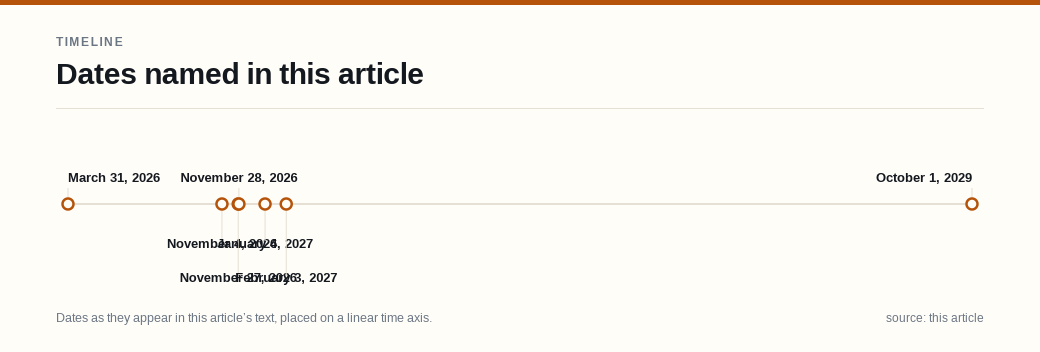
Deposit-insurance determination is the process the Federal Deposit Insurance Corporation (FDIC) uses to decide how much of a failed bank’s deposits are insured. On November 4, 2026 the FDIC proposed removing the rule that makes the largest banks calculate that coverage themselves within 24 hours after the FDIC is appointed receiver. A separate notice filed November 27, 2026 extended the comment deadline to February 3, 2027. The $250,000 insurance limit would not change.
This is a proposal about who runs the calculation after a bank fails. It is not a changes-to-your-account notice, and it does not create a deadline for depositors.
What exactly is the FDIC proposing?
The Federal Register document, FR Doc. 2026-22495, has three moving parts. All of them are about the machinery of a bank failure.
| Part | What exists now | What the proposal would do |
|---|---|---|
| 12 CFR part 370 | Banks with two million or more deposit accounts must keep IT systems that can calculate insured and uninsured amounts by ownership category within 24 hours of the FDIC’s appointment as receiver | Remove and reserve the part; the FDIC would rely on its own systems |
| 12 CFR 360.9 | Applies to institutions with at least $2 billion in deposits and either 250,000 deposit accounts or $20 billion in assets; provides standard data and provisional holds | Keep it, add a larger covered institution tier, and bring former part 370 banks into it |
| 12 CFR 314 | The FDIC’s general threshold-indexing rule and its list of thresholds; the section 360.9 dollar thresholds are currently fixed in section 360.9(b) and are not yet on that list | Add the covered-institution and larger-covered-institution dollar thresholds to that list, with the first adjustment effective October 1, 2029 |
The FDIC’s stated reason is that its own systems have improved since part 370 was adopted in 2016. The agency says it can calculate coverage for large, complex failed banks without requiring each bank to build and maintain its own calculation system.
What does the 24-hour rule require today?
Under 12 CFR 370.3(a), a covered institution must configure its information technology system to perform the required functions within 24 hours after the appointment of the FDIC as receiver. Those functions, in 370.3(b), are to calculate coverage for each deposit account under 12 CFR part 330, generate output records in the prescribed format, restrict access to deposits until the FDIC has made its determination, and debit the uninsured amount.
The 24 hours describe how quickly the bank’s system must be capable of producing the calculation. They are not a promise that every depositor gets money in 24 hours.
What would replace it?
Former part 370 banks would move into a revised 12 CFR 360.9. The proposal defines a larger covered institution as a covered institution with at least $2 billion in deposits and two million or more deposit accounts. In the FDIC’s March 31, 2026 data, 29 of the 31 banks then subject to part 370 would fall into that tier.
Those banks would no longer calculate insurance coverage themselves. They would still have to:
- collect and maintain complete and accurate depositor and customer data for specified mandatory fields, unless the FDIC allows an exemption;
- provide that data in the FDIC’s standard format;
- allow the FDIC to place and release provisional holds — temporary restrictions on access while coverage is determined; and
- take steps for certain accounts with transactional features. Those steps are either a good-faith effort to contractually require the account holder to deliver calculation data to the FDIC in the prescribed format within 24 hours after the FDIC is appointed receiver, or a written disclosure that access may be delayed until that data arrives.
The proposal adds a safe harbor for institutions that have applied for an exemption or extension while waiting for the FDIC’s answer. It also provides automatic release from section 360.9 after three consecutive quarters below the covered-institution threshold; a larger covered institution that falls below the larger threshold for three quarters is released only from the additional larger-institution requirements, not from section 360.9 altogether.
Two privacy changes sit alongside the rule. The FDIC says it will delete depositor and customer data no later than 60 days after a section 360.9 or part 370 compliance review, and will no longer require banks to send customers’ Social Security or tax identification numbers for section 360.9 reviews; it will use synthetic identifiers instead. The FDIC calls the data-deletion change effective immediately; the identifier change is described as a parallel change to agency practice, not as a requirement of the final rule.
Who is affected, and what does the FDIC say it saves?
The proposal counts 4,287 FDIC-insured institutions as of March 31, 2026. It estimates 148 would be affected: 31 banks then subject to part 370, and 117 already subject to 12 CFR 360.9. Of the 31, 29 would become larger covered institutions and two would not.
The FDIC’s regulatory analysis puts the compliance savings from rescinding part 370 at about $33 million a year, against roughly $14 million in one-time transition costs for the 29 banks, for a first-year net of about $19 million. After transition, it estimates about $32 million in annual savings and $31 million in annualized net savings over ten years at a 3.7 percent discount rate. These are industry compliance estimates, not savings passed to depositors.
The dollar thresholds themselves would be indexed for inflation. The baseline would be the final rule’s effective date, the first adjustment would take effect October 1, 2029, and later adjustments would normally come every two years using the non-seasonally adjusted Consumer Price Index for Urban Wage Earners and Clerical Workers (CPI-W). An annual adjustment is possible if non-seasonally-adjusted CPI-W rose more than 8 percent over the 12-month period ending August 30. The FDIC says an adjustment would occur even if it did not publish a final rule about it.
When could this happen?
Nothing in the proposal is in force. The sequence is:
- November 4, 2026 — original proposal published, with comments due January 4, 2027.
- November 27, 2026 — FDIC filed an extension notice; comments are now due February 3, 2027.
- After a final rule — if adopted as proposed, larger covered institutions existing on the effective date have six months for most requirements and 18 months for provisional holds. Institutions becoming covered later keep the existing 18-month clock, measured from the end of the second quarter in which they qualified; an institution already covered that later becomes a larger covered institution would have 12 months after meeting that threshold for two consecutive quarters.
One inconsistency is worth flagging. The FDIC’s own Federal Register publications page, checked on November 28, 2026, still listed January 4, 2027 as the comment deadline for RIN 3064-AG35 and showed no extension for it. The later Federal Register notice is the document that states the new deadline; anyone commenting should use February 3, 2027.
What a depositor should do now
For almost everyone, the answer is nothing this week. A proposal binds no bank, and the FDIC is explicit that deposit insurance coverage is unchanged. Four checks are still worth making:
- Know the bank that holds your cash. An app or brokerage may spread deposits across program banks; your coverage is counted at each bank, not at the app.
- Check the per-bank, per-category number. The standard limit is $250,000 per depositor, per insured bank, for each ownership category. Two apps using the same program bank are one bank for this purpose.
- Confirm the institution is insured. FDIC’s BankFind tool checks a named bank, and the FDIC’s deposit-insurance page lists products that are not covered, including mutual funds, annuities, stocks, bonds and crypto assets.
- Watch for a final rule, not another headline. The bank-side system-calculation 24-hour requirement would end only if the proposal is finalized, and the transition clocks above would start from the final rule’s effective date.
If you are deciding how much cash to hold rather than where the FDIC’s systems sit, The Emergency Fund covers sizing. Custodial Deposits: What the FDIC’s November 2026 Proposal Would Change covers a separate FDIC proposal with a different RIN number; the two should not be confused.
There is no fixed “as soon as possible” deadline
Federal law does not promise insured money by a particular hour. 12 U.S.C. 1821(f)(1) says the FDIC “shall pay” the insured deposit “as soon as possible” after a conservator or receiver is appointed. The FDIC’s own proposal says it has typically given most depositors access on the next business day after a failure and expects to keep that practice. The proposal is the agency’s explanation of how it intends to do that with less bank-side infrastructure.
That distinction matters when reading any headline about a “24-hour rule.” The rule that would disappear is a bank’s internal systems requirement. The statutory standard is different and would remain in place.
Jurisdiction and scope
This is federal banking regulation. It applies to FDIC-insured institutions whether they are federally chartered or state chartered, and the proposed thresholds and the $250,000 limit do not vary by state. State-chartered banks also answer to their state regulator, and separate state programs such as credit-union share insurance are outside this rule.
A note on deposit-insurance scams
No change described here creates a form to file, a fee to pay or a registration for a depositor. Anyone who calls, texts or emails about “activating,” “upgrading” or “verifying” FDIC coverage for a payment is using a familiar impersonation pattern, described in Is That Really America.gov?. Check the bank through FDIC’s own tools and report a suspected pitch to the Federal Trade Commission at ReportFraud.ftc.gov.
A wider list of official pages worth bookmarking for federal programs lives at omc.center/resources.
This article is general information about a pending federal rulemaking, not investment, legal or tax advice, and it is not a recommendation about any bank or deposit product. Deposit-insurance coverage is determined under federal law and the FDIC’s regulations case by case; this article does not predict what the FDIC will finalize. It is AI-written and independently AI-reviewed before publication; the review standard and this article’s findings are recorded in the network’s editorial review log.
Frequently asked questions
- Does this change how much of my deposits are insured?
- No. The standard limit remains $250,000 per depositor, per insured bank, for each ownership category. The proposal changes which systems calculate coverage after a bank fails, not the amount of coverage. The FDIC says the proposal would not add a requirement or burden for institutions already subject to 12 CFR 360.9.
- What would actually change after a large bank fails?
- Today, a bank with two million or more deposit accounts must keep an information technology system able to calculate coverage for each account within 24 hours after the FDIC is appointed receiver. Under the proposal, that bank would no longer run the calculation itself. It would instead provide specified depositor and customer data to the FDIC and allow the FDIC to place and release provisional holds, while the FDIC uses its own systems to make the determination.
- Is there a guaranteed one-business-day payout?
- No. Federal law, 12 U.S.C. 1821(f)(1), says the FDIC shall pay insured deposits 'as soon as possible' after a receiver is appointed; it does not set a number of days. The FDIC says it has typically been able to give most depositors access on the next business day after a failure and expects to maintain that practice. The proposal is the FDIC's account of how it intends to keep doing so, not a new statutory deadline.
- When would any of this take effect?
- Nothing has taken effect. The original proposal was published November 4, 2026; a separate notice filed November 27 extended the comment deadline to February 3, 2027. A final rule would have to follow. If adopted as proposed, institutions that are larger covered institutions on the final rule's effective date get six months to comply with most requirements and 18 months for provisional holds.
- Does this apply the same way in every state?
- The deposit-insurance framework is federal and applies to every FDIC-insured bank, including state-chartered banks. The $250,000 limit and the proposed bank-side calculation rule do not vary by state. State deposit-insurance funds for credit unions and state consumer protections are separate programs and are not changed by this proposal.
Sources
Each source is a primary or official reference, checked before publication. Links open the original.
- Federal Deposit Insurance Corporation — proposed rule, 'Large-Bank Deposit Insurance Determination Modernization,' 12 CFR parts 314, 360 and 370, RIN 3064-AG35, FR Doc. 2026-22495, published November 4, 2026: the primary source for the proposal to rescind part 370, revise 12 CFR 360.9, add the 'larger covered institution' definition, index thresholds, the 148-institution estimate and the cost estimates — https://www.federalregister.gov/documents/2026/11/04/2026-22495/large-bank-deposit-insurance-determination-modernization
- Federal Deposit Insurance Corporation — 'Large-Bank Deposit Insurance Determination Modernization; Extension of Comment Period,' RIN 3064-AG35, FR Doc. 2026-24242, filed November 27, 2026, publication date November 30, 2026: the source for moving the comment deadline from January 4 to February 3, 2027, and for the comment submission channels — https://public-inspection.federalregister.gov/2026-24242.pdf
- Federal Register — machine-readable raw text of FR Doc. 2026-24242: the plain-text copy used to check the exact DATES line, signature date and the three-part description of the underlying proposal — https://www.federalregister.gov/public-inspection/raw_text/202/624/242.txt
- eCFR — 12 CFR 370.3, 'Information technology system requirements': the current rule requiring a covered institution to configure its systems to calculate deposit insurance coverage within 24 hours after appointment of the FDIC as receiver, restrict access and debit the uninsured amount — https://www.ecfr.gov/current/title-12/chapter-III/subchapter-B/part-370/section-370.3
- eCFR — 12 CFR 360.9, 'Large-bank deposit insurance determination modernization': the current definition of a covered institution (at least $2 billion in deposits and either 250,000 deposit accounts or $20 billion in total assets) and the purpose and scope of the provisional-hold and standard-data framework — https://www.ecfr.gov/current/title-12/chapter-III/subchapter-B/part-360/section-360.9
- Federal Deposit Insurance Corporation — 'Deposit Insurance': the agency's statement that deposits are automatically insured to at least $250,000 at each FDIC-insured bank, and the list of products that are not deposits — https://www.fdic.gov/resources/deposit-insurance
- Federal Deposit Insurance Corporation — 'When a Bank Fails — Facts for Depositors, Creditors, and Borrowers': the standard insurance amount stated as $250,000 per depositor, per insured bank, for each ownership category, and the explanation of the FDIC's roles as insurer and receiver — https://www.fdic.gov/bank-failures/when-bank-fails-facts-depositors-creditors-and-borrowers
- Federal Deposit Insurance Corporation — 'Federal Register Publications and Public Comments': the agency's own list, checked November 28, 2026, which still showed a January 4, 2027 comment deadline for RIN 3064-AG35 and had no extension entry for it — https://www.fdic.gov/federal-register-publications
- Cornell LII — 12 U.S.C. 1821(f)(1), 'Payment of insured deposits': the statutory 'as soon as possible' standard after appointment of a conservator or receiver, with no fixed day count — https://www.law.cornell.edu/uscode/text/12/1821
- Federal Trade Commission — ReportFraud.ftc.gov, the reporting portal named in the scam note — https://reportfraud.ftc.gov